Table of Contents
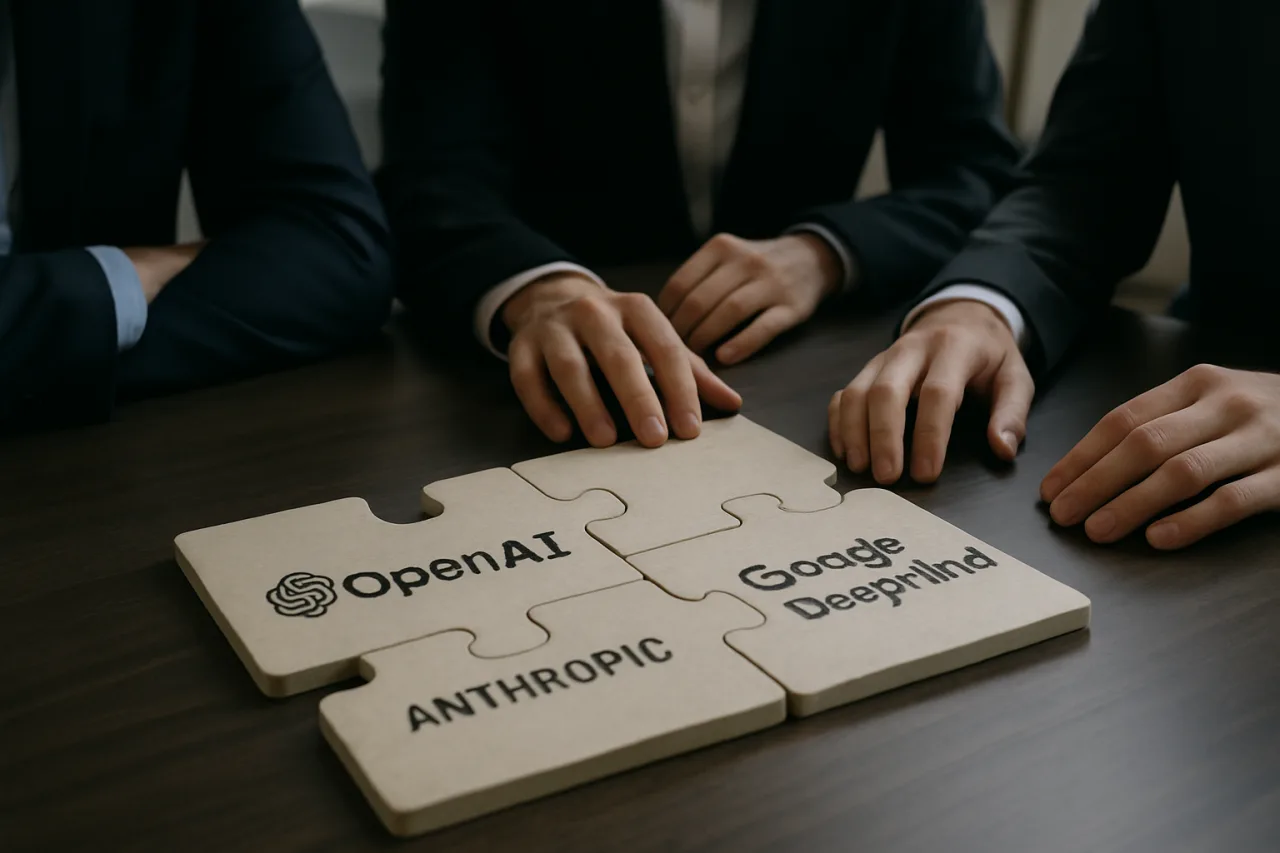
The world’s three biggest AI companies have entered formal AI safety coordination — openly working together on safety — and that sentence contains a paradox that will define AI policy for the next decade. OpenAI’s global policy chief Chris Lehane confirmed this month that the company has been in talks with rivals Anthropic and Google DeepMind for weeks, working with U.S. lawmakers on catastrophic-risk mitigation, and stated that the three firms do not believe they need an antitrust waiver to coordinate on safety. “It’s better to try to work together to prioritize safety,” Lehane told reporters in Washington. The statement arrived days after Amodei’s pacing essay drew public endorsements from Altman and Musk — meaning the industry’s safety architecture and its competitive conduct are now legally entangled by the industry’s own choice of words. When competitors who control the most powerful technology in the world start coordinating while openly declining a legal safe harbor, regulators, competitors, and the public have a right to ask: where does safety cooperation end and anticompetitive coordination begin? This analysis of the AI safety coordination maps the fault line precisely — because the answer will shape what AI tools cost, who may build them, and how the Philippines’ own AI governance fits into whatever regime the giants agree on.
Key Takeaway
- 🤝 The confirmed cooperation: OpenAI, Anthropic, and Google DeepMind have been in safety talks for weeks — Lehane announced it in Washington while lobbying on catastrophic-risk legislation.
- ⚖️ The legal gray zone: Lehane says no antitrust waiver is needed — but competitors coordinating on “pacing” are also coordinating on the single biggest cost variable in the industry.
- 🧭 The context: the talks follow Amodei’s pacing essay, the King Charles summit, OpenAI’s IPO delay, and the new misalignment disclosure framework — a coordinated month of safety positioning.
- 🇵🇭 The Philippine stake: if the giants set de facto global safety standards by agreement, countries like the Philippines inherit those standards — through pricing, access, and platform rules — without a vote.
Antitrust law has one commandment: competitors must not agree to slow the market. Safety, suddenly, requires competitors to do exactly that — publicly, on the record, while declining the legal protection designed for precisely such conversations. The collision is not theoretical. Price-fixing is illegal because coordinating pricing harms consumers; but if the CEOs of the three frontier labs agree to “pace the frontier” — the explicit language of Amodei’s essay and Altman’s endorsement — they are coordinating on the pace of capability release, which functionally determines the price of frontier AI for everyone downstream. Lehane’s position that no antitrust waiver is needed rests on a distinction the lawyers will now test in public: coordinating on safety measures (standards, evaluators, disclosure) versus coordinating on market behavior (release timing, pricing, capacity). The companies argue the first is legitimate and necessary; skeptics — and this analysis will lay out their strongest form — note that the second hides inside the first’s vocabulary, because “pacing” is release timing, and release timing is the market. The honest reading: this may be the first genuinely good-faith AI safety coordination in tech history, or the most sophisticated antitrust-safe cartel formation ever attempted, and the observable evidence — disclosure frameworks, third-party evaluator access, published incident logs — is what will distinguish one from the other over the next two quarters.
The Lehane Statement on AI Safety Coordination, Decoded
Strip the press framing and three facts carry the AI safety coordination announcement’s weight. Fact one: the duration. “In talks for weeks” means the coordination predates the Amodei essay — the public slowdown debate and the private coordination are one strategy, sequenced: the essay created the political moment, the talks have been building the technical substance inside it. Fact two: the venue. Lehane made the announcement in Washington, while working with lawmakers on catastrophic-risk legislation — this is industry-informed regulation being shaped in real time, and the coordination’s existence is a lobbying asset: three rivals jointly asking for oversight is the rarest species of tech testimony — and the AI safety coordination is its proof. Fact three: the antitrust claim. The waiver question is the legally explosive part — companies coordinating normally seek a “safety zone” or explicit government sanction; declining it is either supreme confidence that their conduct is clearly lawful, or an attempt to normalize coordination as ordinary practice before enforcers opine. Antitrust authorities have historically allowed safety standard-setting when it is open, voluntary, and non-exclusionary — the ANSI model — but AI pacing touches model release timing, which no precedent cleanly covers. The Fortune reporting adds the operational layer: OpenAI says it would support bipartisan legislation on catastrophic risks, meaning the talks aim at a regulatory architecture the three companies help design — the best-case reading is an industry building its own oversight before it is imposed; the worst-case reading is three firms writing the rules that fence the field with themselves inside.
The Antitrust Fault Line: Where AI Safety Coordination Becomes Market Coordination
The legal analysis reduces to one test with two prongs: does the coordination reduce competition, and can the companies’ conduct be explained by safety alone? The pro-AI-safety-coordination case is strong on current evidence. The observable outputs so far — OpenAI’s misalignment disclosure framework, Anthropic’s published threat-intelligence reports, third-party evaluator access commitments, the cross-lab agreement on standards — are pro-competitive transparency moves: they publish failures, invite scrutiny, and impose costs on themselves. Coordination that imposes costs on its members is hard to read as cartel behavior, because cartels exist to extract, not confess. The anti-case is equally structural: “pacing” is the stated goal — slowing capability advancement industry-wide — and the natural consequences of pacing benefit the incumbents who are already ahead. Every month of slowed frontier progress extends the moat around the leading models; it raises the cost and risk for anyone trying to catch up; it converts a race into a cartel-of-pace where the runners agree on the speed. And the entry barriers compound: if the three giants agree on safety standards, compliance with those standards becomes the price of admission — a regulatory moat written in the language of prudence, which smaller labs, open-source projects, and foreign competitors must meet or exit. The unresolved question that will decide legality and legitimacy both: is there a mechanism by which a new entrant can join the coordination? A safety club with an open door is a standard-setting body; one with a locked door is a cartel with a conscience. The next six months of evidence — who is invited to the standards tables, whether the disclosure frameworks accept outside audits, whether open-weight alternatives get the same “safety” scrutiny as closed ones — will answer that door question in public.
The Global Chessboard: Why the AI Safety Coordination Extends Beyond Safety
The AI safety coordination’s timing maps onto a diplomatic chessboard that a pure-safety reading misses. Amodei’s framework explicitly ties democratic-nation coordination to strategic advantage: chip-export controls, distillation protections, and model-weight security are framed as preserving the US lead over China — meaning the safety coordination has a trade-policy twin, and the two move together. The same week’s King Charles summit gave the coordination its soft-power cover; Washington gives it its regulatory track; and the open-weight wave — Atria Dawn’s 744B giveaway, DeepSeek’s price collapse, the Qwen architecture line — gives it its antagonist: the labs are coordinating while the open ecosystem hands their best capabilities to everyone for free. Read that triangle and the strategic logic clarifies: closed-lab coordination on “safety” creates a compliance perimeter that open-weight models, by their nature, bypass entirely — you cannot require an MIT license holder to install your safety evaluator. The coordination is therefore as much about positioning against the open ecosystem as against each other: “we three pace ourselves” doubles as “we three agree that the free frontier is the problem.” For the Philippines and other adopter economies, this framing matters practically: the frontier labs’ safety coordination will shape what APIs cost, what use-classes get restricted, and which models remain available for local deployment — while the open-weight channel, the one our Atria Dawn analysis documented, remains the hedge that no coordination can close. Small economies should read the Lehane statement less as a safety milestone than as an early map of who will control global AI access terms — and the answer “three US companies, coordinating, without a waiver” is precisely the configuration competition law exists to scrutinize.
What Philippine Businesses Should Watch as the AI Safety Coordination Unfolds
The AI safety coordination’s outcomes will arrive in the Philippines through four transmission channels, each worth monitoring. Channel one: pricing. If pacing slows frontier releases, the current models stay premium longer — API prices for frontier capability will plateau higher than a competitive market would set, and the open-weight ecosystem becomes the price discipline; Philippine teams should therefore maintain a tested open-model fallback (the wider adoption context our coverage maps) as negotiating leverage and continuity insurance. Channel two: access. Safety-standard compliance may become a de facto license to operate in major markets; Filipino AI startups should track whether the emerging standards are open for certification — an open-standards world keeps the Philippines a full participant in the AI safety coordination’s benefits, while a closed-standards world makes its AI sector a permanent vassal to whatever the giants certify. Channel three: regulation by import. Whatever framework the three labs and Washington shape becomes the template other regulators copy — meaning the DepDev-led AI governance work and the Fair AI Act process should track the US bills’ language now, while templates are still fluid enough to shape. Channel four: the precedent for coordination itself. If three US rivals can coordinate “for safety” without a waiver, Philippine firms in concentrated sectors will cite the precedent — the spillover of this decision reaches far past AI. The action item is the same as this publication’s standing guidance with one upgrade: diversification is no longer just a cost strategy, it is the sovereign hedge against a market whose three dominant players are now formally coordinating their conduct.
Frequently Asked Questions
Are OpenAI, Anthropic, and Google really working together on AI safety?
Yes — OpenAI’s global policy chief Chris Lehane confirmed in mid-September 2026 that the three companies have been in talks for weeks, working with U.S. lawmakers on mitigating catastrophic AI risks, per Bloomberg and Reuters reporting. The talks cover safety standards, external evaluator access, and coordinated approaches to frontier-risk mitigation.
Do the companies need an antitrust waiver to coordinate?
Lehane said they do not believe one is needed — the legally contested claim. Antitrust law permits some competitor coordination (standards-setting, safety research) when it is open and non-exclusionary, but prohibits coordination on market behavior like pricing and release timing. Whether “pacing the frontier” constitutes the latter is the open question regulators and legal scholars will now examine.
Why is “pacing” a potential antitrust issue?
Because pacing is release timing, and release timing is market competition. A coordinated slowdown in frontier capability releases extends incumbents’ lead, raises the entry cost for competitors, and stabilizes premium pricing — the exact harms antitrust law targets — even if the stated motive is safety. The defense is that safety coordination imposes costs on the coordinators themselves; the distinction will be tested in how open, auditable, and joinable the coordination proves to be.
What does this mean for AI pricing and access in countries like the Philippines?
Two effects: pricing — coordinated pacing likely keeps frontier API prices higher for longer, strengthening the case for open-weight alternatives; and access — safety-certification frameworks emerging from the talks may become de facto global entry requirements, which small economies inherit without a vote. Maintaining tested open-model fallbacks and tracking the certification frameworks are the two practical mitigations.
Is the coordination good or bad for AI safety?
Both outcomes remain live. The optimistic case: shared standards, third-party evaluators, and published incident logs are genuine safety architecture the industry imposed on itself — costs and all. The risk case: coordination under a safety banner can harden incumbents’ market position while the “safety” content stays voluntary and unaudited. The observable tests are openness (can new entrants join), verifiability (can outsiders examine compliance), and continuity (does the disclosure cadence survive the news cycle).
How does this relate to the slowdown debate and the King Charles summit?
They are the same story in three registers: Amodei’s essay and Altman’s endorsement made the slowdown publicly respectable; the Buckingham Palace meeting gave it moral and diplomatic gravity; and the Washington talks translate it into regulatory machinery. The sequence — essay, palace, legislation — is how a policy consensus gets built, and the antitrust question is now the central unresolved variable in that build.
Financial Disclaimer
This article is published for general information and policy analysis. It is not investment, legal, or purchasing advice. Statements are from Bloomberg, Reuters, and TechCrunch reporting as of September 2026; legal questions around coordination remain unresolved and readers should not treat this analysis as legal counsel.