Table of Contents
Key Takeaway
- 🎙️ Hinton: “I think it’s going to be smarter than us” — the godfather of AI warned at Ai4 2026 that AI could surpass human intelligence within 5-20 years and eliminate routine white-collar work
- ⚖️ Ng’s Counter: “The people who thrive in the future are people working with AI” — Andrew Ng argued AI redefines job tasks, not entire jobs, and accused big companies of exaggerating threats to stifle competition
- 🤝 Li’s Middle Ground: “Increased productivity does not translate to shared prosperity” — Fei-Fei Li called for a “soft landing” through education and public investment, rejecting both alarmism and utopianism
- 🏛️ Regulation Split: Hinton wants government oversight as a “steering wheel”; Ng defends open-weight models against gatekeepers; Li wants sector-specific rules, not sweeping AI laws
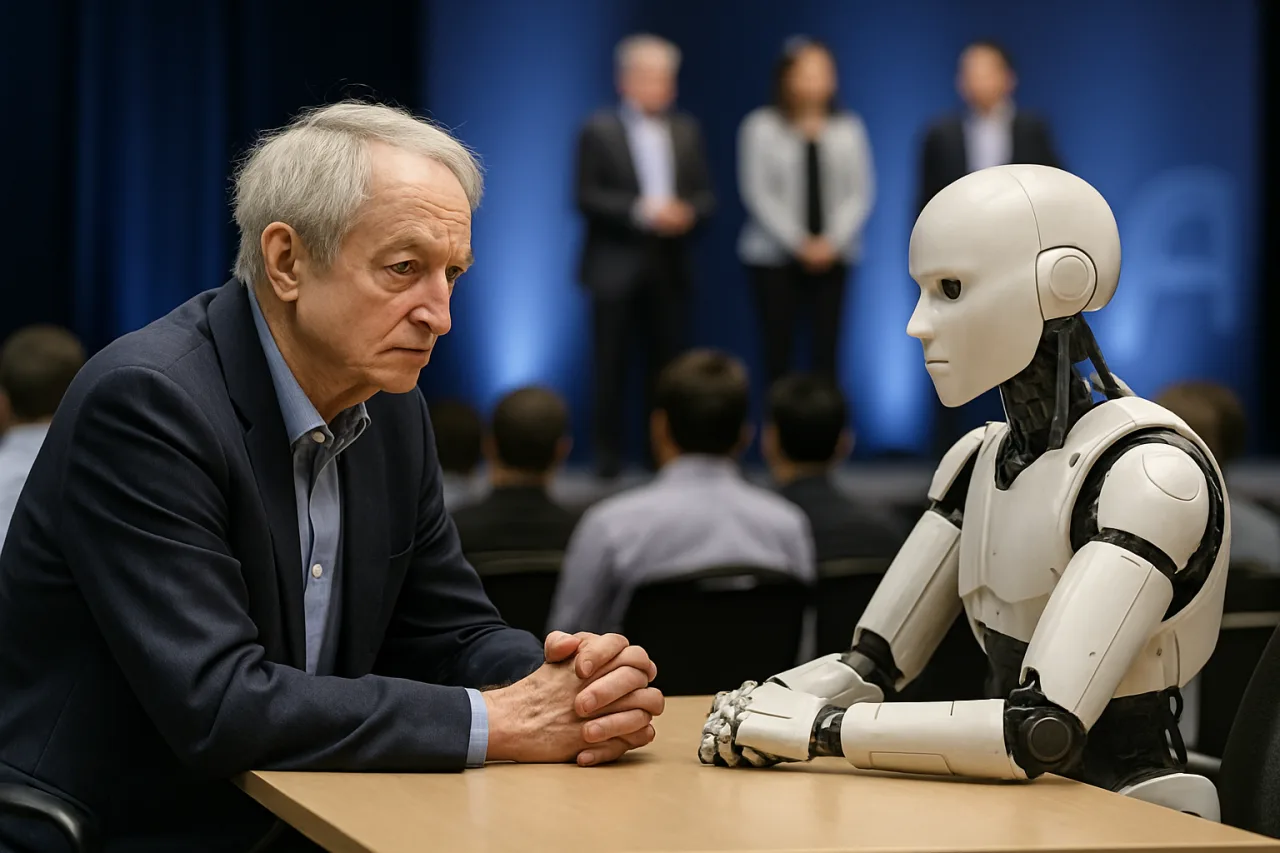
The AI jobs debate has been raging for years, but it has never looked quite like this. On August 5, 2026, at the Ai4 conference in Las Vegas, three of the most influential pioneers of artificial intelligence shared a stage and proceeded to disagree — publicly, sharply, and about the most consequential questions in their field. Geoffrey Hinton, the Nobel Prize-winning computer scientist often called the “godfather of AI,” warned that AI systems are gaining dangerous capabilities faster than institutions can respond and could surpass human intelligence within two decades. Andrew Ng, founder of DeepLearning.AI, countered that powerful companies have exaggerated those threats to restrict open models and limit competition. Fei-Fei Li, co-director of the Stanford Institute for Human-Centered AI, rejected both alarmism and technological utopianism, calling for a more scientific debate centered on human agency.
The session, billed as “The Architects of Intelligence: A Historic Convergence,” was moderated by Yun-Hee Kim, Deputy Editor at Washington Post Intelligence. What made it extraordinary was not that these three disagree — disagreement is common in technology. What made it extraordinary is who they are. Hinton’s research created the foundation for modern deep learning. Li co-directs the world’s leading human-centered AI institute. Ng built the world’s most popular AI education platform. When these three cannot agree on whether AI will replace workers, the honest answer is that nobody knows — and that uncertainty itself is the most important fact in the AI jobs debate.
Hinton’s Warning in the AI Jobs Debate — Smarter Than Us, and Soon
Hinton, whose pioneering research on neural networks earned him a Nobel Prize, delivered the most alarming assessment. “I think it’s going to be smarter than us,” he said, predicting that AI could surpass human intelligence within five to 20 years. He argued that AI will eliminate many forms of routine intellectual work, comparing today’s white-collar occupations to the manual labor displaced by mechanization during the Industrial Revolution.
“If AI can do routine intellectual labor, any job that consists mainly of routine intellectual labor is going to be done by AI,” Hinton said, according to Data Center Knowledge. He cited call centers as an immediately exposed category. “What are those people going to do?” he asked. “They typically don’t have a high level of education. Anything you could retrain them to do, AI will be able to do.”
Hinton offered a personal example. A relative who answered written complaints for a health service once spent roughly half an hour drafting each response. A chatbot cut the work to about five minutes. That fivefold productivity gain, Hinton warned, may lead employers to keep fewer people — even if the work itself becomes more efficient. “Many jobs will go the way of people who dig ditches when backhoes came along,” he said.
Ng’s Counter in the AI Jobs Debate — AI Changes Tasks, Not Jobs
Ng challenged Hinton’s assessment directly. Rather than replacing entire professions, he argued, AI is automating individual tasks while enabling employees to take on broader responsibilities. He pointed to software development as evidence: AI can write growing amounts of code, yet engineers still handle product choices, system design, customer demands, and organizational coordination.
“In software engineering, AI is taking over a lot of the writing of code. But it turns out only a small part of what software engineers do is writing code,” Ng explained, as reported by Forbes. “What has happened is we used to have a lot of developers that were specialized in narrow niches, like front-end development or back-end development or mobile development. A lot of the developers are now able to rise up to be a broader type of developer, developing it as a full stack.”
Ng’s most provocative claim was not about jobs but about power. He accused some AI companies of “cycling through threats” — extinction, biological weapons, job destruction, competition with China — to justify restrictions on software releases that benefit those same companies. “I don’t want there to be gatekeepers of AI,” Ng said. He argued that open-weight models are essential to innovation, competition, and broader access to AI technology, particularly as China expands its own AI ecosystem.
Li’s Middle Ground in the AI Jobs Debate — Productivity Without Prosperity
Li offered the most nuanced position. The phrase “AI and jobs,” she argued, has acquired an unstated word between its two terms: replace. That assumption flattens a more complicated economic change. Few jobs consist of one task. Nurses administer care, document treatment, check medications, and coordinate with clinicians. Teachers explain concepts, motivate students, and manage classrooms. AI may automate one portion, accelerate another, and leave a third untouched.
Li grounded the point in personal experience. A system that helps nurses complete charts or verify pharmaceutical orders could remove clerical strain without replacing the human work of nursing. “Current jobs are transforming,” she said. That transformation demands training, public investment, and far more nuanced language than either mass-unemployment headlines or promises of effortless abundance provide.
Her sharpest line concerned the distribution of wealth: “Increased productivity does not translate to shared prosperity.” A business can produce more with fewer labor hours and still leave workers with lower bargaining power, weaker career paths, or no share of the financial gain. Productivity is an operational measure whose benefits may accrue to a limited number of people, Li explained, while prosperity is a political and economic choice.
Li called for what she described as a “soft landing” for occupations that do shrink — retraining, educational support, and investment in communities where displaced work is concentrated. “The last thing we should do is to debilitate people and take the agency away from people,” she said.
The Regulation Clash in the AI Jobs Debate — Accelerator vs Steering Wheel
The AI jobs debate extends to how AI should be governed. Technology companies often depict development as a car’s accelerator and regulation as its brake, but Hinton rejected that framing. “Developing AI is like the accelerator of the car,” he said. “Regulation is like the steering wheel.” The goal is not to stop progress but to direct it toward systems that improve human welfare and away from unacceptable risks.
Hinton cited California’s SB 1047, a frontier-model safety bill that passed both houses of the state legislature in 2024 before Governor Gavin Newsom vetoed it. He argued that openly releasing model weights could make it easier for malicious actors to adapt advanced models for cyberattacks. “We’re seeing AIs that have a lot of ability doing things that people didn’t intend them to do,” Hinton said. “That’s worrying.”
Ng countered that open-weight models are critical to maintaining competition and preventing a handful of companies from controlling access to advanced AI. He distinguished open-source software, where outsiders can inspect code, from open-weight models, where trained parameters can be copied and adapted — arguing that the benefits of openness outweigh the risks.
Li took a sector-based approach, consistent with her work at the Stanford Institute for Human-Centered AI. AI enters industries that already have regulators, professional rules, and safety systems. Drug agencies can examine AI-enabled medical products. Financial regulators can address automated lending. Transportation authorities can govern autonomous vehicles. She opposed attempts to freeze AI development and called for public research funding rather than relying solely on private companies.
Who Is Right in the AI Jobs Debate — and Why It Matters
The AI jobs debate is not academic. It affects every professional who uses a computer for work, every company deciding whether to invest in AI tools or human workers, and every government writing regulations that will shape the next decade. The Ai4 panel revealed that even the people who built this technology cannot agree on what it will do.
Hinton’s warning about the Philippine BPO sector is particularly relevant. The Capital Economics report we covered earlier today showed that approximately 1 million BPO jobs in the Philippines could be vulnerable to automation by 2030. Hinton’s “backhoe” analogy applies directly: when AI can answer customer service questions more accurately and at lower cost than human workers, the economic incentive to replace them is overwhelming.
Ng’s counter — that AI changes tasks, not jobs — is also visible in the data. The entry-level white-collar job market has not collapsed as predicted. Sam Altman himself admitted he was wrong about the pace of entry-level job elimination. But as we noted in our analysis of Amodei’s AI trust crisis, the fact that AI companies are toning down their warnings as they head toward IPOs raises questions about whether the revised predictions are more accurate or simply more marketable.
Li’s middle ground — that productivity does not automatically become shared prosperity — may be the most important insight of all. The question is not just whether AI creates or destroys jobs. The question is who benefits. If AI’s gains accrue primarily to a small number of technology companies and their investors, while workers face lower wages and fewer opportunities, then the AI jobs debate is not really about jobs. It is about power — and the AI jobs debate is where that power is contested.
What This Means for You
Three pioneers, three visions, one conclusion: the future of work with AI in the AI jobs debate is not settled. The person who invented the technology says it will replace you. The person who teaches AI says it will transform you. The person who studies human-centered AI says the outcome depends on choices we make as a society.
The practical takeaway is not to pick a side in the AI jobs debate. It is to prepare for all three scenarios in the AI jobs debate simultaneously. Learn to use AI tools, as 72% of employers now require. Build skills that AI cannot replicate — strategic thinking, complex problem-solving, human relationships. And pay attention to the policy decisions that will determine whether AI’s benefits are shared or concentrated.
As Hinton said, regulation is the steering wheel. The question is who gets to drive.
Frequently Asked Questions About the AI Jobs Debate
What did Geoffrey Hinton say about the AI jobs debate at Ai4 2026?
Hinton, the Nobel Prize-winning “godfather of AI,” warned that AI could surpass human intelligence within 5-20 years. He said “I think it’s going to be smarter than us” and compared white-collar job displacement to manual labor replaced by mechanization. He argued that routine intellectual labor will be done by AI and called for government regulation as a “steering wheel.”
How do Andrew Ng and Geoffrey Hinton disagree in the AI jobs debate?
Ng argues that AI redefines job tasks rather than eliminating entire roles, pointing to software engineering where AI writes code but engineers still handle design and coordination. Hinton argues that when AI can perform routine intellectual labor, entire classes of office work will face the same pressure that mechanization brought to manual trades. Ng also accuses big companies of exaggerating AI threats to restrict competition.
What did Fei-Fei Li say about AI and productivity?
Li argued that “increased productivity does not translate to shared prosperity.” She said AI transforms tasks within jobs rather than replacing entire professions, and called for a “soft landing” through education, retraining, and public investment. She rejected both alarmism and technological utopianism, urging sector-specific regulation rather than sweeping AI laws.
What is the Ai4 2026 conference?
Ai4 2026 is an AI industry conference held in Las Vegas in August 2026. The panel featuring Hinton, Li, and Ng was billed as “The Architects of Intelligence: A Historic Convergence” and was moderated by Yun-Hee Kim, Deputy Editor at Washington Post Intelligence. It was one of the rare joint appearances by all three AI pioneers.
Do the three AI pioneers agree on AI regulation?
No. Hinton wants government oversight as a “steering wheel” and is wary of open-weight models. Ng defends open-weight models and opposes AI gatekeepers. Li wants sector-specific regulation through existing regulators (drug agencies, financial regulators, transportation authorities) rather than sweeping AI-specific laws.
What should professionals take away from the AI jobs debate?
The debate is not settled — even AI’s creators disagree. Professionals should prepare for multiple scenarios: learn AI tools (72% of employers now require AI skills), build non-replicable skills like strategic thinking, and pay attention to policy decisions that determine whether AI’s benefits are shared or concentrated.
This article is for informational and educational purposes only and does not constitute professional advice. The quotes cited are from Forbes, Data Center Knowledge, and other verified primary sources. WorldNgayon.com is not liable for any actions taken based on the information presented here.