Table of Contents
Key Takeaway
- ⚖️ The Filing: The Seattle Times and Newsday sued OpenAI and Microsoft on September 4, 2026 in federal court in Manhattan — and they are not asking only for money.
- 🗑️ The Remedy: The AI copyright lawsuit demands the impoundment or outright destruction of datasets and AI models trained on the outlets’ work — the most aggressive remedy ever sought against a frontier lab.
- 📉 The Stakes: Court filings cite industry data showing search referral traffic to midsize publishers fell 47% year over year in December 2025 — the revenue floor is already collapsing.
- 🏛️ The Twist: The U.S. Justice Department sided with OpenAI this week, arguing copyright limits on AI would stall “scientific progress” — setting up a federal court fight with national consequences.
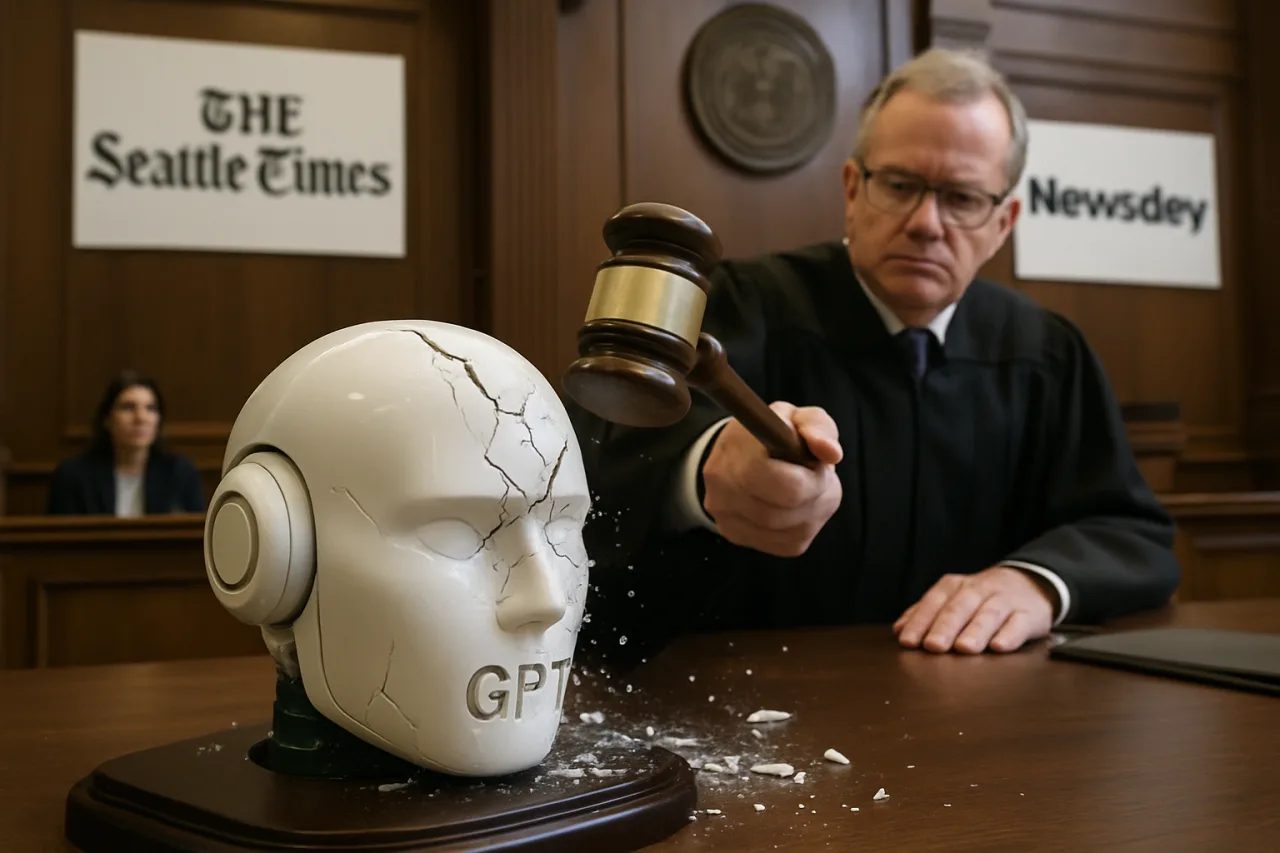
AI copyright lawsuits just crossed a line nobody in publishing had crossed before: two American newspapers are asking a federal court to destroy the models themselves. The Seattle Times Company and Newsday filed their complaint against OpenAI and Microsoft in the Southern District of New York on Friday, September 4, 2026, seeking damages and court orders for the “impoundment and/or destruction” of every dataset and model built on their journalism. That is a remedy no publisher has extracted from any AI lab, and it turns a familiar legal fight into an existential one.
The complaint arrives at a moment when the economics it describes are no longer theoretical. The outlets cite industry data showing that search referral traffic to midsize publishers dropped 47% year over year in December 2025, as AI answers replace the blue links that once carried readers to newsrooms. This is the first AI copyright lawsuit to pair that collapse with a demand to physically delete trained models — and the first to land while the Justice Department is actively arguing, in the same courthouse, that AI development outranks copyright itself.
Why the AI Copyright Lawsuit Demands Model Destruction
Most publishers who have sued AI companies asked for one of two things: money, or a licensing regime that pays for the past. The Seattle Times and Newsday are asking for something structural. According to reporting by the Spokane Spokesman-Review, which published details of the filing, the two outlets want the court to order damages “as well as the destruction of all AI training sets that used their published work” — and, per coverage of the complaint, the impoundment or destruction of models containing their journalism.
Why go that far? Because deletion of a few articles from a training corpus, the plaintiffs argue, does not undo what the models learned. Once a model has absorbed hundreds of thousands of articles, it can reproduce their style, their facts, and their conclusions on demand. A removal request is a leaky bucket; destruction is the only remedy that empties it. That logic mirrors what copyright scholars have called the “model as infringing product” theory — the claim that a trained model is itself an unlawful derivative work, not just a clean product built from dirty inputs.
The human stakes behind the filing are unusually concrete. Seattle Times President and CEO Alan Fisco wrote to employees on the day the suit was filed: “This was not an easy decision. However, we feel strongly that we must defend our content – which we spend millions of dollars a year to produce – from being used without our consent or compensation.” He added a line that will be quoted in every newsroom strategy meeting this quarter: “It is about making sure that innovation does not come at the expense of our business model.”
The AI copyright lawsuit also adds a claim earlier suits skipped: trademark dilution. The outlets allege OpenAI’s models have generated fabricated stories falsely attributed to the Seattle Times and Newsday — meaning readers were shown invented reporting wearing trusted mastheads. For a regional newspaper whose brand is its only durable asset, fabricated attribution is not an abstraction; it is counterfeiting. That claim gives the court something novel to weigh alongside the familiar copyright counts.
The 47 Percent Collapse Behind the AI Copyright Lawsuit
The damages story in this filing is really a search story. Attorneys for the outlets cite industry data that search referral traffic to midsize publishers declined 47% year over year in December 2025. When Google’s AI answers a question on the results page, the user never clicks; when ChatGPT answers it, there was never a search at all. The referral spigot that funded digital newsrooms for two decades is being closed from both ends at once.
For publishers, that 47% figure reframes the AI copyright lawsuit from a dispute about back copies to a dispute about the future. If AI systems can summarize the news without sending readers anywhere, then the value of being the first, verified source — the entire economic basis of journalism — leaks away. The lawsuit’s trademark claim doubles down on the same fear: a model that attributes fake stories to a real newspaper is not just stealing traffic, it is converting the masthead itself into raw material.
Microsoft’s response was notably softer than its legal position. “While we’re surprised by the lawsuit, we appreciate the importance of the Seattle Times to our region and we’re always happy to sit down and explore solutions to this type of dispute,” a Microsoft spokesperson said in an emailed statement. OpenAI’s was standard doctrine: its models are trained on publicly available data and are “grounded in fair use, which helps hundreds of millions of people improve their daily lives and delivers benefits such as empowering human creativity, science, and medical research.”
Both companies have argued that generative systems transform copyrighted work into new material, which the fair use doctrine permits. That argument has kept every previous AI copyright lawsuit in motion without a decisive loss. Fair use has never been tested against a remedy as drastic as model destruction — and whether it survives is precisely what makes this filing the most important one yet. The U.S. Copyright Office has spent two years studying exactly this question, and its findings now matter to every newsroom on both sides of the Pacific.
The DOJ Just Picked a Side in the AI Copyright Lawsuit Fight
Days before the Seattle Times filed, the U.S. Justice Department weighed in on the broader copyright conflict in a filing that read like a national-security brief for the defense. AI development, the government argued, is a matter of national interest — and a judicial finding that OpenAI and Microsoft violated copyright would stifle “scientific progress while hindering American prosperity and economic mobility.” The filing added that the “creative possibilities” and benefits of AI models “far outweigh any competitive harm” that training on publisher content might cause.
That is an extraordinary posture for a government whose copyright system exists to give creators exclusive control over their work. It tells every judge handling an AI copyright lawsuit, including the Southern District of New York, that the executive branch sees model-level remedies as a threat to national competitiveness. Plaintiffs now have to beat not just a fair use defense but the policy weight of the U.S. government.
It also explains the timing. Publishers watching the DOJ brief could read the political weather: the window for winning damages quietly through licensing negotiations may be closing, and courts are becoming the only venue where the value of owned content can still be asserted. Filing a model-destruction demand now, while the question is live in multiple courtrooms, is an attempt to get a remedy on the table before the “AI is too important” doctrine hardens into precedent.
A Pattern Two Years in the Making
None of this came from nowhere. The same Astra model that crossed OpenAI’s own “critical” cyber line is now the subject of federal scrutiny in an entirely different arena. The New York Times sued OpenAI and Microsoft in December 2023, accusing the companies of training on millions of its stories. A group of daily newspapers owned by Alden Global Capital sued in 2024. Last year, 35 publishers representing more than 400 community newspapers joined the docket. Authors and musicians have filed class actions of their own. The AI copyright lawsuit by the Seattle Times and Newsday is simply the first to reach for destruction rather than damages.
The one completed data point in this entire litigation wave cuts against the labs. Anthropic settled with a coalition of authors and publishers for $1.5 billion in 2025 — the largest copyright settlement in history — after authors accused the company of training Claude on pirated books. A settlement of that size changed the risk calculus for every publisher boardroom: the downside of suing stopped being “expensive and uncertain” and became “possibly enormous.” It also gave plaintiffs a template: the labs will pay when the evidence of wholesale copying is undeniable. The Seattle Times filing is what that template looks like when the plaintiff is a newsroom with the receipts and the resolve.
The irony, though, is real, and both sides know it. Microsoft Philanthropies underwrites journalism projects at the Seattle Times, and the paper was part of a coalition that received a Lenfest Institute fellowship funded by $10 million from Microsoft and OpenAI to explore AI in the newsroom. The paper holds ChatGPT licenses and uses AI tools for transcription and data analysis under a published policy — while explicitly refusing to use AI to generate stories. A newsroom that uses the defendants’ tools is now asking a court to destroy models trained on its work. That is not hypocrisy; it is the contradiction every working professional now lives inside. It does, however, give OpenAI’s lawyers a story to tell about goodwill spurned.
What the AI Copyright Lawsuit Means for Writers Everywhere
The verdict that matters most will not be handed down in Manhattan. It will be felt by every writer, editor, and content professional whose income depends on being paid for original work — including the Filipino journalists, BPO content teams, and freelance writers who supply much of the English-speaking world’s copy. For publishers across Southeast Asia, the parallel fight over AI distribution economics is already visible in how regulators just forced ChatGPT search to play by Google’s rules — the same pressure that pushed publishers to court. Three signals are already legible.
First, model destruction is now a live remedy. Whatever happens to this case, every future negotiation between publishers and AI labs starts from the knowledge that plaintiffs are willing to seek deletion of the models. Licensing fees are quoted differently when the alternative on the table is not a licensing fee. Expect the labs to accelerate licensing deals — OpenAI has already signed content partnerships with major publishers — because a settled market is cheaper than a courtroom precedent.
Second, the traffic collapse is quantified and citable. The 47% referral decline figure is now in a federal complaint, which means it will appear in legislative hearings, advertiser pitches, and every future AI copyright lawsuit. It lands in the same week that Anthropic’s own CEO, per his earlier warning about entry-level white-collar work, is being re-litigated across the industry — the economics and the employment effects are converging. For content businesses across Southeast Asia, the strategic conclusion is uncomfortable: distribution through search is a depreciating asset, and owned audiences — newsletters, apps, communities — are the hedge.
Third, the fair use defense has a federal sponsor. The DOJ’s brief will be cited by every defendant in every pending case. That does not guarantee victory for the labs — fair use is decided by courts, not departments — but it raises the bar for plaintiffs and raises the odds that this fight is ultimately settled by Congress or by a negotiated compulsory license rather than by judges.
For readers deciding what to do with this: if you publish original work, register your copyrights and keep your records current, because statutory damages only accrue to registered works. If you license content, price the AI question explicitly into every deal. And if you build on AI-generated summaries, remember the lesson buried in the 47% figure — the source that verifies facts is getting rarer and more valuable, not less.
What Comes Next in the AI Copyright Lawsuit
The complaint was filed in the same district court that hosts the New York Times case, which means scheduling, discovery, and possibly consolidation are all in play. OpenAI’s stated position — publicly available data, fair use, benefits to humanity — has not changed since 2023. What has changed is the remedy being sought, the DOJ’s on-record support for the defense, and a completed $1.5 billion settlement showing publishers what the endgame can pay. The next milestone to watch is OpenAI’s motion to dismiss; whether the court treats “destroy the models” as a legally cognizable request or a rhetorical flourish will shape every AI copyright lawsuit filed after it.
There is a deeper question underneath the docket, and it is the one this AI copyright lawsuit forces into the open: can an industry that consumes the world’s journalism at training scale coexist with the businesses that produce it — or does one have to end for the other to begin? The Seattle Times chose to make that question a matter for a judge. Whatever the Southern District of New York decides, the answer will define the next decade of publishing on both sides of the Pacific. This article is for general information only and is not legal advice; consult qualified counsel regarding copyright matters affecting your work.
Frequently Asked Questions About the AI Copyright Lawsuit
What do the Seattle Times and Newsday want from OpenAI?
The two publishers, who filed suit jointly on September 4, 2026 in the U.S. District Court for the Southern District of New York, are seeking unspecified damages plus court orders for the impoundment or destruction of datasets and AI models trained on their published work. They also allege trademark dilution from fabricated content falsely attributed to their mastheads.
Is this the first AI copyright lawsuit against OpenAI?
No. The New York Times sued OpenAI and Microsoft in December 2023, followed by newspaper groups owned by Alden Global Capital in 2024 and a coalition of 35 publishers representing over 400 community papers in 2025. What distinguishes the Seattle Times and Newsday case is the requested remedy: destruction of trained models, not just damages or licensing.
What is the 47% search referral decline cited in the lawsuit?
The outlets’ attorneys cite industry data showing that search referral traffic to midsize publishers fell 47% year over year in December 2025. The figure is used to argue that AI-generated answers are replacing the search clicks that fund digital newsrooms, converting a copyright dispute into a fight over the future economics of journalism.
Did the Justice Department support OpenAI in the copyright dispute?
Yes. In a filing the week of the lawsuit, the Justice Department argued that AI development is a matter of national interest and that a finding of copyright violation would stifle “scientific progress while hindering American prosperity and economic mobility,” adding that AI’s benefits “far outweigh any competitive harm” from training on publisher content.
Could a court really order AI models destroyed?
No court has ever done so, and legal scholars consider it an extreme remedy. But the request is legally framed — impoundment and destruction are recognized remedies in copyright cases involving infringing products — and the plaintiffs argue a trained model is itself an infringing product. Whether the theory survives a motion to dismiss is one of the most consequential open questions in AI law.
What should publishers and creators do while the case proceeds?
Register copyrights for valuable work so statutory damages are available, keep dated records of original publication, and treat AI licensing as a negotiated line item in every distribution deal. The Anthropic $1.5 billion settlement in 2025 demonstrated that wholesale training on copyrighted work carries real financial risk for AI companies — and that documented ownership is what converts that risk into leverage.
Sources: Spokane Spokesman-Review (September 4, 2026); Seattle Times reporting by Alex Halverson; Justice Department filing as reported September 2026.