Table of Contents
Key Takeaway
- 🏆 The Gap Is Closing Fast: The US-China AI performance gap has collapsed from 31.6% in 2023 to just 2.7% in 2026 (Stanford AI Index 2026) — despite America spending 23x more on AI.
- 🤖 Two Different Races: The US leads in foundational AI research, frontier model capability, and chip design. China leads in AI deployment at scale, open-source models, patent output, and industrial robot installations.
- ⚡ The Chip War Is Escalating: Nvidia went from 95% of China’s AI chip market to near-zero after US export controls. Huawei is now racing to fill the gap with its Ascend chips, but still lags Nvidia by 1-2 generations.
- 🇵🇭 The Philippines Is in the Crossfire: The Philippines recently joined the US-led “Pax Silica” semiconductor initiative. Filipino engineers and OFWs in tech manufacturing will be directly affected by how this competition plays out.
- 💡 What This Means for You: Whether you’re an OFW in tech, a Filipino investor, or a student choosing a career, the US-China AI Cold War will shape job markets, supply chains, and investment opportunities for the next decade.
The New Cold War: Why AI Is the Battlefield
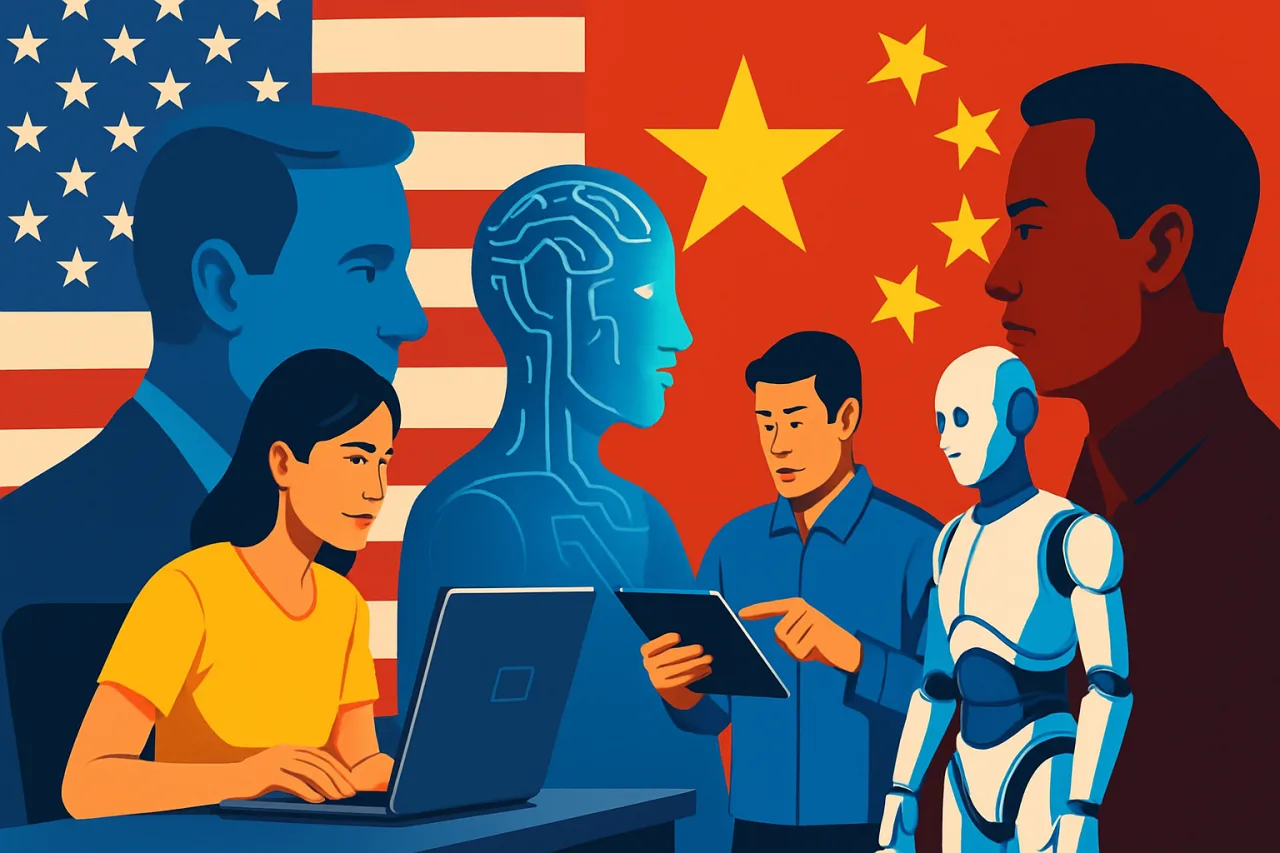
In the 20th century, the Cold War between the US and Soviet Union was fought with nuclear weapons, space races, and proxy wars. In the 21st century, the new Cold War is being fought with algorithms, semiconductors, and data. And the two superpowers are the United States and China.
The US-China AI competition is no longer a future scenario — it is the defining geopolitical reality of 2026. Both nations are pouring hundreds of billions of dollars into artificial intelligence, racing to achieve dominance in a technology that will reshape every industry, every military, and every economy on Earth. For the Philippines — a nation caught geographically and economically between these two powers — the outcome of this US-China AI competition will have profound consequences for OFW employment, domestic industries, and national security.
This article breaks down where the US-China AI competition stands today, what each side’s strategy means, and how Filipinos should prepare for the world it is creating. If you’ve read our previous coverage on DeepSeek V4 vs OpenAI, China’s Open-Source AI Strategy, and China’s Physical AI Revolution, this article provides the geopolitical framework that ties them all together.
By the Numbers: The Stanford AI Index 2026
The most authoritative snapshot of the US-China AI competition comes from the Stanford Institute for Human-Centered AI (HAI). Their 2026 AI Index Report reveals a competition that is far closer than most people realize:
- Performance gap: The difference between the best US and best Chinese AI models has shrunk to just 2.7% — down from 31.6% in 2023. In practical terms, Chinese models are now nearly as capable as American ones.
- Investment gap: The US still outspends China by approximately 23x on AI development. Despite this massive spending advantage, the performance gap has almost disappeared — suggesting China is spending far more efficiently.
- Model production: The US still produces more frontier AI models (40 vs China’s 15 in 2025), but Chinese models are closing the quality gap rapidly.
- Patents and publications: China leads in total AI patent output and research publication volume. The US leads in high-impact patents and citation-weighted research.
- Talent migration: AI talent migration to the US has dropped 89% — more Chinese AI researchers are staying home, strengthening China’s domestic ecosystem.
- Industrial deployment: China has the world’s largest installed base of industrial robots (over 1.5 million units) and is deploying AI in manufacturing at a scale the US cannot match.
The headline from Stanford is stark: the US-China AI competition has reached near-parity, and the US spending advantage is not translating into proportional performance gains. This is the new reality that policymakers, businesses, and workers must grapple with.
Two Different Strategies, Two Different Strengths
One of the most important insights from the US-China AI competition is that the two countries are running fundamentally different races. Understanding these differences is key to predicting where each will excel.
The US Strategy: Frontier Innovation and Chip Dominance
The American approach to the US-China AI competition centers on maintaining a lead in the most advanced AI research and controlling the semiconductor supply chain. The US strategy has three pillars:
1. Foundational Model Leadership: US companies — OpenAI, Google DeepMind, Anthropic, Meta — continue to produce the most capable frontier AI models. GPT-5, Gemini Ultra, and Claude 4 Opus represent the cutting edge of AI capability. These models require massive computing resources (thousands of the most advanced GPUs) and billions of dollars in training costs — resources that US companies, with access to Nvidia’s best chips and deep capital markets, can deploy more easily than anyone else.
2. Chip Export Controls: The US government has weaponized its dominance in semiconductor technology. Through a series of escalating export controls starting in 2022, the US has restricted China’s access to the most advanced AI chips — Nvidia’s H100, H200, and Blackwell series. The goal is simple: if China cannot buy the best chips, it cannot train the best models. Nvidia went from controlling 95% of China’s AI chip market to near-zero after the controls took effect.
3. Alliance Building: The US is building a coalition of like-minded nations to maintain its technological edge. The “Pax Silica” initiative — which the Philippines recently joined — aims to create a secure semiconductor supply chain that excludes China. The CHIPS Act is bringing semiconductor manufacturing back to American soil. Partnerships with Taiwan, South Korea, Japan, and the Netherlands ensure that the most advanced chip-making equipment stays out of Chinese hands.
The China Strategy: Scale, Speed, and Self-Reliance
China’s approach to the US-China AI competition is different but equally formidable. China has three structural advantages:
1. Open-Source AI Ecosystem: While US companies keep their most advanced models proprietary, China has embraced open-source AI. DeepSeek’s models (including the R1 and V4) were released with open weights, allowing developers worldwide to use, modify, and build on them. Alibaba’s Qwen model family surpassed 700 million downloads by January 2026, making it the world’s most widely used open-source AI model. Baidu’s ERNIE and Tencent’s Hunyuan models are also open-source. This strategy sacrifices short-term competitive advantage for long-term ecosystem dominance — the same playbook that made Android the world’s dominant mobile operating system.
2. Manufacturing Scale: China’s greatest advantage in the US-China AI competition is its unmatched manufacturing ecosystem. The same factories that build smartphones, electric vehicles, and solar panels can build AI hardware — robots, sensors, servers, and networking equipment. When China decides to scale a technology, it can do so faster and cheaper than any other country. This is why China installed 300,000 industrial robots in 2024 while the rest of the world combined installed fewer.
3. Domestic Chip Development: Cut off from Nvidia’s best chips, China is pouring resources into domestic alternatives. Huawei’s Ascend 916B chip is China’s most advanced AI processor, delivering performance roughly comparable to Nvidia’s A100 (two generations behind the latest H200/Blackwell). SMIC (Semiconductor Manufacturing International Corporation) is producing 7nm chips at scale and working toward 5nm. While China still lags 1-2 generations behind the cutting edge, the gap is narrowing — and for many AI applications, “good enough” chips deployed at scale can match “best” chips deployed sparingly.
The Chip War: The Most Critical Front
If the US-China AI competition has a single most important battleground, it is semiconductors. AI runs on chips, and whoever controls the chip supply controls the AI future.
The US chip war against China has unfolded in several phases:
- October 2022: First export controls restrict sale of advanced AI chips (Nvidia A100, H100) to China.
- 2023-2024: Controls expanded to include chip-making equipment (ASML lithography machines) and advanced memory chips.
- Early 2025: Trump administration briefly loosens controls, approving Nvidia H200 sales to China — then reverses course after political backlash.
- May 2026: US Commerce Department’s BIS closes loophole that allowed Chinese firms to access advanced chips through foreign subsidiaries. Licenses now required for Nvidia Blackwell and AMD MI350x chips sold to any entity whose ultimate parent is Chinese.
- June 2026: Section 232 national security investigation into semiconductor imports launched, potentially leading to tariffs on all foreign-made chips.
As Reuters reported in May 2026, the US took steps to halt Nvidia AI chip shipments to Chinese firms operating outside China, closing a loophole that had allowed indirect access.
- Stockpiling chips before controls took effect
- Using older, unrestricted chips in larger quantities to compensate for lower per-chip performance
- Developing more efficient algorithms that require less computing power
- Accelerating domestic chip development (Huawei Ascend, SMIC 7nm)
The impact on US companies has also been real. Nvidia lost access to one of its largest markets. The China market for AI chips was worth an estimated $15-20 billion annually before the controls. US chip equipment makers like Applied Materials and Lam Research have also seen revenue decline.
As the Council on Foreign Relations reported, China’s AI chip deficit remains a real constraint — Huawei cannot yet match Nvidia’s latest chips. But the gap is closing, and China’s massive investment in domestic semiconductor capacity means the long-term trajectory favors Beijing.
DeepSeek: The Sputnik Moment of the AI Cold War
No story captures the US-China AI competition better than DeepSeek. When the Chinese startup released its R1 reasoning model in early 2025, it sent shockwaves through Silicon Valley. Here was a Chinese company producing AI that rivaled OpenAI’s best models — at a fraction of the cost.
DeepSeek’s impact on the US-China AI competition was profound:
- Cost disruption: DeepSeek trained its models for approximately $5.6 million — compared to the $100+ million that US companies spend on comparable models. This shattered the assumption that AI leadership required massive capital expenditure.
- Open-source challenge: By releasing its model weights openly, DeepSeek undercut the proprietary model business that US companies relied on. Developers worldwide could now use world-class AI without paying OpenAI or Google.
- Export control defiance: DeepSeek achieved its results using restricted chips (Nvidia H800s, a downgraded version of the H100 created specifically for the Chinese market). This demonstrated that chip controls alone could not prevent Chinese AI advancement.
DeepSeek’s latest model, V4 (released April 2026), continues the trend. It matches or exceeds GPT-4o on many benchmarks while remaining open-source and significantly cheaper to run. As Digital in Asia reported, DeepSeek fundamentally disrupted the global AI economics — forcing US companies to justify their premium pricing and accelerating the open-source movement.
DeepSeek was not an isolated success. Alibaba’s Qwen series, Baidu’s ERNIE, Tencent’s Hunyuan, and ByteDance’s Doubao are all competitive with US models. The US-China AI competition is no longer a one-sided race — it is a genuine contest between two ecosystems, each with distinct strengths.
What the AI Cold War Means for the Philippines
For Filipinos, the US-China AI competition is not an abstract geopolitical issue. It directly affects employment, investment, and the country’s strategic position.
The Pax Silica Opportunity
In April 2026, the Philippines joined the US-led “Pax Silica” semiconductor initiative — a coalition aimed at building a secure, China-free semiconductor supply chain. This is a significant strategic decision that positions the Philippines as a beneficiary of US efforts to diversify chip manufacturing away from China and Taiwan.
What this means in practice:
- More semiconductor investment: US and allied companies are looking for alternative manufacturing locations. The Philippines — with its English-speaking workforce, lower labor costs, and strategic location — is a natural candidate for chip packaging, testing, and assembly facilities.
- Engineering jobs: Filipino engineers and technicians will be needed to staff these facilities. The semiconductor industry offers higher wages than traditional manufacturing — a potential upgrade for OFWs returning from factory work in China and Taiwan.
- Technology transfer: Working in semiconductor facilities exposes Filipino workers to advanced manufacturing processes and technologies that can spawn domestic startups and supplier industries.
OFWs in the Crossfire
Millions of OFWs work in countries and industries directly affected by the US-China AI competition:
- Taiwan: Many Filipino engineers and skilled workers are employed in Taiwan’s semiconductor industry (TSMC, etc.). As the US-China tech war intensifies, Taiwan’s strategic importance grows — but so does the risk of conflict. Any disruption to Taiwan’s chip industry would have immediate consequences for Filipino workers there.
- China: OFWs in Chinese manufacturing face the risk of factory automation accelerating as China deploys more AI and robots. The 300,000 industrial robots China installed in 2024 are replacing human workers — including foreign workers.
- Middle East: OFWs in Gulf states may see demand shift as oil-dependent economies invest in AI diversification. Saudi Arabia’s Vision 2030 and the UAE’s AI Strategy both require tech talent — creating new opportunities for Filipino workers with AI skills.
The BPO Question
The Philippine BPO industry faces a dual challenge from the US-China AI competition. As US companies invest heavily in AI to reduce costs, some outsourced functions will be automated rather than sent to the Philippines. At the same time, Chinese AI companies expanding globally will need English-language support — potentially creating new BPO demand.
The net effect is uncertain, but the direction is clear: BPO workers who develop AI-related skills (prompt engineering, AI training, data analysis) will thrive. Those who don’t will face increasing pressure.
Investment Implications
The US-China AI competition creates both risks and opportunities for Filipino investors:
- PSE-listed tech and telecom companies (PLDT, Globe) may benefit from increased demand for data services driven by AI adoption.
- Semiconductor-related stocks could gain if the Philippines attracts more chip manufacturing investment through Pax Silica.
- US AI stocks (Nvidia, Microsoft, Alphabet) remain the purest plays on AI growth — accessible to Filipinos with international brokerage accounts.
- Chinese AI stocks (Alibaba, Baidu, Tencent) offer exposure to China’s AI growth but carry geopolitical risk from escalating US-China tensions.
The Military Dimension: AI and National Security
The US-China AI competition extends beyond economics into military applications — and this is where the stakes are highest.
Both nations are investing heavily in AI for defense:
- Autonomous weapons: Drones, naval vessels, and ground vehicles that can operate without human pilots or drivers.
- Cyber warfare: AI-powered cyber attacks and defenses that can penetrate or protect critical infrastructure.
- Intelligence analysis: AI systems that can process vast amounts of surveillance data to identify threats.
- Decision support: AI advisors that help military commanders make faster, better-informed decisions.
For the Philippines, the military dimension of the US-China AI competition is particularly relevant given the territorial disputes in the West Philippine Sea. The US-Philippines Mutual Defense Treaty means that any US-China military confrontation would directly involve the Philippines. AI-powered surveillance, drones, and naval systems will play a role in any future conflict in the region.
Where Is the AI Cold War Heading?
The US-China AI competition is entering a critical phase. Several trends will shape the next 2-5 years:
1. China will achieve chip self-sufficiency — eventually. The US can delay China’s semiconductor progress, but it cannot stop it permanently. China is investing over $150 billion in domestic chip development. Within 3-5 years, China will likely produce chips that are “good enough” for most AI applications, even if they remain behind the absolute cutting edge.
2. Open-source AI will erode US proprietary advantage. China’s open-source strategy is working. As more developers worldwide adopt Chinese open-source models, the ecosystem around those models grows — creating a self-reinforcing cycle that US proprietary models cannot match.
3. The competition will fragment the global AI ecosystem. The world is heading toward two AI ecosystems — one US-led, one Chinese-led — with different standards, different models, and different rules. Countries will increasingly have to choose which ecosystem to align with.
4. AI regulation will become a battleground. The US and China are taking very different approaches to AI regulation. The US favors industry self-regulation with targeted government oversight. China imposes strict government control over AI development and deployment. These different approaches will shape how AI evolves in each ecosystem.
5. The Philippines will need to navigate carefully. As a US ally with deep economic ties to China, the Philippines cannot afford to fully align with either side. The country will need to maintain its US security partnership while engaging with China’s AI ecosystem for economic benefit.
What Filipinos Should Do
The US-China AI competition will shape the next decade. Here is how Filipinos can prepare:
- Learn about AI: You don’t need to become an engineer, but understanding how AI works — and what it can and cannot do — is now essential literacy. Free resources from Google, Coursera, and edX can help.
- Develop complementary skills: AI is best at routine tasks. Skills that complement AI — creativity, critical thinking, emotional intelligence, complex problem-solving — will become more valuable, not less.
- Watch the semiconductor industry: The Philippines’ participation in Pax Silica could create significant job opportunities. Follow developments in semiconductor investment and be ready to apply.
- Diversify investments: If you invest, consider exposure to both US and Chinese AI growth — but be aware of the geopolitical risks.
- Stay informed: The US-China AI competition is evolving rapidly. Follow reliable news sources and be prepared to adapt as the situation changes.
Conclusion: No One Wins a Cold War, But Everyone Must Choose
The US-China AI competition is the defining technological and geopolitical contest of our era. Unlike the original Cold War, which was primarily military, this one is economic, technological, and ideological. And unlike the original Cold War, which had a clear end (the collapse of the Soviet Union), this one may persist for decades — because China is not collapsing. It is rising.
For Filipinos, the message is clear: the world is being reshaped by the US-China AI competition, and the Philippines cannot stand on the sidelines. The workers, investors, and students who understand this shift — and prepare for it — will be the ones who thrive in the new world being built.
The Cold War has a new battlefield. Make sure you understand the terrain.
Change for the better.
Frequently Asked Questions (FAQ)
Q1: How close is China to matching US AI capabilities?
A: Very close. According to the Stanford AI Index 2026, the performance gap between the best US and Chinese AI models has shrunk to just 2.7% — down from 31.6% in 2023. Chinese models like DeepSeek V4, Alibaba Qwen, and Baidu ERNIE now rival US models on many benchmarks.
Q2: What are US chip export controls and how do they affect China?
A: Since 2022, the US has restricted China’s access to advanced AI chips (Nvidia H100, H200, Blackwell). Nvidia went from 95% of China’s AI chip market to near-zero. China is responding by developing domestic chips (Huawei Ascend) and using older chips more efficiently. The controls delay but cannot stop China’s AI progress.
Q3: What is DeepSeek and why is it important?
A: DeepSeek is a Chinese AI startup whose R1 and V4 models rival OpenAI’s best at a fraction of the cost. It trained its models for ~$5.6 million vs. $100M+ for US competitors. DeepSeek released its models as open-source, accelerating China’s open-source AI ecosystem and disrupting the global AI economics.
Q4: What is Pax Silica and why did the Philippines join?
A: Pax Silica is a US-led semiconductor initiative to build a secure, China-free chip supply chain. The Philippines joined in April 2026, positioning the country to attract semiconductor investment, create engineering jobs, and benefit from US efforts to diversify chip manufacturing away from China and Taiwan.
Q5: How will the US-China AI competition affect Filipino OFWs?
A: OFWs in tech manufacturing (Taiwan, China) face both opportunities and risks. Semiconductor investment in the Philippines could create higher-paying jobs. But automation in Chinese factories and geopolitical tensions around Taiwan pose risks. OFWs with AI-related skills will be most competitive.
Q6: Should Filipino investors buy AI stocks?
A: AI stocks (Nvidia, Microsoft, Alphabet) offer exposure to US AI growth. Chinese tech stocks (Alibaba, Baidu) offer exposure to China’s AI growth but carry geopolitical risk. PSE-listed telecom and tech companies may also benefit from AI-driven demand. Diversification and risk awareness are key.
Q7: Will AI replace BPO jobs in the Philippines?
A: AI will automate some BPO functions (routine data entry, basic customer service), but new opportunities in AI training, prompt engineering, and data analysis are emerging. BPO workers who upskill in AI-related areas will remain competitive. The net impact depends on how quickly the industry adapts.
Q8: What is the “AI Cold War” and how is it different from the original Cold War?
A: The “AI Cold War” refers to the escalating technological, economic, and military competition between the US and China over artificial intelligence. Unlike the US-Soviet Cold War (primarily military), the AI Cold War is fought with semiconductors, algorithms, data, and talent. It may persist for decades because China is not collapsing — it is rising.
Disclaimer
This article is for informational and educational purposes only and does not constitute financial, investment, or career advice. The data and statistics cited are based on publicly available reports and may change over time. Readers should conduct their own research and consult with qualified professionals before making any financial or career decisions. WorldNgayon.com is not responsible for any actions taken based on the information presented in this article.