
Table of Contents

Key Takeaway
- 🧠 BCI Explosion: The number of people with brain implants has more than doubled in the last two years. Neuralink alone has implanted 21 people. China approved the first medical BCI device in 2026.
- 💪 Real Impact: Casey Harrell, an ALS patient, has used a brain-computer interface for nearly 3 years to speak, work as a climate activist, read to his daughter, and live independently — all through thought-controlled technology.
- 🌍 Global Race: Companies like Neuralink, Synchron, Neuracle, and Precision Neuroscience are racing to commercialize BCIs. Academic research (BrainGate) continues alongside corporate efforts.
- 🇵🇭 OFW Angle: The Philippines has no BCI regulatory framework. Filipino patients with paralysis or ALS have no access to these trials. OFW families with disabled relatives deserve to know about this technology — and advocate for access.
- ⚠️ Risks Remain: Invasive brain surgery carries infection and complication risks. Wireless implants add cybersecurity concerns. The technology is promising but still experimental.
Imagine controlling a computer, speaking to your family, and working a full-time job — all without moving a muscle. That is the reality for Casey Harrell, a man with ALS who has spent nearly three years using a brain-computer interface (BCI) implanted in his brain. His story, covered by MIT Technology Review this week, is not science fiction. It is the leading edge of a brain implant revolution that is accelerating faster than most people realize — and one that the Philippines is almost entirely unprepared for.
The number of people worldwide with electrodes in their brains has more than doubled in the last couple of years, according to BCI researchers. In January 2026, Neuralink — the BCI company founded by Elon Musk — announced it has implanted 21 people with its device in just two years. Synchron is running trials in North America and Australia. China’s Neuracle recently became the first BCI to receive approval for use outside clinical trials. The era of brain implant technology is no longer coming. It is here.
Casey Harrell: The “First Power User” of Brain Implants
Casey Harrell was diagnosed with ALS (amyotrophic lateral sclerosis), a progressive neurodegenerative disease that gradually paralyzes the body. By the time he enrolled in a trial at the University of California, Davis, in July 2023, he was already losing the ability to speak coherently. Today, nearly three years later, he uses a BCI to communicate, surf the web, and work as a climate activist — largely independently.
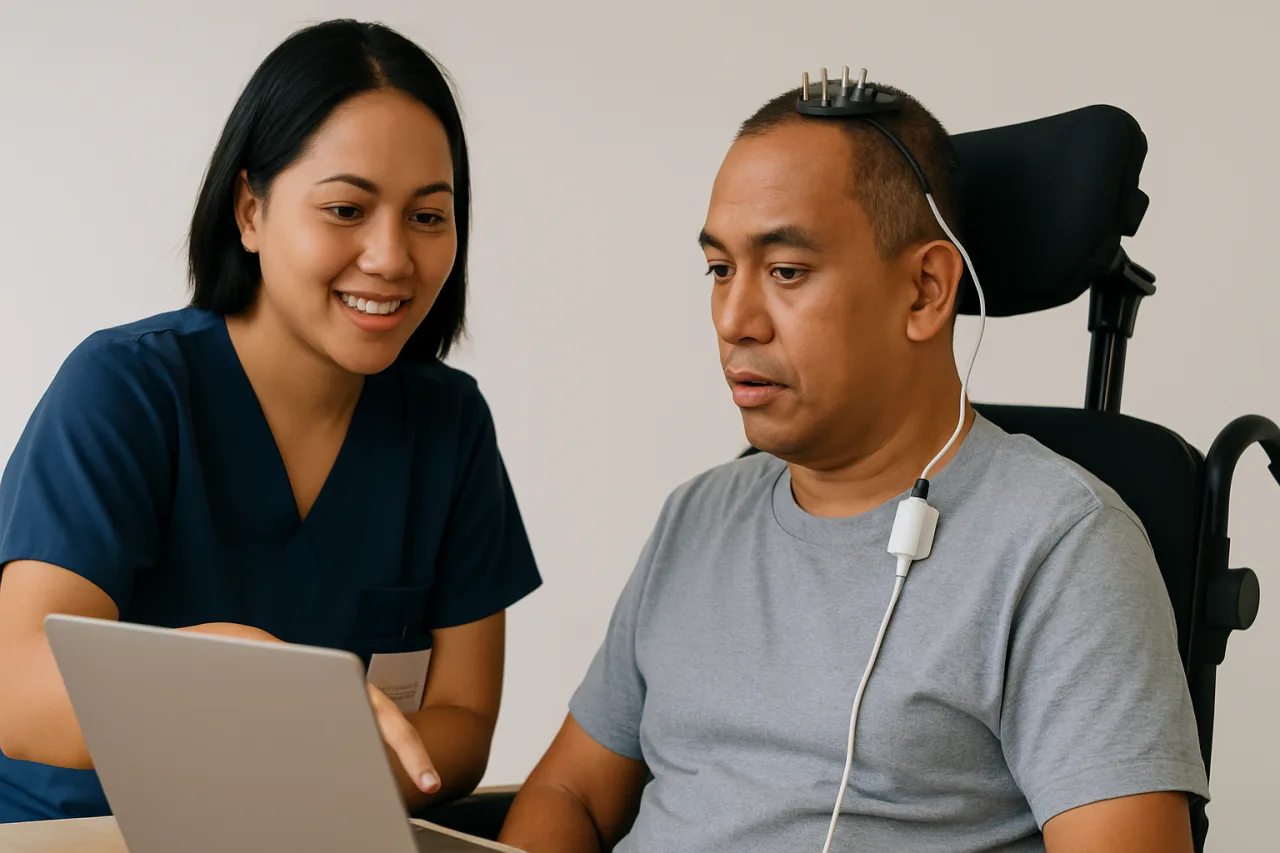
His brain implant works through a set of electrodes embedded in his brain that pick up electrical activity associated with speech. These electrodes connect to docking ports on top of his head, which plug into a computer running software trained to decode his brain signals into phonemes — the units of sound that make up speech. He uses an eye gaze tracker to make corrections before the words are played out loud.
The UC Davis team has continuously refined the system. They have improved accuracy, added a privacy mode, and even introduced a “profanity filter” so Harrell can talk to his daughter without accidental swearing. “For me, the device is nothing short of revolutionary!” Harrell said. It has enabled him to maintain an income, reconnect with friends and family, and read to his daughter — things that ALS was systematically taking away.
Harrell describes his motivation simply: “Pay it forward and do the scientific research … [and] get some personal benefit.” He is one of a growing number of volunteers whose participation in BCI trials is advancing the technology for future patients.
The Global Brain Implant Race: Who Is Leading
The BCI landscape in 2026 is a mix of corporate giants and academic pioneers. Here is who is leading the race:
- Neuralink (USA): Founded by Elon Musk, has implanted 21 people in two years. Uses a fully implanted wireless device called the N1. Focuses on paralysis patients with plans to expand to other conditions.
- Synchron (USA/Australia): Uses a less invasive approach — a stent-like device inserted through blood vessels, avoiding open brain surgery. Currently running trials in North America and Australia.
- Neuracle (China): Became the first BCI to receive regulatory approval for use outside clinical trials in China. Has been trialing since November 2024.
- Precision Neuroscience (USA): Co-founded by a former Neuralink co-creator. Uses a thin electrode array that sits on the surface of the brain, reducing surgical risk.
- BrainGate (USA): A two-decade academic research effort involving multiple universities. The UC Davis team that worked with Harrell is part of this consortium. Focused on “point-and-click” communication for paralyzed patients.
The diversity of approaches reflects the early stage of the technology. Some devices are fully implanted and wireless. Others require physical connections. Some sit on the brain’s surface; others penetrate deeper. Each approach trades off signal quality against surgical risk.
A 2024 roundup by researchers at the University of Houston identified 21 research groups that had trialed BCIs in 67 volunteers between 1998 and 2023. Since then, the numbers have surged. Mariska Vansteensel, a BCI researcher at University Medical Center Utrecht, says the increase has been dramatic — driven by both corporate investment and academic momentum.
Why the Philippines Is Falling Behind
While the BCI revolution accelerates in the US, China, and Australia, the Philippines has virtually no presence in this space. There is no regulatory framework for brain-computer interfaces. No Philippine hospital or research institution is conducting BCI trials. Filipino patients with ALS, spinal cord injuries, or other conditions that could benefit from BCIs have no access to this technology within the country.
This matters for OFW families. An OFW who suffers a spinal cord injury abroad — a construction worker falling from scaffolding in Saudi Arabia, a seafarer injured on a cargo ship — may return home paralyzed. In the US or Europe, they might qualify for a BCI trial. In the Philippines, they would have no such option.
According to the Philippine Overseas Employment Administration (POEA), there are approximately 10.2 million Filipinos working overseas. The physical risks of overseas work — construction injuries, vehicular accidents, workplace violence — mean that a significant number of OFWs return home with disabilities each year. Brain-computer interfaces could offer them a path to communication and independence that does not currently exist in the Philippines.
The Department of Health (DOH) has no published roadmap for neurotechnology adoption. The Food and Drug Administration (FDA Philippines) has not issued guidance on BCI regulation. Until these gaps are filled, Filipino patients will continue to watch the BCI revolution from the sidelines.
Risks and Ethical Concerns
Brain-computer interfaces are not without risks. Invasive brain surgery carries the possibility of infection, bleeding, and other complications. The more invasive the device, the better the signal — but also the higher the risk. Wireless implants add another concern: cybersecurity. A device connected to the internet could theoretically be hacked, raising the specter of brain data theft or even malicious control.
There are also profound ethical questions. Who owns the data generated by a brain implant? Can a BCI company access a user’s thoughts? What happens if a company goes bankrupt — do users lose access to the software that makes their implant work? These questions are far from resolved.
For OFWs considering participation in BCI trials abroad, the risks must be weighed carefully. Experimental brain surgery is not a decision to take lightly. But for patients with no other options — those who have lost the ability to speak, move, or interact with the world — the potential benefits may outweigh the risks.
What OFWs Should Know About Brain Implants
Brain-computer interface technology is advancing rapidly, and OFWs should be aware of both the opportunities and the limitations:
- BCIs are real and working. This is not science fiction. People like Casey Harrell are using BCIs daily to communicate and work. The technology is experimental but functional.
- Trials are happening now. Neuralink, Synchron, and other companies are actively recruiting volunteers. Most trials target people with paralysis or severe communication disabilities.
- The Philippines has no BCI access. Filipino patients cannot access BCI trials domestically. Those who qualify for trials abroad should research carefully and consult with medical professionals.
- Cybersecurity matters. As BCIs become more connected, the risk of hacking increases. Future devices will need robust security protections.
- Advocate for access. OFW families and disability advocates should push Philippine regulators to develop frameworks for neurotechnology. The technology exists — the Philippines just needs to catch up.
As we have reported on OFW health insurance coverage and device security, the gap between what overseas workers need and what is available to them remains wide. Brain-computer interfaces represent the next frontier of that gap — a technology that could transform lives but remains out of reach for Filipinos.
The Future of Brain-Computer Interfaces
The BCI field is moving at a pace that surprises even its own researchers. Features that seemed impossible five years ago — wireless implants, real-time speech decoding, eye-gaze correction — are now routine in trials. The next frontier includes bidirectional communication (sending signals to the brain, not just reading from it), memory enhancement, and treatment for conditions like depression and PTSD.
For the global Filipino community, the question is not whether BCIs will become mainstream — they will. The question is whether Filipinos will be participants in this revolution or merely spectators. The answer depends on whether Philippine institutions invest in neurotechnology research, whether regulators create frameworks for safe adoption, and whether OFW advocates push for access to these life-changing devices.
Casey Harrell put it simply: the device gave him his life back. Every paralyzed Filipino worker, every ALS patient in Manila, every spinal cord injury victim in Cebu deserves the same chance.
The global brain implant market is projected to reach $6.2 billion by 2030, according to Grand View Research. North America currently dominates, but Asia-Pacific — led by China — is the fastest-growing region. The Philippines has virtually no presence in this market. No Philippine company develops brain implant technology, and no Philippine hospital offers BCI procedures. This gap means Filipino patients must go without or seek treatment abroad at enormous costs — a single BCI procedure in the US can cost $100,000-$500,000.
As we reported in our article on OFW health insurance coverage, most overseas workers’ insurance plans do not cover experimental procedures like brain implants. This leaves Filipino patients dependent on charity programs or clinical trial participation — options available only to the most privileged or desperate. The brain implant revolution is here, but Filipinos are watching from the sidelines.
FAQ
What is a brain-computer interface (BCI) and how does it work?
A brain-computer interface is a device that reads electrical signals from the brain and translates them into commands for a computer or other external device. In Casey Harrell’s case, electrodes embedded in his brain pick up speech-related signals, which software decodes into phonemes and then into spoken words. Some BCIs are fully implanted and wireless; others require physical connections. They are primarily used by people with paralysis or severe communication disabilities.
How many people currently have brain implants?
The number has more than doubled in the last two years. Neuralink alone has implanted 21 people. Academic research groups like BrainGate have worked with dozens more. China’s Neuracle has begun commercial deployment. Estimates suggest over 100 people worldwide now have some form of BCI implant as of mid-2026.
Are brain-computer interfaces available in the Philippines?
No. The Philippines has no BCI research programs, no regulatory framework for neurotechnology, and no clinical trials. Filipino patients who want access to BCI technology would need to participate in trials abroad — primarily in the US, China, or Australia. This represents a significant gap in healthcare access for disabled Filipinos.
What are the risks of brain implant surgery?
Invasive BCI surgery carries risks including infection, bleeding, and damage to brain tissue. The more invasive the device, the better the signal quality but the higher the risk. Wireless implants add cybersecurity concerns — a hacked BCI could theoretically expose brain data or allow malicious control. These risks must be carefully weighed against the potential benefits.
Can OFWs participate in BCI trials abroad?
Potentially, yes. Most BCI trials target people with specific conditions — ALS, spinal cord injuries, or severe paralysis. OFWs who have such conditions and are located near trial sites (primarily in the US, China, or Australia) may qualify. However, participation involves experimental brain surgery and long-term commitment. Consultation with medical professionals is essential.
What is the future of brain-computer interface technology?
The next frontier includes bidirectional communication (sending signals to the brain), memory enhancement, and treatment for mental health conditions like depression and PTSD. Companies like Neuralink and Synchron are working toward consumer-grade devices, though these are likely years away. The technology is advancing rapidly and is expected to become more accessible and less invasive over the next decade.
Disclaimer: This article is for informational and educational purposes only. It does not constitute medical advice. Individuals considering participation in BCI trials should consult qualified medical professionals. Information is based on publicly available sources as of June 2026.