
Table of Contents
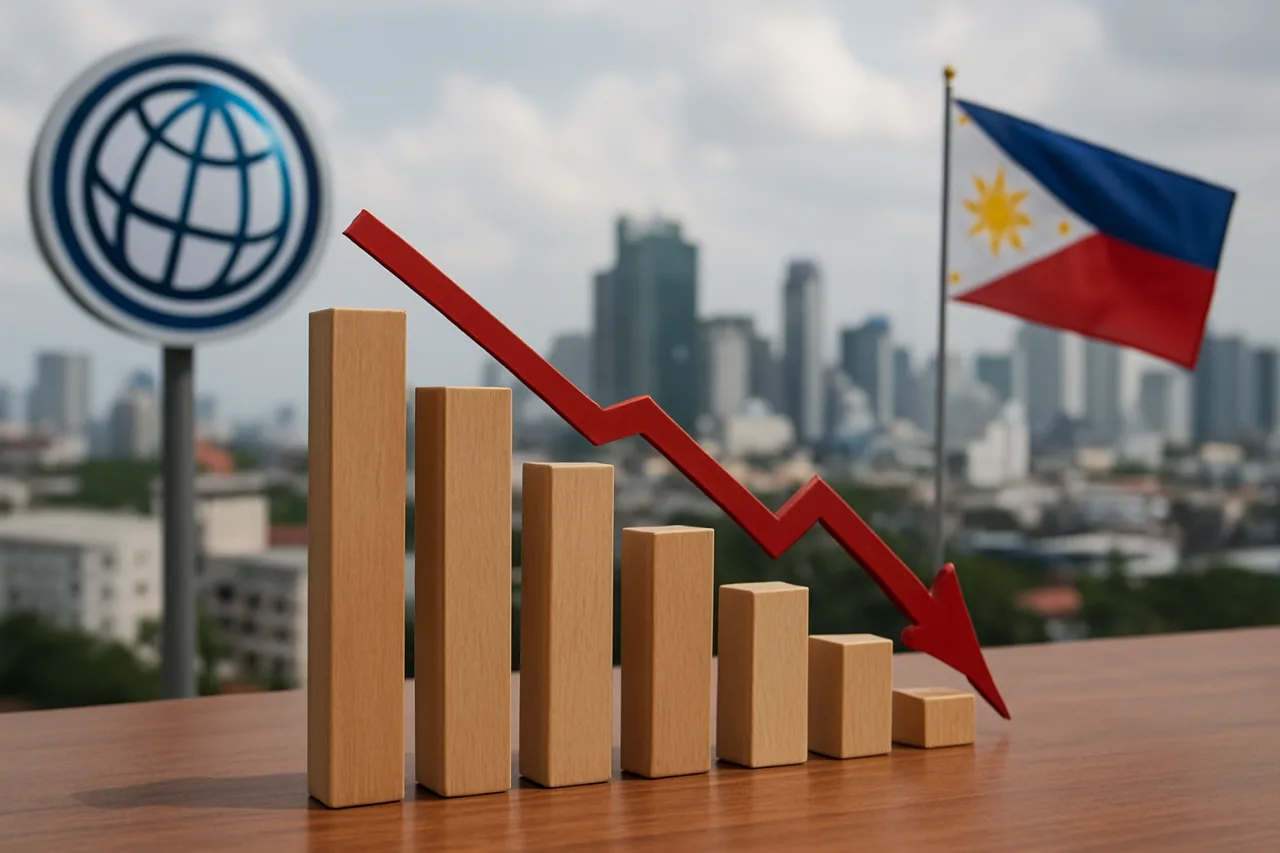
The World Bank slashed its 2026 Philippine economic growth forecast to 3.7 percent on August 3, 2026, down sharply from the 5.3 percent projection it issued in December 2025. The cut places the Philippine economic growth rate below the 4.1 percent average expected for developing economies in East Asia and the Pacific, reversing years of outperformance that had made the country one of the region’s fastest-growing markets. Zafer Mustafaoglu, the World Bank division director for the Philippines, Malaysia, and Brunei, delivered the assessment at an economic forum in Manila, citing weak investment, constrained consumption, and a global oil shock driven by the Middle East conflict as the primary drivers of the Philippine economic growth slowdown. The full World Bank Philippines Economic Update provides the underlying data and methodology.
Key Takeaway
- 📉 Sharp downgrade: The World Bank cut its 2026 Philippine economic growth forecast from 5.3% to 3.7% — a 1.6 percentage point drop that puts the Philippines below the regional average of 4.1% for developing East Asian economies.
- 🛢️ Oil shock + policy uncertainty: The Middle East conflict sent global oil prices surging, feeding through to domestic inflation and weakening consumer spending. A separate infrastructure spending review launched in mid-2025 has slowed public project execution.
- 💰 Inflation staying high: The World Bank projects inflation averaging 5.8% for 2026, with the peso trading at 60-62 per dollar through 2030, keeping import costs elevated.
- 📈 Recovery expected in 2027: Growth is forecast to rebound to 5.2% in 2027 and 5.5% in 2028 as public investment recovers and the central bank resumes monetary easing — but both estimates were trimmed from previous projections.
- ⚡ Action for professionals: Filipino professionals and investors should hedge against peso weakness, prioritize skills that withstand economic slowdowns, and monitor the government’s 3.5-4.5% official growth target for signs of further downward revision.
Why the Philippine Economic Growth Slowdown Is Happening Now
The Philippine economic growth deceleration did not arrive without warning. The economy grew just 2.8 percent in the first quarter of 2026, already below expectations, weighed down by the Middle East conflict and a delayed national budget passage. The World Bank’s full-year forecast of 3.7 percent represents a continuation of that first-quarter weakness rather than a sudden deterioration — and it reflects two structural forces that have been building for months.
The first force is a contraction in investment. According to the World Bank’s Philippine Economic Update, rising global and domestic policy uncertainty has depressed private sector investment, while a review of public infrastructure projects launched in mid-2025 has temporarily slowed government project execution. This matters because infrastructure spending has been a primary engine of Philippine economic growth under the Marcos administration’s “Build Better More” program. When that engine slows, the ripple effects reach construction employment, materials suppliers, and the informal economy that depends on project sites for daily wages.
The second force is the Middle East conflict, which produced what the World Bank called a “negative terms-of-trade shock.” Global oil prices surged, feeding through rapidly to domestic prices. The Philippines is a net oil importer, and every increase in global crude prices widens the trade deficit, weakens the peso, and raises the cost of everything from transportation to food to electricity. For Filipino consumers already spending a disproportionate share of income on food and fuel, the oil shock directly reduces discretionary spending — the same spending that drives the consumption-led growth model the Philippine economy relies on.
What the Numbers Reveal — and What They Miss
The headline figure — 3.7 percent — tells one story. The context beneath it tells another. Consider the trajectory: the World Bank’s December 2025 forecast of 5.3 percent was already a downgrade from earlier projections. The August 2026 cut to 3.7 percent represents a further 1.6 percentage point reduction. The government’s own economic managers have lowered their target to 3.5 to 4.5 percent, a range that acknowledges the World Bank’s assessment but still holds out hope for the upper bound of Philippine economic growth.
Q2 2026 growth is likely to come in at approximately 2.5 to 2.7 percent according to a poll of economists by UA&P, which would mark a postpandemic low. If confirmed when official data is released, this would mean the Philippine economy has grown at roughly half the rate needed to sustain the government’s poverty reduction targets and fiscal consolidation plans. The numbers miss something important, however: the distributional impact. A 3.7 percent aggregate growth rate does not affect all Filipinos equally. Salaried professionals in IT-BPM and knowledge services may see minimal direct impact, while construction workers, informal sector vendors, and families dependent on remittances from OFWs in the Middle East face disproportionate exposure.
The Oil Shock Channel: How Global Conflict Reaches Filipino Wallets
The Middle East conflict affects Philippine economic growth through three specific transmission channels that every Filipino professional should understand.
1. Fuel prices. The Philippines imports approximately 90 percent of its petroleum requirements, according to the Department of Energy. When global oil prices rise, domestic pump prices follow within weeks. Higher fuel costs increase transportation expenses for commuters, logistics costs for businesses, and operating costs for the agriculture sector (diesel for irrigation pumps and fishing boats). On August 4, 2026, diesel and gasoline prices dropped by less than P1 per liter — a minor relief that does not offset the cumulative increases earlier in the year.
2. Peso depreciation. Oil is priced in US dollars. Higher oil imports mean more dollar demand, which weakens the peso. The World Bank projects the peso to trade at 60 to 62 per dollar through 2030. A weaker peso raises the cost of all imports — electronics, machinery, pharmaceuticals, and food products that the Philippines does not produce domestically. For OFW families, a weaker peso increases the peso value of remittances, providing a partial offset. For businesses that import raw materials or equipment, it squeezes margins.
3. Inflation persistence. The World Bank projects inflation averaging 5.8 percent for 2026, above the BSP’s 2-4 percent target corridor. Inflation is expected to ease to 5.2 percent in 2027 as conditions stabilize — but that projection assumes the Middle East conflict does not escalate further. If oil prices rise instead of stabilize, both the growth and inflation forecasts would need further downward revision. For a deeper analysis of how monetary policy responds to these pressures, see our coverage of PSEi market trends and rate hike fears.
The Second-Order Effect on Filipino Professionals
The immediate impact of the Philippine economic growth deceleration is on aggregate demand — businesses spend less, consumers buy less, hiring slows. But the second-order effects are where the real risk lies for Filipino professionals.
The IT-BPM sector, which employs over 1.7 million Filipinos and generates approximately $35 billion in annual revenue, is less directly exposed to domestic economic conditions because its revenue comes from foreign clients. However, a global economic slowdown driven by oil prices and geopolitical conflict reduces the willingness of foreign companies to outsource — or at least slows the growth of outsourcing budgets. The IT-BPM sector already slashed its 2028 revenue target from $59 billion to $43.3 billion in a downside scenario, as our analysis of the Philippine digital workforce documented.
For OFWs, the risk is more direct. Over 12,000 OFWs have been repatriated from the Middle East since the conflict began, according to President Marcos’s State of the Nation Address. The DMW continues to process returning OFWs, with 37 qualified returnees from Cebu receiving P375,000 in reintegration assistance on July 28. For OFWs still working in the region, the conflict creates job insecurity even as the weaker peso temporarily boosts remittance values. The tension between higher remittance values and job insecurity is the defining characteristic of the current OFW economic experience.
For investors in Philippine equities, the growth slowdown creates a bifurcated market. Companies with domestic-facing revenue (banks, property, consumer goods) face weaker demand. Companies with dollar-linked revenue (ICTSI, BPO operators, export manufacturers) benefit from peso weakness. The PSEi rebalancing effective August 3 — which saw Maynilad enter and Converge exit — reflects this shifting landscape. Our PSEi rebalancing analysis covers the investment implications in detail.
What the Government Is Doing — and What It Is Not
The Philippine government’s response to the economic growth slowdown has been mixed. On the fiscal side, economic managers have lowered the growth target to 3.5-4.5 percent, a realistic acknowledgment of the constraints. The Bureau of Customs was seen beating its July revenue goal, suggesting that import-driven tax collection remains robust despite the slowdown. The ERC approved Meralco’s collection of P8.71 billion in unrecovered fees on August 4, a decision that will increase electricity bills for consumers but improves utility sector financial stability.
On the relief side, Congress is eyeing tax hikes to offset relief for workers and small businesses, according to an Inquirer report published August 4. The specific mechanisms remain under debate, but the direction is clear: the government is trying to fund relief measures without expanding the fiscal deficit further. This is a delicate balance — raising taxes during a slowdown risks further dampening consumption, while not providing relief risks political and social instability.
What the government is not doing, according to the World Bank’s implicit assessment, is accelerating the infrastructure project review that has slowed public investment. The “review of public infrastructure launched in mid-2025” that the World Bank cited as a growth constraint has no announced completion date. Until that review concludes and project execution resumes, the investment component of Philippine economic growth will remain below potential.
What Comes Next — and What Every Professional Should Do
The World Bank’s 2027 forecast of 5.2 percent growth assumes that the Middle East conflict stabilizes, public investment recovers, and the central bank resumes monetary easing. Each of these assumptions carries downside risk. If the conflict escalates, oil prices could rise further, pushing inflation above 5.8 percent and forcing the Bangko Sentral ng Pilipinas to maintain or raise rates rather than cut them. If the infrastructure review extends into 2027, the investment recovery would be delayed further, keeping Philippine economic growth below potential for a second consecutive year.
For Filipino professionals, the actionable steps are specific:
1. Hedge against peso weakness. The peso at 60-62 per dollar through 2030 means any income or savings in pesos will lose purchasing power against imported goods. Professionals with foreign currency income (OFWs, freelancers, BPO employees paid in dollars) benefit. Those with purely peso-denominated income should consider dollar-denominated investments or hedge through diversified portfolios. Our PSE blue chip investment guide covers peso-hedging strategies through domestic equities.
2. Prioritize recession-resistant skills. Sectors that withstand economic slowdowns include healthcare, cybersecurity, AI/automation, and government services. The CYFIRMA 2025-2026 threat landscape report confirms that Philippine cybersecurity spending is projected to reach $282.68 million by 2026 (CAGR 8.10%), making it one of the few sectors with confirmed growth trajectories regardless of the broader economic environment. The Philippine AI infrastructure master plan similarly represents a multi-year investment cycle that is less sensitive to short-term GDP fluctuations.
3. Monitor the Q2 2026 GDP release. The official Q2 GDP figure, expected in late August or early September, will confirm whether the 2.5-2.7 percent estimate is accurate. A figure below 2.5 percent would likely trigger further forecast downgrades from the IMF, ADB, and S&P, each of which has already reduced their Philippine growth projections this year. Each downgrade puts further pressure on the peso and on investor confidence.
4. Watch the BSP’s next policy move. With inflation projected at 5.8 percent — well above the 2-4 percent target — the BSP has limited room to cut rates despite the growth slowdown. If inflation surprises on the downside as oil prices stabilize, a rate cut in Q4 2026 or Q1 2027 becomes possible, which would support both growth and equity markets.
The Risk Nobody Is Talking About
The World Bank’s forecast assumes a single scenario: the Middle East conflict continues at its current intensity but does not escalate. The bank’s June 2026 global report outlined a downside case where, if energy disruptions last longer and oil prices average $115 per barrel, global growth could slow to 2.1 percent. If the energy shock triggers financial market stress, global growth could fall to 1.3 percent — a scenario the World Bank’s deputy chief economist Ayhan Kose warned could unfold if “energy and financial pressure reinforce each other.”
For the Philippines, a global growth slowdown of that magnitude would reduce demand for Philippine exports, pressure OFW employment across multiple regions (not just the Middle East), and reduce foreign direct investment. The 3.7 percent Philippine economic growth forecast would look optimistic in that scenario. The appropriate response is not panic but preparation: maintaining liquidity, avoiding over-leveraged investments, and ensuring that career skills remain relevant across multiple economic conditions.
Frequently Asked Questions About Philippine Economic Growth in 2026
What is the World Bank’s 2026 growth forecast for the Philippines?
The World Bank projects Philippine economic growth of 3.7 percent in 2026, down from its December 2025 forecast of 5.3 percent. The cut was announced on August 3, 2026, in the World Bank’s latest Philippine Economic Update. Zafer Mustafaoglu, World Bank division director for the Philippines, Malaysia, and Brunei, cited weak investment, constrained consumption, and the Middle East oil shock as the primary reasons.
Why did the World Bank cut the Philippine growth forecast?
The World Bank identified two main factors: a contraction in investment driven by policy uncertainty and a mid-2025 infrastructure project review that slowed public spending, and the Middle East conflict which caused a surge in global oil prices that fed through to domestic inflation and weakened economic activity.
How does the 3.7% growth rate compare to other Asian economies?
The Philippines’ 3.7 percent forecast is below the 4.1 percent average growth expected for developing economies in East Asia and the Pacific, according to the World Bank. This marks a reversal from recent years when the Philippines consistently outperformed the regional average. The government’s own target range of 3.5-4.5 percent is broader, acknowledging uncertainty in both directions.
What is the inflation forecast for the Philippines in 2026?
The World Bank projects inflation averaging 5.8 percent for 2026, above the Bangko Sentral ng Pilipinas’ 2-4 percent target corridor. Inflation is expected to ease to 5.2 percent in 2027 as governance conditions stabilize, public investment recovers, and the central bank resumes monetary easing.
How does the peso depreciation affect Filipino professionals?
The World Bank expects the peso to trade at 60 to 62 per US dollar through 2030. A weaker peso increases the cost of imported goods but raises the peso value of dollar-denominated income such as OFW remittances. Professionals with purely peso income face reduced purchasing power for imported products, while those earning in dollars or serving foreign clients benefit from the exchange rate movement.
When will Philippine economic growth recover?
The World Bank forecasts growth to rebound to 5.2 percent in 2027 (trimmed from 5.6 percent in June) and 5.5 percent in 2028, as public investment gradually recovers and economic conditions improve. However, these projections assume the Middle East conflict stabilizes and the infrastructure spending review concludes — both of which carry downside risk.
Should Filipino investors change their strategy because of the growth slowdown?
The growth slowdown creates a bifurcated market: domestic-facing companies face weaker demand, while companies with dollar-linked revenue benefit from peso weakness. Investors should review portfolio exposure accordingly, prioritize sectors with recession-resistant characteristics (cybersecurity, AI infrastructure, healthcare), and maintain liquidity for potential opportunities if asset prices decline. Consult a licensed financial advisor before making investment decisions.
Disclaimer: This article is for informational and educational purposes only and does not constitute financial or investment advice. References to economic forecasts are based on publicly available information from the World Bank, Philippine government agencies, and news reports as of August 4, 2026. Readers should consult qualified financial advisors before making investment decisions. The author and publisher disclaim any liability for actions taken based on this information.
Related reading: The regional dimension is accelerating: Manila’s hosting of the ASEAN AI Summit puts the Philippines at the center of the region’s AI-for-MSME policy push.
Related reading: Infrastructure meets AI policy: the Luzon Economic Corridor’s European investment push and the US data center backlash reshaping global siting both frame where Philippine growth capital moves next.
Related reading: The remittance rails are shifting: Western Union’s JuanPay tie-up shows legacy players racing the fintech wave that carries OFW money home.