
Table of Contents
Key Takeaway
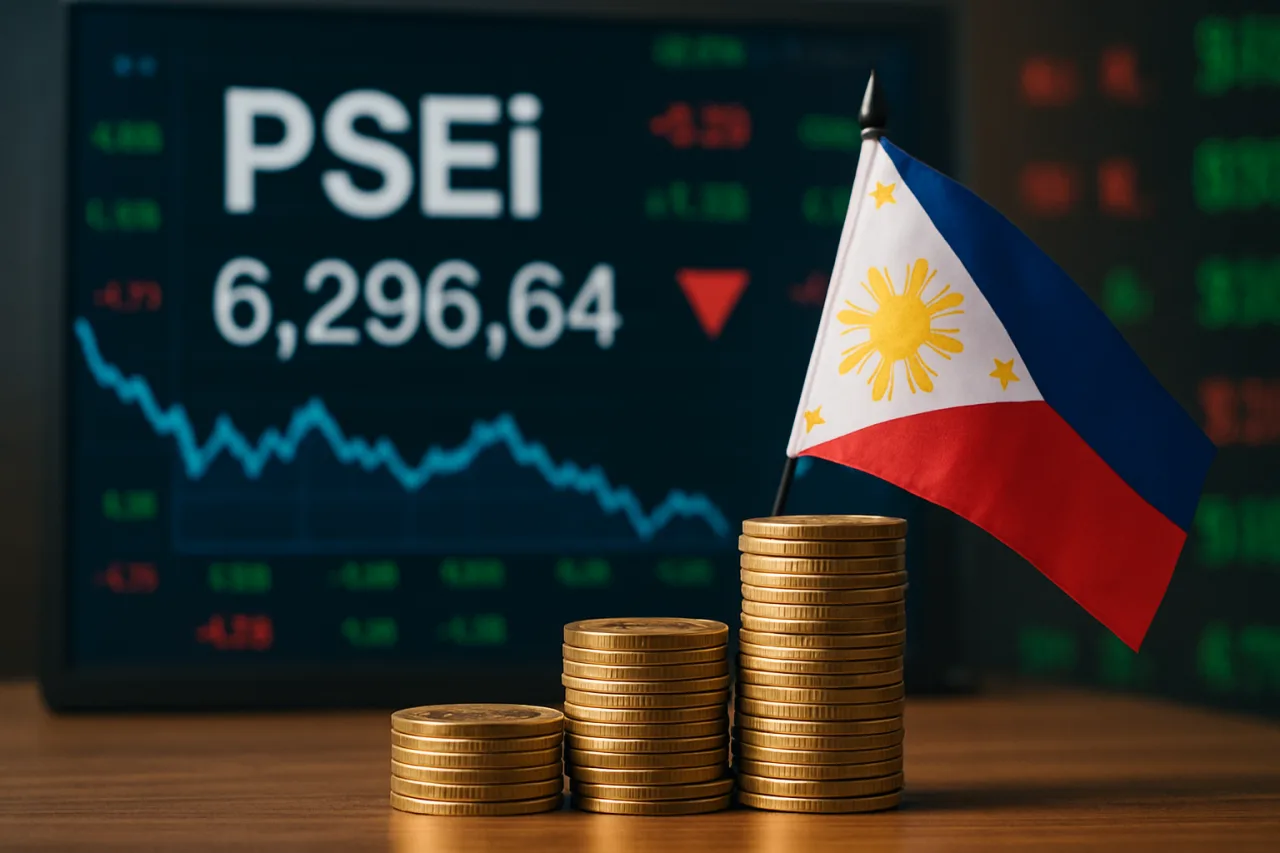
- 📊 PSEi at 6,297: The Philippine Stock Exchange index sits at 6,296.64 as of August 4, 2026 — up 1.17% over the past month but down 0.90% year-on-year, far below its all-time high of 9,078 in January 2018.
- 💰 Cheap Valuation: The PSEi trades at a P/E ratio of 8.1x with earnings forecast to grow 9.4% annually — making it one of the cheapest markets in Asia, but cheap for reasons that include inflation, political risk, and slow growth.
- 📈 Sectors Diverging: Materials gained 5.7% in the past week while the broader market stayed flat. ICTSI leads with +118% YoY returns. Real Estate trades below its 3-year average — the least preferred sector for future growth.
- 🔄 Rebalancing Impact: The August 2026 PSEi rebalancing (effective August 3) added Maynilad and removed Converge — reshaping the index composition and creating both opportunities and risks for index-tracking investors.
- ⚡ What You Should Do: Filipino investors should focus on sectors with earnings momentum (Materials, Industrials), avoid blindly buying the index, and watch for the BSP rate decision — inflation at 6.4% and the policy rate at 4.75% will determine whether the PSEi recovery sustains.
The PSEi August 2026 outlook is a story of contradictions. The index trades at 6,297 points — barely 70% of its January 2018 peak of 9,078. Its P/E ratio of 8.1x makes it one of the cheapest equity markets in Asia. Earnings are forecast to grow 9.4% annually. Yet the market is flat over the past year and down 2.6% year-to-date. Cheap does not mean safe. The PSEi August 2026 picture demands that investors understand not just where the market is, but why it is there — and what would need to change for it to move.
Here is the analytical tension that defines the PSEi in August 2026. The valuation says buy. The macroeconomy says wait. Inflation eased to 6.4% in June 2026 from 6.8% in May, but that remains well above the Bangko Sentral ng Pilipinas’ 3.0% ± 1.0% target. The BSP raised its policy rate to 4.75% from 4.50% in June, signaling continued focus on inflation control. The DEPDev (formerly NEDA) revised 2026 growth expectations down to 3.5-4.5%, below the government’s initial 5-6% target. Oil shocks from the Middle East conflict and slower government spending continue to drag the economy. The question for Filipino investors is whether the gap between cheap valuations and weak macro is a buying opportunity or a value trap.
Why the PSEi August 2026 Valuation Is Cheap — and Whether It Should Be

The PSEi’s P/E ratio of 8.1x as of August 4, 2026, tells a story that requires context. According to Simply Wall Street’s aggregated market analysis, this is below the 8.6x recorded in February 2026 and the 10.1x absolute P/E from earlier in the year. The market capitalization stands at ₱13.0 trillion against revenue of ₱13.9 trillion and earnings of ₱1.4 trillion. On the surface, this is a buyer’s market — you are paying 8.1 pesos for every peso of earnings across the PSEi’s 251 listed companies.
But the cheapness has a reason. The Philippine economy is growing slower than expected. The World Bank cut its 2026 growth forecast to 3.7%. AMRO flagged the Philippines as potentially the fourth slowest-growing ASEAN economy this year. Inflation at 6.4% erodes consumer purchasing power and corporate margins simultaneously. The BSP’s rate hike to 4.75% raises borrowing costs for the property sector and leveraged companies. Government underspending, partly linked to a flood control corruption scandal that surfaced in late 2025, has slowed public infrastructure investment. These are not temporary headwinds — they are structural constraints that could persist through 2027.
Yet the earnings forecast tells a different story. Analysts expect annual earnings growth of 21.6%, according to Simply Wall Street, which is higher than the past year’s earnings decline of 4.4% per year. If those earnings materialize, the P/E ratio compresses further — making the market even cheaper on a forward basis. The tension is between what analysts expect and what the macro environment will allow. The top Philippine fund managers who see bargains after the selloff are betting on the earnings forecast. The investors staying away are betting on the macro.
The Sector Divergence: Where PSEi August 2026 Money Is Moving
The PSEi is not a monolith. In the week ending August 4, 2026, the Materials sector gained 5.7% while the broader market remained flat. Over the past year, the market is down 1.3% — but that average masks dramatic sector divergence. ICTSI, the port logistics company, surged +118% year-on-year, making it the only PSEi stock delivering triple-digit returns. PEZA’s ₱300 billion investment target and the semiconductor manufacturing boom have driven Materials and Industrials outperformance, while Real Estate and Financials have lagged.
The Real Estate sector trades below its 3-year average P/E of 9.6x, according to Simply Wall Street, making it the least preferred sector for future growth. This reflects the combination of high interest rates (4.75% BSP policy rate) and slower economic growth — both of which directly suppress property demand and developer margins. The August 2026 PSEi rebalancing, which took effect on August 3, added Maynilad (water utility) and removed Converge (telecom), reflecting this sector rotation — investors are favoring utilities and infrastructure over technology and property.
The Materials sector’s 5.7% weekly gain connects directly to the semiconductor export boom, which reached $8.8 billion and saw PEZA first-half investment approvals nearly double. When global firms diversify manufacturing beyond China and choose the Philippines, the listed companies that supply materials, components, and logistics services benefit directly. This is not speculative — it is the earnings impact of real investment flowing through real supply chains. Filipino investors who understand this connection can position their portfolios ahead of quarterly earnings reports that will reflect the investment pipeline.
What the PSEi August 2026 Forecasts Say — and What They Miss
Trading Economics, using global macro models and analyst expectations, forecasts the PSEi to trade at 6,114.62 points by the end of Q3 2026 — roughly 3% below the current 6,297 level. Looking further forward, their 12-month estimate is 5,537.34, implying a further 12% decline. These forecasts are driven by the macro headwinds: inflation above target, slow growth, political uncertainty, and global trade disruption.
But macro models miss what earnings models capture. The SEC’s SEConomics June 2026 report noted that the PSEi rebounded 4.65% to 6,037.17 as of end-June 2026, with total market capitalization increasing 0.81% month-on-month to ₱19.44 trillion, supported by improving crude oil supply conditions. Since then, the PSEi has climbed further to 6,297 — a gain of over 4% from the June lows. The BSP’s June 2026 Monetary Policy Report projects inflation at 6.4% for 2026 (up from 3.6% in the February forecast), declining to 4.5% in 2027 and 3.1% in 2028. If that inflation path holds, the BSP can begin cutting rates in 2027 — and rate cuts are the single most powerful catalyst for emerging market equity rallies.
The global minimum tax (QDMTT) implementation adds another variable. PEZA-registered companies that form a significant portion of PSEi earnings — particularly in manufacturing and IT-BPM — may see their effective tax rates rise starting in 2027, compressing the earnings that current valuations are pricing in. Filipino investors should model the QDMTT impact on the companies in their portfolios, not just the index level.
The Second-Order Effect on Filipino Investors in the PSEi August 2026 Market
The PSEi August 2026 environment creates a specific decision framework for Filipino investors — including OFWs deploying savings and professionals building long-term portfolios. The decision is not “should I invest?” but “how should I invest in a market that is cheap but facing structural headwinds?”
The answer is sector-specific, not index-wide. Buying the PSEi through an index fund means buying Real Estate at a premium to its growth prospects, Financials at a discount but with NPL ratios rising (3.37% in April, an 8-month high), and Materials at a moment when semiconductor investment is accelerating. Diversifying across blue chip stocks with sector awareness is more effective than blind index investing in this environment.
For OFW investors, the peso’s weakness creates an additional consideration. A weaker peso means OFW remittances buy more Philippine assets — but it also means the real return on those assets must outpace peso depreciation. The BPO sector now generating $40 billion annually provides a natural hedge: companies earning in dollars but listed in pesos benefit when the peso weakens. ICTSI, which earns port fees in multiple currencies, is the clearest example — its 118% stock surge reflects this dynamic.
What to Watch in the PSEi August 2026 Outlook: Catalysts and Risks
Three catalysts could move the PSEi meaningfully in the coming months. First, the BSP rate decision. If inflation continues to ease toward the DBCC’s 6.0-7.0% target range and the BSP signals rate cuts, the PSEi could rally sharply — rate cuts compress bond yields, push investors toward equities, and lower borrowing costs for property and infrastructure companies. Second, the AI sector’s growing weight in the PSEi — now at 21% — means that any acceleration in AI investment flows directly into index performance. Third, the DEFA signing in November 2026 could boost market sentiment by confirming the Philippines’ role as ASEAN’s digital economy hub.
Three risks could push the PSEi lower. First, the Middle East conflict could reignite, sending oil prices higher and inflation back above 7%. Second, the impeachment trial of Vice President Sara Duterte creates political uncertainty that historically suppresses emerging market equities. Third, the global minimum tax implementation could compress earnings for PEZA-registered companies starting in 2027, reducing the forward P/E advantage that current valuations imply.
The PSEi August 2026 outlook is not a buy or sell call. It is a positioning decision. The market is cheap, the earnings are growing, the sectors are diverging, and the macro is uncertain. In that environment, the investors who win are not the ones who predict the index level — they are the ones who buy the right sectors at the right time, with the patience to let the earnings materialize while the macro headwinds resolve. The PSEi August 2026 market rewards patience and sector selection, not index-level gambling.
Frequently Asked Questions About PSEi August 2026
What is the PSEi level in August 2026?
The PSEi closed at 6,296.64 on August 4, 2026, down 0.60% from the previous session. Over the past month, the index has climbed 1.17%, though it remains 0.90% lower than a year ago. The all-time high of 9,078.37 was recorded in January 2018. First Metro Securities reported the PSEi closed at 6,334.72 on August 3, up 1.58% on ₱5.10 billion value traded.
Is the Philippine stock market cheap in August 2026?
Yes, by traditional valuation metrics. The PSEi trades at a P/E ratio of 8.1x as of August 4, 2026, with earnings forecast to grow 9.4% annually. Market capitalization stands at ₱13.0 trillion against earnings of ₱1.4 trillion. However, the cheapness reflects structural headwinds: inflation at 6.4%, BSP policy rate at 4.75%, and 2026 GDP growth revised down to 3.5-4.5%. Cheap valuation alone is not a buy signal — the macro environment must improve for the valuation gap to close.
What sectors are performing best in the PSEi in August 2026?
The Materials sector gained 5.7% in the week ending August 4, 2026, driven by the semiconductor export boom and PEZA investment pipeline. ICTSI (Industrials) leads with +118% year-on-year returns. Real Estate trades below its 3-year average P/E of 9.6x, making it the least preferred sector. The August 2026 PSEi rebalancing added Maynilad (Utilities) and removed Converge (Telecom), reflecting sector rotation toward utilities and infrastructure.
What is the PSEi forecast for late 2026?
Trading Economics forecasts the PSEi to trade at 6,114.62 points by the end of Q3 2026, roughly 3% below the current level. Their 12-month estimate is 5,537.34, implying a further 12% decline. However, these forecasts are macro-driven and may not capture earnings growth. Analysts expect 21.6% annual earnings growth, which would compress the forward P/E and potentially drive the index higher if the macro stabilizes.
How does inflation affect the PSEi in August 2026?
Inflation eased to 6.4% in June 2026 from 6.8% in May, but remains above the BSP’s 3.0% ± 1.0% target. The BSP raised its policy rate to 4.75% in June. High inflation suppresses consumer spending and corporate margins, while high interest rates increase borrowing costs for property and infrastructure companies. If inflation continues to ease toward the DBCC’s 6.0-7.0% target range, the BSP may signal rate cuts, which could trigger a PSEi rally.
How does the PSEi rebalancing affect investors?
The August 2026 PSEi rebalancing took effect on August 3, 2026. Maynilad (water utility) joined the index while Converge (telecom) was removed. For index-tracking investors, this means automatic portfolio adjustment — funds that replicate the PSEi will buy Maynilad and sell Converge. For active investors, the rebalancing signals which sectors the exchange considers representative of the current Philippine economy: utilities and infrastructure are in, while some technology names are out.
Should OFWs invest in the PSEi in August 2026?
OFW investors should approach the PSEi with sector-specific strategy rather than index-wide buying. The weak peso means remittances buy more Philippine assets, but real returns must outpace peso depreciation. Companies earning in dollars but listed in pesos — like ICTSI — benefit from peso weakness. Sectors with strong earnings momentum (Materials, Industrials) offer better risk-adjusted returns than sectors facing structural headwinds (Real Estate). Dollar-cost averaging remains the safest approach in a market with high macro uncertainty.
Financial Disclaimer: This article is for informational and educational purposes only and does not constitute investment advice. Stock market investments carry risk, including potential loss of principal. Readers should consult a licensed financial advisor before making investment decisions. Past performance does not guarantee future results.