Table of Contents
Key Takeaway
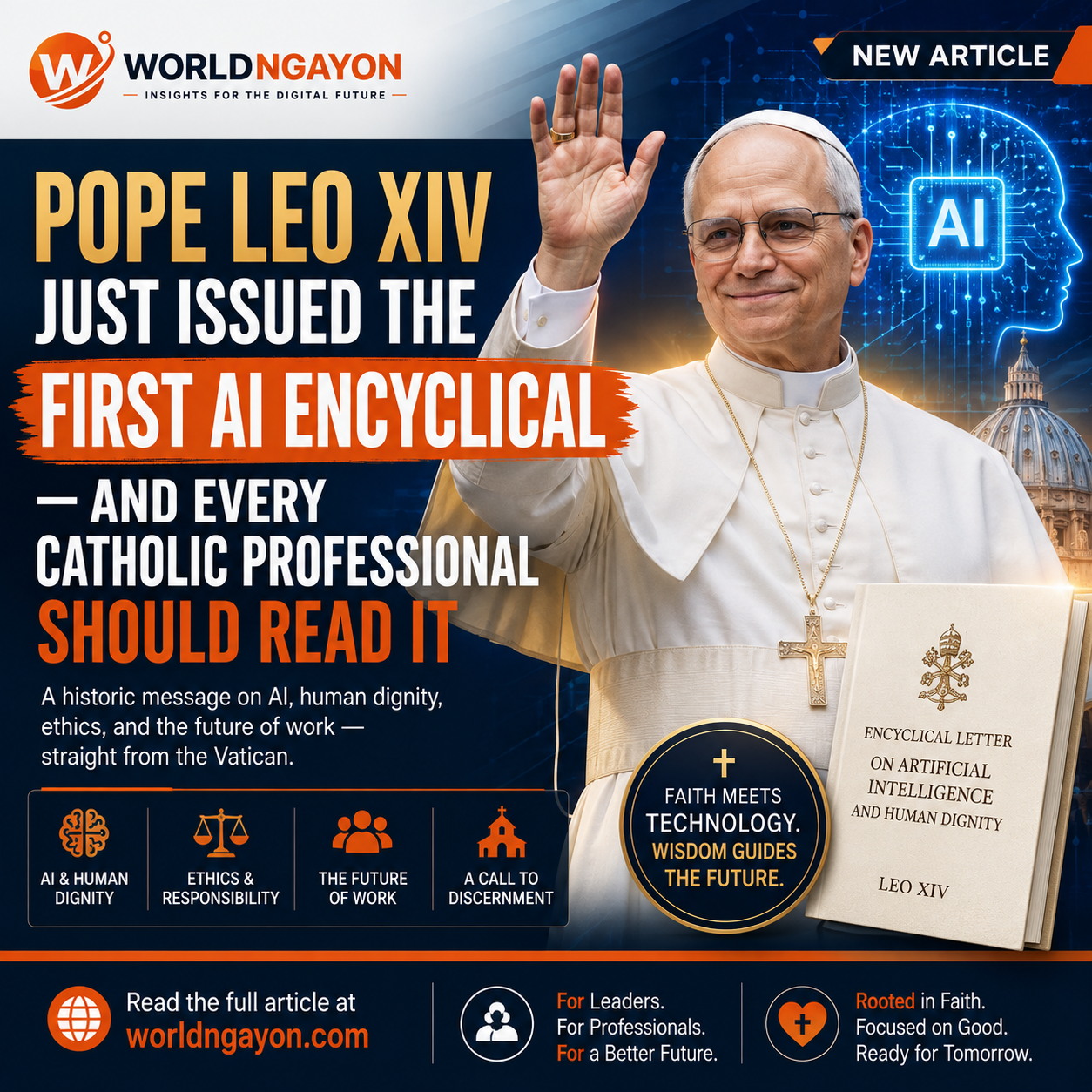
- 📜 First of Its Kind: Pope Leo XIV issued “Magnifica humanitas,” the first papal encyclical dedicated to artificial intelligence — addressing AI regulation, job displacement, and human dignity from the Vatican’s highest teaching authority
- ⚖️ Core Warning: The Pope AI encyclical warns that AI threatens human dignity when deployed without ethical guardrails — calling for regulation that prioritizes the human person over technological efficiency
- 💼 Job Displacement: Pope Leo XIV addresses AI-driven job loss directly, positioning it as a moral issue for employers, governments, and technology companies — not just an economic challenge
- 🌐 Global Relevance: The encyclical arrives alongside statements from Sam Altman and Jensen Huang, placing the Pope’s moral framework in conversation with Silicon Valley’s commercial vision for AI
- 🇵🇭 Filipino Impact: For the Philippines — one of the world’s largest Catholic populations — the encyclical provides an ethical lens for Filipino professionals navigating AI adoption in their workplaces
When the Pope speaks, a billion Catholics listen. When the Pope issues an encyclical — the highest form of papal teaching — the world pays attention. Pope Leo XIV has done both, publishing “Magnifica humanitas: on safeguarding the human person in the time of artificial intelligence,” the first papal encyclical dedicated to AI. The document addresses the technology’s most pressing ethical questions: AI regulation, job displacement, human dignity, and the moral obligations of those who build and deploy AI systems. For the Philippines, where over 80% of the population is Catholic and where AI adoption is reshaping the BPO sector, the call center industry, and the broader services economy, this encyclical is not abstract theology. It is a practical ethical framework for professionals navigating the most significant technological transformation of their careers.
Business Insider noted that the Pope’s encyclical arrives at a moment when the AI conversation is dominated by commercial interests — Sam Altman of OpenAI promoting AI as a tool for human flourishing, Jensen Huang of Nvidia building the hardware that powers the AI revolution. The Pope’s voice adds a dimension that Silicon Valley cannot provide: a moral framework that asks not “what can AI do?” but “what should AI do?” This framing, as Vatican News has reported, positions the encyclical as a contribution to the global conversation on AI ethics that is grounded in centuries of Catholic social teaching rather than the quarterly earnings cycles of technology companies.
The Encyclical Explained — What “Magnifica humanitas” Says and the Pope AI Encyclical
“Magnifica humanitas” — Latin for “magnificent humanity” — is structured as a moral argument about the relationship between artificial intelligence and the human person. The Pope AI encyclical‘s full title, “on safeguarding the human person in the time of artificial intelligence,” signals its central concern: that AI, deployed without ethical constraints, can diminish rather than enhance human dignity.
The encyclical addresses three core themes. First, AI regulation: the Pope calls for regulatory frameworks that prioritize human welfare over technological efficiency, arguing that self-regulation by technology companies is insufficient. The market alone, he contends, cannot ensure that AI serves the common good. Government action, guided by ethical principles, is necessary.
Second, job displacement: the encyclical directly addresses the economic disruption caused by AI automation. Pope Leo XIV frames job loss not merely as an economic challenge but as a moral issue. Employers have obligations to workers that extend beyond profit maximization. Governments have obligations to ensure that technological progress does not leave workers behind. Technology companies have obligations to consider the social consequences of their products.
Third, human dignity: the encyclical argues that AI systems must be designed and deployed in ways that respect the inherent dignity of every person. This includes concerns about AI bias, surveillance, manipulation, and the reduction of human beings to data points. The Pope’s framing draws on Catholic social teaching — the tradition of encyclicals addressing economic justice, labor rights, and the responsibilities of the powerful toward the vulnerable.
The Pope vs. Silicon Valley — Competing Visions for AI and the Pope AI Encyclical
The encyclical does not exist in a vacuum. It arrives in a year when the AI conversation has been dominated by technology executives with very different perspectives. Sam Altman, CEO of OpenAI, has promoted a vision of AI as a tool for human flourishing — a technology that, if developed responsibly, can solve humanity’s greatest challenges. Jensen Huang, CEO of Nvidia, has built the hardware empire that powers the AI revolution, framing GPU computation as the infrastructure of a new industrial age.
The Pope’s encyclical does not reject these visions outright. It complicates them. Where Altman emphasizes what AI can achieve, the Pope asks what AI should be allowed to do. Where Huang celebrates the infrastructure of AI, the Pope asks who benefits from that infrastructure and who bears its costs. The encyclical’s contribution is not a technical critique of AI — it is a moral critique of the values that guide AI development.
This is where the VIP quote hook becomes powerful. The Pope is not a technology critic or a policy analyst. He is the spiritual leader of 1.3 billion Catholics, speaking with an authority that no tech CEO can claim. When he warns that AI threatens human dignity, the warning carries weight that no corporate AI ethics statement can replicate. For Catholic professionals — and there are millions of them in the Philippines alone — the encyclical provides a framework for evaluating AI that is grounded in faith rather than market logic.
What This Means for Filipino Professionals and the Pope AI Encyclical
The Philippines is one of the world’s largest Catholic nations. Over 80% of the population identifies as Catholic, and the Church’s teachings influence everything from politics to business ethics. For Filipino professionals — whether working in BPO, technology, finance, healthcare, or government — the encyclical provides a moral vocabulary for discussing AI that goes beyond cost-benefit analysis.
Consider the BPO worker facing AI-driven automation. The Pope AI encyclical does not say AI should not be used. It says the workers displaced by AI must not be abandoned. Employers have a moral obligation to retrain, support, and transition workers whose jobs are automated. Governments have a moral obligation to provide safety nets and retraining programs. This is a practical framework that Filipino professionals can use to advocate for themselves and their colleagues.
The encyclical is also relevant to the broader debate about AI and employment that we have tracked in our analysis of the AI jobs debate between Hinton, Li, and Ng, where leading AI researchers disagree on whether AI will create or destroy jobs. The Pope’s encyclical adds a dimension that the technical debate often misses: regardless of whether AI creates or destroys jobs in aggregate, the individuals who lose their jobs experience real suffering that cannot be dismissed as a statistical adjustment.
The Trust Crisis and the Papal Response and the Pope AI Encyclical
The encyclical also speaks to the broader crisis of trust in AI that we examined in our coverage of the AI trust crisis and Dario Amodei’s admission. When the CEO of Anthropic — one of the world’s leading AI companies — publicly acknowledges that ordinary people do not trust the tech industry, the Pope AI encyclical’s call for ethical AI regulation becomes more than a religious statement. It becomes a policy proposal grounded in a widespread public concern.
The Pope AI encyclical‘s emphasis on regulation is notable because it positions the Catholic Church as an advocate for government oversight of AI — not as an opponent of technology. This is consistent with Catholic social teaching, which has historically supported government regulation of industries where market forces alone cannot ensure the common good. The Pope is not asking for AI to be banned. He is asking for AI to be governed by the same Pope AI encyclical principles that have guided Catholic social teaching for over a century.
For Filipino policymakers, the encyclical provides moral authority for AI regulation efforts. The Philippines is developing its own AI governance framework, and the Pope’s encyclical can serve as a reference point for legislators and regulators who want to ground their work in ethical principles rather than purely commercial considerations.
The Philippines AI Boom and the Moral Question and the Pope AI Encyclical
The Philippines is in the midst of an AI transformation that we have documented extensively in our coverage of the Philippines AI boom. The BPO sector is integrating AI into customer service and back-office operations. The government is joining international AI initiatives. Technology companies are investing in data centers and AI infrastructure. The economic potential is real — but so are the risks the encyclical identifies.
The tension between economic opportunity and ethical obligation is exactly what “Magnifica humanitas” addresses. The Pope does not ask the Philippines to reject AI investment. He asks that AI investment be guided by principles that protect workers, respect dignity, and serve the common good. This is a message that resonates in a country where the Catholic faith shapes how millions of people understand their obligations to one another.
For Filipino business leaders, the encyclical poses a direct question: are your AI deployments guided by ethical principles, or by efficiency alone? For Filipino workers, it poses another: are you demanding that your employers and government take the moral dimensions of AI seriously? The encyclical gives both groups a vocabulary for a conversation that needs to happen.
The Moral Framework for Filipino Business and the Pope AI Encyclical
For Filipino business leaders, the Pope AI encyclical provides a framework that goes beyond compliance with labor law. Catholic social teaching has long emphasized the concept of the “common good” — the idea that economic activity should benefit all members of society, not just shareholders. The encyclical applies this concept to AI: companies deploying AI have a moral obligation to ensure that the benefits of automation are shared with workers, not extracted from them.
This has practical implications for how Filipino companies approach AI adoption. A BPO company that replaces call center agents with AI chatbots has a moral obligation — not just a legal one — to retrain displaced workers, provide severance that reflects their years of service, and invest in transition programs. A bank that automates loan processing with AI has an obligation to ensure the system does not discriminate against marginalized communities. A hospital that deploys AI for diagnostic support has an obligation to ensure the system is trained on diverse data that represents all patients, not just wealthy ones.
The Pope AI encyclical does not prescribe specific policies. It provides principles. But principles matter. They shape how leaders make decisions when no one is watching. They shape how workers advocate for themselves when they lack bargaining power. They shape how governments write regulations when industry lobbying pushes in the opposite direction. For a country where Catholic identity is woven into the fabric of daily life, the encyclical gives professionals a vocabulary for ethical AI that resonates with their faith.
Frequently Asked Questions About the Pope AI Encyclical
What is the title of Pope Leo XIV’s AI encyclical?
The encyclical is titled “Magnifica humanitas: on safeguarding the human person in the time of artificial intelligence.” It is the first papal encyclical dedicated specifically to artificial intelligence, addressing AI regulation, job displacement, and human dignity.
What does the Pope AI encyclical say about job displacement?
Pope Leo XIV frames AI-driven job loss as a moral issue, not just an economic challenge. The encyclical states that employers have obligations to workers that extend beyond profit maximization, governments must ensure technological progress does not leave workers behind, and technology companies must consider the social consequences of their products.
Why is the Pope AI encyclical relevant to the Philippines?
The Philippines is one of the world’s largest Catholic nations, with over 80% of the population identifying as Catholic. The encyclical provides an ethical framework grounded in Catholic social teaching for Filipino professionals navigating AI adoption in BPO, technology, and other sectors. It also provides moral authority for policymakers developing AI regulation.
How does the encyclical compare to Silicon Valley’s view of AI?
The encyclical adds a moral dimension to a conversation dominated by commercial interests. Where Sam Altman of OpenAI emphasizes AI’s potential for human flourishing and Jensen Huang of Nvidia celebrates AI infrastructure, the Pope asks what AI should be allowed to do and who bears the costs of its deployment. The encyclical does not reject technology but calls for ethical governance.
Does the Pope AI encyclical call for banning AI?
No. The encyclical does not call for banning AI. It calls for regulation that prioritizes human welfare over technological efficiency. The Pope positions the Catholic Church as an advocate for government oversight of AI, consistent with Catholic social teaching on regulating industries where market forces alone cannot ensure the common good.
What are the three main themes of “Magnifica humanitas”?
The encyclical addresses three core themes: AI regulation (calling for government frameworks that prioritize human welfare), job displacement (framing automation as a moral issue for employers, governments, and tech companies), and human dignity (requiring AI systems to respect the inherent dignity of every person, including concerns about bias, surveillance, and manipulation).
Disclaimer: This article is for informational and educational purposes only and does not constitute religious, legal, or investment advice. The encyclical descriptions are based on publicly available information about “Magnifica humanitas” and related reporting. Readers should consult the original encyclical text for authoritative guidance. WorldNgayon.com is not liable for any actions taken based on the content presented here.