Table of Contents
The Philippine economy is telling two stories at once, and the louder one right now is coming from the factory floor. S&P Global’s Manufacturing PMI climbed to 54.9 in August, up from 51.8 in July — the fourth consecutive month of expansion and the strongest reading since December 2016, per the survey of around 400 manufacturers conducted August 12 to 24. Production grew at its fastest pace in more than nine and a half years, and factories responded the way factories do when demand is real: they hired and they bought. All of this is happening while the BSP holds its policy rate at a 5.00 percent high, inflation runs at 6.2 percent, and the peso sets record lows — a stress test Philippine manufacturing was not expected to pass. The paradox is the story: the tightest money in years, and the most confident manufacturers in a decade.
Key Takeaway: Philippine Manufacturing at a Crossroads
- 🏭 PMI hit 54.9 — a near-decade high: fourth straight month of expansion, strongest since December 2016, with production growing at its fastest pace in over 9.5 years.
- 👷 Factories are hiring and buying: stronger demand pushed manufacturers to increase employment and purchasing activity — the employment signal Filipino workers should watch.
- ⚡ The paradox is the story: decade-best factory momentum alongside a 5.00% policy rate, 6.2% inflation and a record-weak peso — the real economy is outperforming its monetary headwinds.
- 📦 Watch the bottleneck: supplier delivery times deteriorated sharply and inventories were drawn down — growth is outrunning supply chains, which can feed prices.
- 📅 The September 4 test: the BSP’s Monetary Policy Report will reveal whether this resilience changes the central bank’s tightening calculus.
The thesis here is that August’s Philippine manufacturing surge deserves to be read as a macro argument, not a monthly statistic. The argument: the economy’s productive core has decoupled from the financial panic around it. Monetary policy is squeezing — three rate hikes since April, a peso at ₱62.40, inflation double the target’s midpoint — yet the sector most sensitive to financing costs, import prices and consumer demand just posted its best expansion in nearly a decade. When a system grows through that much pressure, the strength is structural, and structural strength changes what policymakers, employers and investors should do next.
What the Philippine Manufacturing PMI Actually Measured
The numbers first, because the interpretation depends on them. The S&P Global Philippines Manufacturing PMI rose to 54.9 in August from 51.8 in July — a 3.1-point jump, the fourth consecutive month of improvement, and the strongest overall reading since December 2016, per S&P Global’s official PMI release. Anything above 50 signals expansion; 54.9 is a strong expansion, not a technical drift over the line — the Daily Tribune’s 9-year-high report captured the scale. The survey ran from August 12 to 24 and covered approximately 400 manufacturing firms, the standard S&P Global panel methodology used across more than 40 economies.
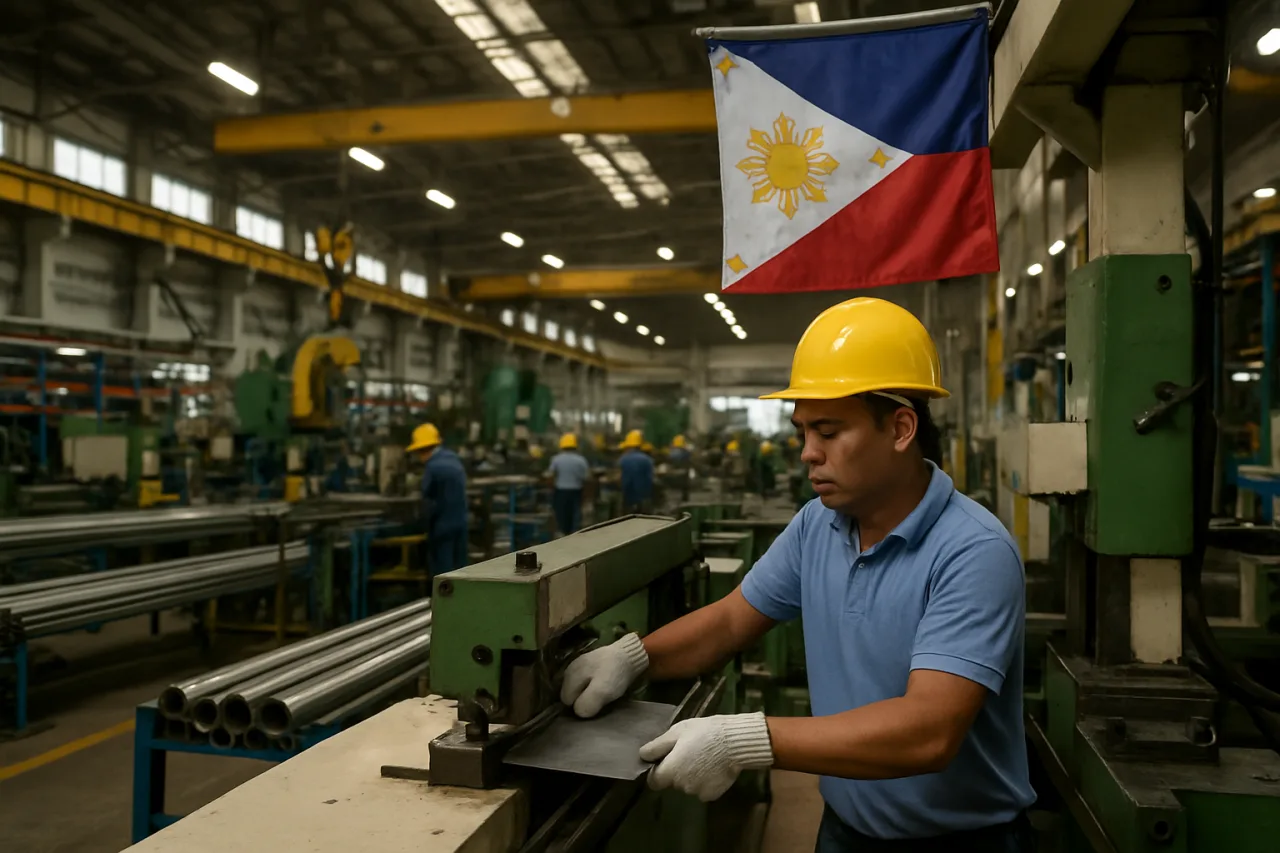
The internals matter as much as the headline. Production expanded at its fastest pace in more than nine and a half years — since roughly early 2017, in practical terms. Stronger underlying demand and new project wins drove the fastest growth in new orders and output in five months. Factories responded by increasing purchasing activity and — the detail with the widest social reach — increasing hiring. Employment growth in manufacturing is the kind of signal that compounds: paychecks become consumption, consumption feeds domestic demand, and domestic demand feeds the next round of orders.
The one warning flag sits in the supply chain. Firms drew down both raw material and finished goods inventories to meet rising demand as supplier delivery times deteriorated sharply. Strength that outruns supply has consequences: longer lead times, and eventually, price pressure. The same demand that is good news for workers and producers is, in its excess, a candidate driver of the next inflation print — which is exactly what the BSP is fighting. This is why the August PMI reads two ways at once: as a growth story, and as a live input into the inflation debate.
The Philippine Manufacturing Paradox: Decade-Best Factories in the Tightest Money
Set the PMI against its monetary backdrop and the paradox sharpens. The BSP raised rates three times in 2026 — April, June and August — taking the policy rate from 4.25 percent to 5.00 percent, its most aggressive sequence since the inflation shock began, precisely because inflation hit a three-year high of 7.2 percent in April and remained at 6.2 percent in July. The peso touched a record low of ₱62.40 on September 1. By the textbook, this is the environment in which manufacturing contracts: financing costs rise, imported inputs inflate, and consumers retrench.
Instead, Philippine manufacturing expanded for four straight months and just hit a nine-and-a-half-year peak. Three explanations carry weight. First, the demand may be structural rather than cyclical: infrastructure spending, the electronics export cycle, and domestic consumption backed by record remittances are demand sources that a 75-basis-point tightening cycle does not instantly extinguish. Second, firms may have completed the worst of their adjustment — the 2025-2026 period of high inventory and weak consumption that we covered in our World Bank growth forecast analysis — leaving leaner producers better positioned to respond to any demand recovery. Third, the currency cuts both ways: a ₱62.40 peso makes Philippine exports cheaper abroad and supports the export-linked half of the factory sector, even as it raises the cost of imported inputs for the rest.
The paradox matters because it changes the question the country should be asking. The dominant narrative of 2026 has been defensive — inflation, rates, currency, caution. The August PMI proposes a different question: what can the Philippine economy grow into if the factory momentum holds? An economy expanding its industrial base at decade-best rates while still poor by regional standards is not a story of decline under pressure; it is a story of resilience that the financial market’s four-day losing streak — ended by the very manufacturing data, as our PSEi rebound analysis shows — briefly mispriced.
The Jobs Signal: What Factory Hiring Means for Filipino Workers
The employment line in the Philippine manufacturing story deserves its own examination, because it converts an abstract index into household stakes. When roughly 400 manufacturers representing the sector report net hiring growth — alongside a 54.9 expansion reading — the signal flows through the economy in predictable channels. Direct factory employment rises first: production workers, quality control, machine operators, line supervisors. Then the second wave: logistics, transport, canteen services, security, maintenance — the ecosystem of jobs that surrounds every operating factory. Then the wage effect: sustained expansion gives workers bargaining power that contraction never permits.
For the Philippines specifically, the geography of this signal matters. Manufacturing growth concentrates in the industrial corridors — Laguna, Batangas, Cavite, Cebu, Davao, and the export zones — where each sustained expansion translates into local hiring that competes with overseas deployment for the same workers. A factory sector strong enough to hire at home changes the domestic calculus for millions of families weighing labor migration against staying: not by replacing OFW income, which remains irreplaceable at current wages, but by adding a domestic option to the household ledger. The near-decade-high reading is one month’s data; the direction, sustained across four months, is the beginning of a trend that labor-market planners should treat seriously.
The skills angle is equally concrete. Manufacturing at this intensity demands technicians — maintenance, automation operation, quality systems, machine calibration. The workers who position themselves for the upgrade path, whether through TESDA certification or employer training, will capture the wage growth that a 54.9 economy generates; those who remain in undifferentiated roles will feel less of it. The factory boom rewards skill formation precisely because it is occurring under cost pressure: firms expanding output while watching margins import inflation need the workers who prevent errors, not just the workers who perform tasks. The same logic extends to the tech workforce — the automation layer inside these factories is the domain where AI agents are already reshaping practical work, and Filipino technicians who combine line experience with digital fluency will command the premium.
The Inflation Risk Inside the Good News
Here is the uncomfortable part of the analysis, and honesty requires it: the same PMI that signals jobs also signals price pressure. Supplier delivery times deteriorated sharply — meaning the supply chain is congested — while firms ran down inventories to meet demand. In an economy where the BSP just hiked three times to contain inflation at 6.2 percent, a manufacturing sector demanding inputs faster than suppliers can deliver is a mechanism for price increases, not just a growth engine. Demand-pull pressure inside factories eventually appears in the price statistics the Monetary Board watches.
This is the lens through which Philippine manufacturing becomes genuinely suspenseful ahead of the September 4 Monetary Policy Report. If the BSP reads the PMI as confirmation that demand is robust enough to absorb another hike without breaking growth, the September report could keep the door open to a fourth increase — ING already projects one more 25-basis-point move in Q4. If the BSP instead reads the manufacturing strength as evidence the economy can grow without additional tightening — that inflation’s second-round effects are contained — the report could mark the pause the equity market began pricing in this week. The factory data will be cited in both arguments; the interpretation will decide the rate path, and the rate path will decide the cost of every loan a Filipino household or business holds.
The supply-chain congestion also raises a strategic question for businesses: the firms positioned to help manufacturers manage the bottleneck — logistics providers, local suppliers who can shorten lead times, inventory-technology vendors — inherit a demand tailwind of their own. Congestion is a business opportunity for whoever relieves it, and the PMI’s delivery-times line is effectively a market map of where that relief is needed.
What Comes Next for Philippine Manufacturing: Reading the PMI Through the BSP’s Eyes
The forward calendar concentrates the analysis. September 4 brings the BSP’s Monetary Policy Report — the document that will either extend or conclude the tightening narrative, with the August PMI as fresh evidence on the demand side of the inflation equation. Late September brings the next PMI round, which will answer the question every monthly data point raises: was 54.9 a peak or a plateau? The four-month streak of improvement — 50.9 in June, 51.8 in July, 54.9 in August — gives the benefit of the doubt to momentum, but supplier delivery deterioration is the kind of constraint that caps production growth in exactly the next quarter.
The longer arc runs through 2027. Consensus forecasts see Philippine growth moderating but holding above regional peers, and a manufacturing sector that has proven it can expand through a 75-basis-point tightening cycle is precisely the constituency for that view. The structural story — young workforce, infrastructure buildout, electronics supply-chain diversification away from single-country risk, and remittance-backed consumption — has not been repealed by monetary policy. The August PMI is the first hard data of the second half suggesting the structural story is winning the argument with the cyclical one.
The takeaway that survives every scenario: an economy that posts decade-best factory growth while absorbing its third rate hike, record currency weakness and 6.2 percent inflation is showing a capacity to grow under pressure that deserves a place in every serious assessment of the Philippines’ trajectory — from credit analysts to OFW families deciding where to invest their remittances. The mountain’s read: the real economy just filed its rebuttal to the year of pessimism. Watch whether the BSP, on September 4, reads it.
Frequently Asked Questions About Philippine Manufacturing
What is the Philippine Manufacturing PMI and why does it matter?
The Manufacturing Purchasing Managers’ Index is an S&P Global survey of around 400 Philippine manufacturers measuring monthly changes in output, orders, employment, inventories and delivery times. A reading above 50 signals expansion. The August 2026 PMI of 54.9 — strongest since December 2016 — matters because manufacturing drives employment, investment and the real economy’s response to monetary policy.
Why is Philippine manufacturing at a near 10-year high?
Stronger underlying demand and new project wins drove the fastest growth in new orders and output in five months, with the momentum building for four consecutive months (50.9 in June, 51.8 in July, 54.9 in August). Production expanded at its fastest pace in over 9.5 years, supported by domestic infrastructure spending, the electronics cycle, and consumption backed by record remittances.
Are Philippine factories hiring more workers?
Yes — the August PMI showed manufacturers increasing hiring and purchasing activity to meet rising demand. Employment growth in factories has second-round effects: logistics, transport and service jobs around each facility, and wage pressure that benefits workers in industrial corridors like Laguna, Cavite, Batangas, Cebu and Davao.
How can manufacturing grow while the BSP is raising interest rates?
Rate hikes slow credit-driven demand but do not immediately extinguish infrastructure spending, export orders or remittance-backed consumption. The weak peso also makes Philippine exports more competitive abroad. The result is a genuine paradox: decade-best factory growth running alongside the tightest monetary policy since the inflation shock — with the August PMI showing the real economy outpacing its headwinds.
Does the manufacturing boom help or hurt inflation?
Both. Growing production adds supply, which helps contain prices, but the same survey showed supplier delivery times deteriorating sharply and inventories drawn down — congestion that can feed input cost increases. The BSP will weigh both effects in its September 4 Monetary Policy Report when deciding whether a fourth rate hike is needed.
What should workers and job seekers do with this signal?
Manufacturing expansion is hiring growth with an upgrade path: technical roles — machine maintenance, automation operation, quality systems — capture the strongest wage growth during factory booms. TESDA-certified skills and employer training programs are the practical bridge into those roles, particularly in the industrial corridors where the hiring concentrates.