Key Takeaway
- 🔥 The score through July: OFW remittances 2026 run at $20.39 billion in seven months, up 2.3% year over year — steady growth with a war premium looming at the edges of the map.
- ⚔️ The risk overlay: Middle East escalation scenarios threaten the corridors that employ the most Filipinos — the bank research consensus pins full-year at +2.2-2.7% IF flows hold, with the Gulf corridor the swing factor.
- 💱 The exchange-rate twist: at ₱62.84 to the dollar, every dollar remitted buys more pesos than a year ago — cushioning families even as send-cost percentages stay sticky.
- 🛠️ The drill: the corridor map for OFW remittances 2026 (which lanes wobble in which scenarios) + the 3-layer family buffer plan that survives a corridor shock without panic moves.
- 📊 The honest frame: flows have kept rising through every crisis this decade — the planning question is not IF money stops, but at what cost and speed it re-routes when a corridor wobbles.
Table of Contents
The OFW Remittances 2026 Seven-Month Scoreboard
The OFW remittances 2026 seven-month print gives the year its spine: OFW remittances 2026 reached $20.39 billion through July, up 2.3% against the $19.93 billion of 2025’s same window — growth that held through each month of the year’s geopolitical slides. The full-year trajectories sitting on the desk: private bank research holds +2.2% ($36.4 billion) while the central bank’s own projection runs +2.7% — a two-tenths gap that matters mostly as a marker of how differently institutions price the war-risk overlay.
The OFW remittances 2026 scoreboard’s texture matters more than its headline. Personal cash transfers (the wage-earner corridor) grew faster than the total, while other flows were flatter — meaning the Filipino wage-remitter, the exact reader of this desk, carried the growth. That is the audience’s own signature in the data: family-support transfers held through every month of escalation news, exactly as they did through the pandemics and price shocks of the decade. The pattern is this economy’s deepest constant.
The War Map: Which Corridors Carry How Much
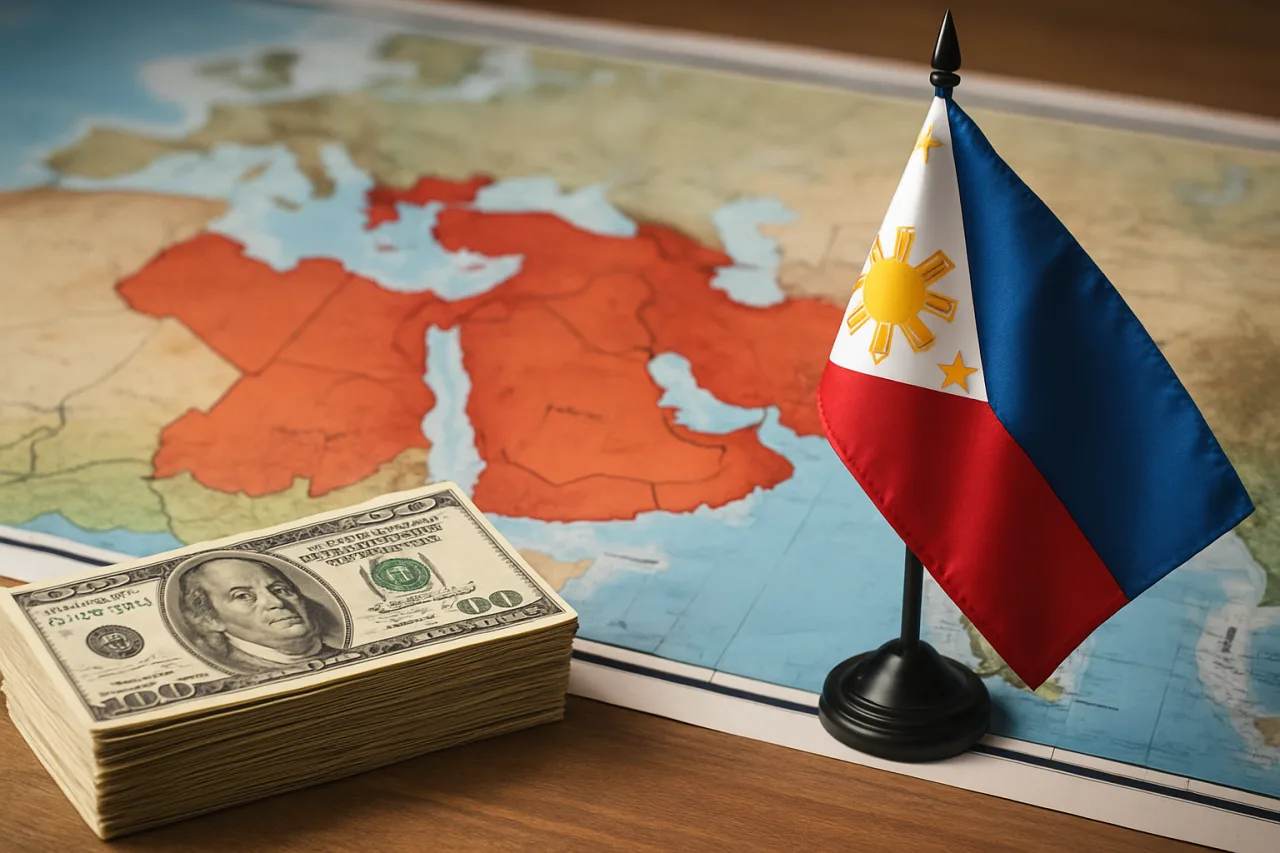
The Gulf sits at the OFW remittances 2026 map’s center of gravity: Saudi Arabia and the UAE together host the largest concentrations of Filipino workers, and the research note this desk tracks (BusinessWorld’s September analysis) models the risk precisely there — the conflict’s escalation paths threatenen shipping lanes, hiring freezes, and evacuation scenarios across economies where remittance sensitivity is highest. The map’s other layers: the US corridor (the largest single-country source) carries minimal war exposure but full sensitivity to US labor-market conditions; the Asia-Pacific corridors (Singapore, Hong Kong, Japan, Malaysia) wobble with regional growth; and the emerging Europe corridors (Poland, Czechia — the newest hiring waves) carry growth upside absent in the legacy lanes.
What escalation changes for OFW remittances 2026, mechanically: not a stop — a RE-ROUTE and a SPEED-UP in cost. Workers leaving a disrupted economy send home final settlements (a one-time bulge); displaced workers re-route through third-country hiring (flows wobble while documents move); and corridor costs spike during disruptions (as any OFW who remitted during the 2020 repatriations remembers). The bank research consensus — flows UP 2.2-2.7% for the year — absorbs those mechanics; the tails beyond its model are the family’s planning problem.
The Twist in the Peso’s Favor
The OFW remittances 2026 year’s quiet gift: the exchange rate. At the ₱62.84 dollar print — versus the mid-62s averages families budgeted on — every dollar sent now converts to roughly 2-4 pesos more than a year ago, depending on the month compared. For a $500 monthly corridor, that is ₱1,000-2,000 of extra buying power per transfer, landing unannounced in the household budget. The family-level arithmetic: a 2.3% flow growth PLUS a ~1.5% effective peso gain PLUS sticky transfer fees = a household purchasing-power path roughly flat-to-up this year DESPITE the 7.2% inflation print — the cushion that made this year’s price shock survivable was currency, not salary.
The honest caveat: the peso’s softness is the same force that makes imports (fuel, food) dearer — the cushion is denominated in the economy’s own stress. But for the remittance-DECIDING family, the operational lesson holds: dollar-earning corridors currently buy more home-currency value than the budget’s assumptions assumed, and that spread is worth capturing in the transfer-timing drill (below) rather than leaving it to luck.
The OFW Remittances 2026 3-Layer Buffer Plan
- Layer 1 — the corridor split (do this week). Keep accounts in TWO receiving banks/channels — a primary and a fallback with a different payout rail. Corridor disruptions historically hit specific rails (one provider, one payout network), not all of them; the split turns a provider outage from a crisis into a same-day workaround. Cost: zero to minimal; the Wise-style digital lane plus one bank lane is the pattern.
- Layer 2 — the two-month float (build over this quarter). A dedicated buffer equal to two months of the family’s fixed expenses, held in the RECEIVING account, not the sending one. It exists to make the family indifferent to a corridor outage and slow to panic-transfer. The remittance-budget tool this desk shipped computes exactly how to fill it from monthly flows at 62.84.
- Layer 3 — the scenario calendar (the quarterly rep). Every quarter: re-read the corridor mix (does the family’s employment sit on a watchlist economy?), re-run the buffer math, and confirm the fallback channel by actually sending one small test transfer through it. A fallback channel untested in peacetime is a rumor, not a plan.
The Scenario Calendar
The dates that change assumptions this quarter: October 23 (BSP’s policy meeting — the rate move that re-prices the peso leg of every corridor decision); each month’s BSP remittance release (the eight-month print lands mid-November — the war-overlay’s first full-quarter test window); and the shipping/insurance headlines tied to Gulf escalation news. On the family calendar: re-run the buffer math the week after each BSP decision — the tool’s exchange-rate input is the only cell that moves, and the drill is five minutes.
The standing desk judgment stays as the year’s close: flows kept rising through every crisis this decade, and the consensus projections absorb the visible risks — the FAMILY’s exposure is not the macro trend but the corridor mechanics, and the three-layer plan above is the honest hedge against exactly that layer. OFW remittances 2026 is a scoreboard that keeps delivering; the planning job is to survive its worst week, not to predict its average year.
The Historical Ledger: What Every Crisis Did to Flows
The “never zero” pattern rests on receipts, not sentiment — the decade’s crisis ledger, kept by the central bank’s own data:
- 2020 pandemic: global lockdowns, mass repatriations — full-year personal remittances FELL only 0.8%, the smallest drop of any major Philippine external flow, and re-rebounded +5.2% in 2021.
- 2022 oil shock: Gulf corridor costs spiked, the peso touched historic lows — flows grew +3.7% through the year as workers sent MORE against weaker pesos (the send-more-when-weak pattern that recurs every peso dip).
- 2023 Gulf hiring freeze scares: deployment news churned; remittances grew +2.9% — redeployment through new corridors (the Europe lane’s rise began here) absorbed the wobble.
- 2024-25 escalation periods: shipping-lane tension and the region’s conflict news — flows held their 3%-ish growth path without a single negative month in the release series.
The ledger’s lesson is mechanical, not optimistic: family wage-transfers behave like infrastructure demand, not like investment flows — they dip briefly, re-route fast, and never dry. THAT is what the full-year consensus (+2.2-2.7%) is really saying: even the cautious models assume the decade’s behavior continues, because in every observed stress it has.
One more scoreboard note worth its own lines: the seven-month growth was earned WITHOUT counting the two crisis bulges this desk expects in the second half’s data — final-settlement surges (when displaced workers leave a disrupted corridor) and re-route spikes (when redeployed workers send from new bases). Both patterns show in the 2020 and 2023 ledgers; both add to, not subtract from, the year’s total. The family planning read: even the cautious +2.2% model likely PRINTS higher if the Gulf’s second half stays eventful — grim mechanism, mechanical result, and exactly why the decade’s scoreboards kept their growth streak through every crisis.
The Send-More-When-Weak Drill: Capturing the Twist
The peso’s soft quarter is a family opportunity with an execution discipline. The pattern the 2022 ledger documents — remitters sending MORE when the peso weakens — can be run deliberately: on any week the dollar print crosses above your family’s budgeted rate (at 62.84, that means any print above the ₱62 level most budgets assumed), the transfer of a PLANNED amount captures the bonus spread; and the discipline is to send the SAME planned amount, not to inflate the transfer because “the rate is good.” The failure mode of rate-timing is budget inflation — the spreadsheet’s job is to pin the planned amount so the drill captures spread, not creates spend.
The quarterly version: if the family’s buffer (layer 2) is already filled, the bonus spread routes to the layer-3 test transfer or to a pre-agreed family investment envelope (the tuition prep fund is the pattern most families choose). The OFW remittances 2026 scoreboard’s currency twist is thus not a market opinion — it is an execution habit with a spreadsheet guardrail, exactly the kind of quiet machinery this desk exists to hand over.
The Corridor-by-Corridor Decision Sheet
Strategy at the family level reads the corridor table, not the world map. The 2026 decision sheet, lane by lane:
| Corridor | War-risk exposure | 2026 behavior | Family action |
|---|---|---|---|
| Saudi/Gulf | High (the escalation epicenter) | Flows holding; hiring news choppy | Layer-1 split NOW; keep documents current; evacuation-benefit literacy (OWWA membership status verified) |
| UAE | Elevated (financial-hub wobble risk) | Steady; the most liquid fallback hub | The natural secondary-employment lane — keep the CV current there |
| US | Low (labor-market risk only) | Largest single source; stable | Standard discipline; rate-timing drill applies |
| Asia-Pacific hubs | Low-moderate | Growth steady, contracts-driven | Buffer math standard; no special overlay |
| Europe (Poland/Czechia) | Low (energy-price passthrough only) | The growth lane — the newest hiring wave | Upside corridor: language/certification investment pays highest here |
The sheet’s reading: the family’s own deployment country decides which row rules — and the Europe row explains why OFW remittances 2026 kept growing despite Gulf anxiety: the system diversifies at the worker level BEFORE it diversifies at the macro level, one redeployment at a time. A family with current skills in two rows runs half the corridor risk of a single-row household — that is the deepest hedge this desk can prescribe, and it costs a course enrollment, not a fee.
The Money-Flow Truths the Panic Posts Miss
Three misreadings circulate in every escalation cycle — each corrected by the release data itself. First, “OFWs are pulling money out”: actually, family-building transfers INCREASE in stress months (the send-more-when-weak pattern) — what changes is investor-class flows, which were never remittances. Second, “the Gulf is collapsing”: Gulf EMPLOYMENT wobbles with each escalation headline, but Filipino worker headcount in the region has been stable-to-growing through 2026 — deployment cycles slow, then resume; existing workers overwhelmingly stay and keep sending. Third, “send everything now while the rate is high”: rate-timing without a budget pin (the drill above) historically moves families MORE cash forward than planned, leaving the buffer thin exactly when stress arrives. The scoreboard disciplines all three: monthly releases, corridor shares, and the decade’s growth pattern — the data IS the calm.
Financial Disclaimer
This article is for general information and education only. It is not financial, legal, or investment advice, and not an offer of any financial product. Corridor and currency observations do not predict future rates or flows. Consult duly registered professionals before making financial decisions. WorldNgayon.com and its writers hold no position in any instrument mentioned as of publication.
FAQ
How much did OFW remittances total in the first seven months of 2026?
$20.39 billion through July per BSP data, up 2.3% from $19.93 billion in the same 2025 window — with wage-driven personal cash transfers carrying the growth.
What is the full-year 2026 projection?
Private bank research holds +2.2% (about $36.4 billion) and the central bank’s own projection runs +2.7% — both assuming the Gulf corridor’s flows hold through the year’s escalation risk.
Does Middle East risk actually threaten remittances?
It threatens specific corridors, not the aggregate: Gulf economies host the largest Filipino worker concentrations, and escalation scenarios there (shipping disruption, hiring freezes, evacuations) would re-route and re-time flows — decades of data show family transfers resume and often bulge after disruptions, via re-routed corridors.
Why does the exchange rate matter to my remittance now?
At ₱62.84 to the dollar, each dollar converts to more pesos than family budgets assumed — a quiet 1.5-2% effective gain on every transfer this quarter; the layering drill (timing transfers after peso-soft prints) captures it deliberately.
What is the fastest buffer step a family can take?
The corridor split: a second receiving account on a different payout rail, funded and TESTED with one small transfer this week. It converts any single-provider outage into a same-day workaround.
Where do I verify the remittance numbers myself?
The Bangko Sentral ng Pilipinas publishes the monthly personal remittances releases on its official site — the primary source for every figure this piece cites.