Table of Contents
TLDR: OFW fake app scam — A 35-year-old Filipino domestic worker in Dubai lost PHP 1,000,000 after downloading a fake version of the Philippine government’s eGovPH app from a WhatsApp link. Scammers impersonated the Department of Migrant Workers to offer fake cash assistance. Here is how these OFW fake app scam operations work and how to verify official government apps.
A 35-year-old Filipino domestic worker in Dubai received a WhatsApp message in March 2025. The sender claimed to be from the Department of Migrant Workers. She qualified, the message said, for a special PHP 15,000 government cash assistance. All she had to do was download the official eGovPH app from a link they provided and verify her identity.
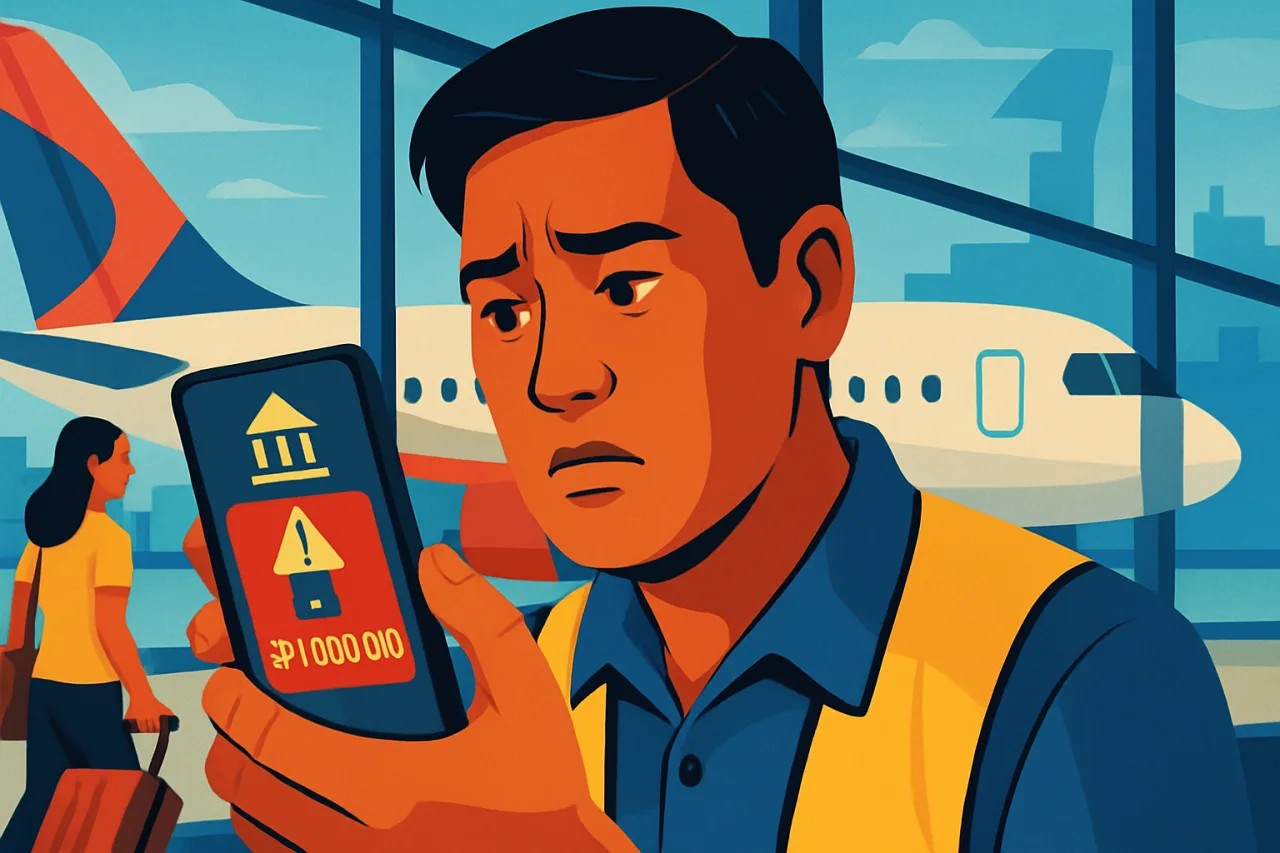
She did exactly that. Within an hour, PHP 50,000 vanished from her bank account. Over the next three days, smaller transfers drained the remaining PHP 950,000. Total loss: PHP 1,000,000 — roughly a year’s salary for many domestic workers in the Gulf.
The app she downloaded was not eGovPH. It was a near-perfect replica, built to harvest banking credentials and One-Time Passwords (OTPs) from victims who believed they were dealing with their own government.
This is the new face of the OFW fake app scam — and it is spreading fast.
OFW Fake App Scam: How Did It Drain PHP 1 Million From a Dubai Domestic Worker?
The Gulf News report (published March 25, 2025) detailed a scam operation with chilling precision. The anonymous victim, a 35-year-old Filipina working as a domestic helper in Dubai, received an unsolicited WhatsApp message from an unknown number. The sender posed as DMW personnel and informed her she had been selected for a special financial assistance program worth PHP 15,000.
The message contained a download link to what appeared to be the legitimate eGovPH mobile application — the Philippine government’s official one-stop portal for services from the DFA, SSS, PhilHealth, and Pag-IBIG.
After installing the fake app, the victim was prompted to enter her online banking username, password, and multiple OTP codes under the guise of “identity verification” to receive the aid. Every credential she entered was captured in real time by the scammers.
Within the first hour, PHP 50,000 was transferred out of her account. Over the next 72 hours, dozens of smaller transactions siphoned the remaining PHP 950,000, dispersed across multiple “money mule” accounts to make recovery nearly impossible. She discovered the theft only when her bank’s fraud alert SMS arrived.
The Philippine Consulate in Dubai issued a public advisory following the incident, warning OFWs to verify any aid-related messages through official consulate hotlines. The Department of Information and Communications Technology (DICT) confirmed that the legitimate eGovPH app is only available on Google Play Store and Apple App Store — never via third-party links sent through messaging apps.
OFW Fake App Scam: Why Fake Government Apps Are a Dangerous New Vector
Previous scam warnings have focused on fake job ads, bogus recruiters, and phishing emails. The OFW fake app scam represents a fundamentally different threat: software that impersonates a trusted government service on the victim’s own phone. This OFW fake app scam vector is particularly dangerous because it exploits the trust OFWs place in their own government.
The eGovPH app is a legitimate tool used by millions of Filipinos to access government services. By impersonating it, scammers bypass the skepticism that typically greets unsolicited offers. A message from “DMW” directing someone to download the “government app” sounds plausible — especially to an OFW abroad who relies on digital services to manage paperwork from overseas.
This is not an isolated case. The Global Anti-Scam Alliance (GASA), which partnered with the DMW in February 2026, has tracked similar “fake government portal” operations targeting OFWs — websites and apps that impersonate PhilHealth, SSS, Pag-IBIG, and OWWA to harvest personal data.
GASA APAC Director Brian Hanley described the pattern as part of a wider transformation: scams have evolved from a “local nuisance into a global cybercrime industry,” requiring government-private sector collaboration to combat.
OFW Fake App Scam: How to Verify a Government App — 6-Step Checklist
Before downloading any app claiming to be from a Philippine government agency, follow these steps:
- Confirm the official download source. Philippine government apps are distributed through Google Play Store and Apple App Store only. Never download from a link sent via WhatsApp, SMS, or Facebook Messenger. The legitimate eGovPH app, for example, lists the “Department of Information and Communications Technology” as its developer on both stores.
- Check the developer name. On Google Play, tap “App info” under the app name. The developer field should match the official government agency. Fake apps often use generic names like “DevTeam PH” or “GovServices.”
- Verify through the official website. Go to the government agency’s actual website (e.g., dict.gov.ph for eGovPH) and look for their official app download link. If it redirects to the Play Store or App Store, you are safe.
- Check the download count and reviews. The real eGovPH app has over one million downloads and thousands of reviews. A fake version will have a low download count, recent upload dates, and generic or suspicious reviews.
- Look for permission requests. Legitimate government apps do not request access to your SMS messages, call logs, or banking apps. If a government app asks for these permissions during setup, uninstall immediately.
- Call the agency directly. Use the official hotline listed on the agency’s website — not a number from the suspicious message. DMW’s 24/7 hotline is 1348. If the offer was real, the agency can confirm it.
OFW Fake App Scam: What the DMW-GASA Partnership Means for OFWs
On February 19, 2026, the Department of Migrant Workers and the Global Anti-Scam Alliance signed a Memorandum of Understanding to combat the rising tide of digital fraud targeting OFWs. The partnership, led by DMW Secretary Hans Leo Cacdac, goes beyond awareness campaigns to address structural vulnerabilities.
The MOU covers cross-border information sharing between governments and private sector partners, research into evolving scam tactics targeting Filipino workers, and direct support pathways for scam victims — connecting them to both aid and legitimate employment opportunities.
For the OFW reading this, the practical takeaway is clear: the government is building better defenses. But individual vigilance remains the first and most important line of protection.
See our detailed breakdown: Global Anti-Scam Alliance: DMW-GASA Deal to Protect OFWs.
OFW Fake App Scam: What to Do If You Have Downloaded a Suspicious App
If you suspect you have installed a fake government app:
- Uninstall the app immediately. Do not open it again. Scraping continues as long as the app is installed.
- Change your online banking passwords from a different device. Do not use the same phone.
- Contact your bank and report possible credential compromise. Ask them to flag your account for unusual activity.
- Report to the DMW 24/7 hotline at 1348 — they can coordinate with Philippine cybercrime authorities.
- File a report with the NBI Cybercrime Division or the PNP Anti-Cybercrime Group (ACG).
- Notify the Philippine consulate in your host country. Consulates have issued advisories on these scams and can assist with local police coordination.
Time matters. Bank reversals are possible for transactions reported within 24 hours. Every hour reduces the chance of recovery.
Related reading: DMW Fake Job Scam Red Flags: 200,000 Ads Removed — 8 Red Flags Checklist.
OFW Fake App Scam FAQ: Answers to Common Questions
Subscribe to WorldNgayon — Get weekly OFW scam alerts, financial guides, and verified remittance tips delivered to your inbox. Subscribe free here.
WorldNgayon may earn a small commission when you use our affiliate links, at no extra cost to you.