Key Takeaway
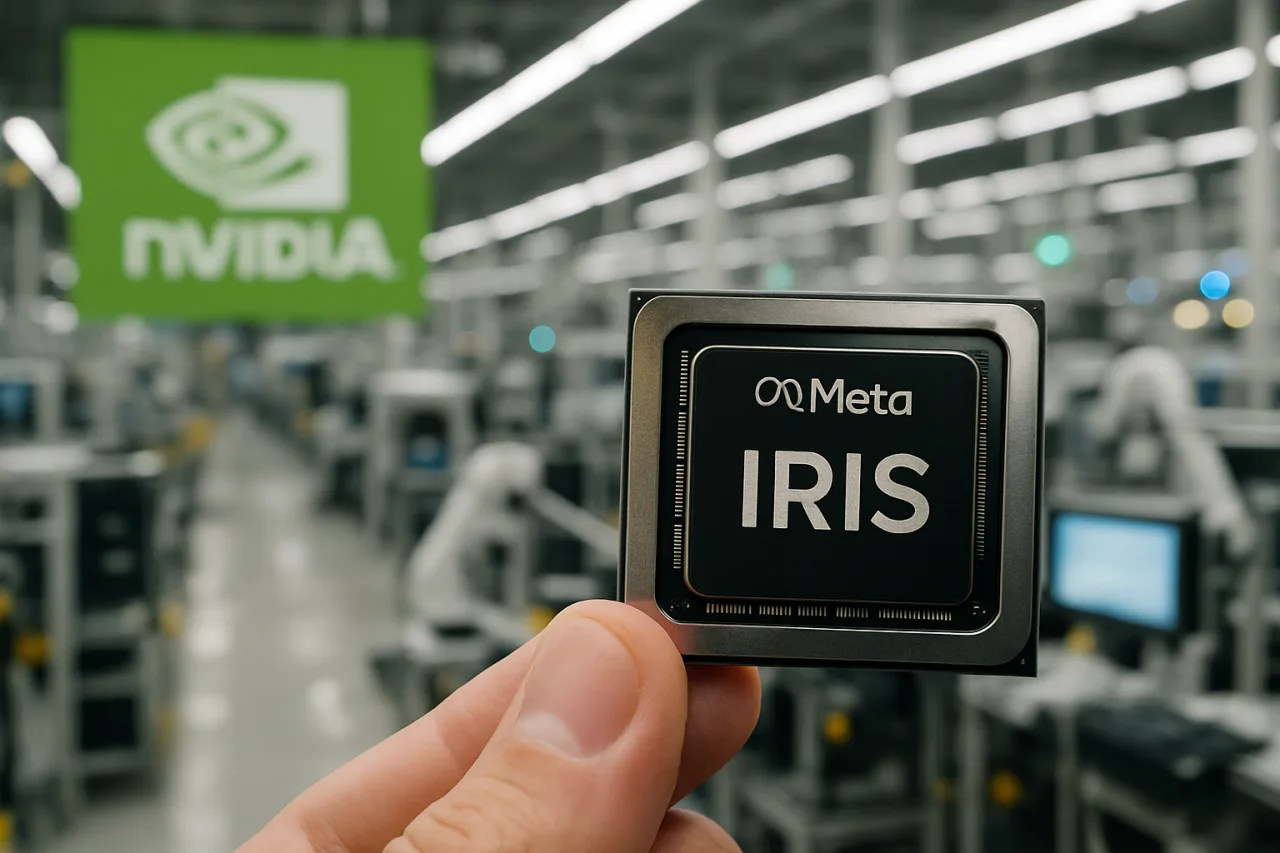
- 🏭 The Meta Iris chip entered production in September 2026, per an internal memo reviewed by Reuters — Meta’s Meta Iris chip accelerator is no longer a slide, it is silicon on a fab line.
- 🎯 The plan: supplement — not replace — the Nvidia and AMD GPUs Meta buys in bulk, while roughly doubling data-center AI capacity to 14 gigawatts by 2027.
- 🧩 Iris sits inside the Meta Iris chip family’s four-chips-in-two-years roadmap (MTIA), with MTIA 500 scheduled for mass deployment in 2027 and Broadcom’s design partnership running through 2029.
- ⚔️ A four-way the Meta Iris chip versus Google TPU, Amazon Trainium, and Microsoft Maia race is now on: Meta’s MTIA against Google’s TPU, Amazon’s Trainium, and Microsoft’s reported Maia 300 — with Nvidia still selling to all four.
- 🇵🇭 Why Filipinos should care: custom-silicon buildouts mean data-center, QA, and hardware-support jobs moving into markets with engineering talent — and GPU price pressure easing for every AI buyer.
For three years, the arithmetic of AI was simple: Meta bought, Nvidia sold. The company that operates the world’s largest recommendation engines also became one of the largest customers of the world’s dominant GPU maker — and paid the prices that came with it. That arithmetic changed this month. The Meta Iris chip, the company’s internally designed data-center accelerator, entered production in September 2026, according to an internal memo reviewed by Reuters. Iris is not a rebellion against Nvidia — it is a hedge, built to move the workloads that don’t need a GPU’s full generality onto chips Meta designs, Broadcom co-engineers, and TSMC fabricates. This guide unpacks the seven numbers behind the move, the four-generation MTIA roadmap, and what the exit plan means for the AI market’s pricing power — and for the professionals who build on top of it.
Table of Contents
What Iris Is — and What It Is Not
The Meta Iris chip is a custom AI accelerator under Meta’s Training and Inference Accelerator program — MTIA — built for a specific job: the ranking, recommendation, and increasingly generative-AI workloads that run Facebook, Instagram, and Meta’s ad systems. The Reuters-reported memo describes it as a data-center AI accelerator rather than a general-purpose GPU, tuned for Meta’s own stack. That distinction is the whole strategy: the company is not trying to out-GPU Nvidia. It is trying to move the enormous, predictable, internally defined slice of its compute onto hardware it controls, and keep GPUs for the training runs and frontier workloads that need their flexibility.
The honesty check matters here: Meta has published real specifications for MTIA v1 (TSMC 7nm, 800 MHz, 102.4 TOPS at INT8, 51.2 TFLOPS at FP16) and confirmed MTIA v2’s roughly 3x generation-over-generation gain across four evaluated models — but has not published Iris’s process node, clock, or throughput figures. Any Iris performance number beyond those anchors is unconfirmed until Meta discloses it. What is confirmed is the plan: manufacturing began in September 2026, per the memo.
The 7 Numbers Behind Meta’s Nvidia Exit Plan
- September 2026: the month Iris enters production, per the internal memo (Reuters, July 9, 2026 exclusive; production confirmed by September press tracking).
- 14 GW: the reported 2027 target for Meta’s data-center AI capacity — roughly double today’s footprint, the number the exit plan must serve.
- 7 GW: the compute infrastructure Meta plans to deploy this year alone, per the memo — the ramp Iris production feeds.
- 4 chips / 2 years: the MTIA cadence — a pace Meta’s own blog titles “Four MTIA Chips in Two Years,” aggressive by any hardware standard.
- 3x: the measured performance jump from MTIA v1 to v2 across four key models — the program’s proof that the bet compounds.
- 2029: how far Broadcom’s co-engineering partnership on Meta silicon reportedly extends — multi-generation commitment, not a one-off.
- 300,000+: the accelerator units Microsoft has reportedly ordered of TSMC capacity for its Maia line — the scale the four-way silicon race now consumes (The Information, unconfirmed by Microsoft).
Inside the MTIA Roadmap: Four Chips in Two Years
Meta’s engineering blog lays out a roadmap where a chip called MTIA 500 is scheduled for mass deployment in 2027, alongside earlier generations already running in production clusters. Some MTIA variants are deployed in Meta’s data centers today, handling inference for ranking and recommendation systems; Iris and the newer chips roll out through late 2026 and into 2027, layering on top of what runs rather than replacing it overnight. The cadence — four distinct accelerator designs in a two-year window — is the loudest signal in the story: most chip programs measure generations in years, not months, and Meta compressing the cycle says how much capital and internal pressure stand behind the de-GPU-fication effort.
The design lineage shows the compounding logic. MTIA v1 was built to balance compute, memory bandwidth, and capacity for serving ranking models — a deliberate spec, not a benchmark chase. MTIA v2’s 3x jump across evaluated models justified the program’s continuation. Iris extends the family toward generative AI inference; MTIA 500 aims at mass deployment in 2027. Each generation buys Meta a larger share of its own workload stack — and each share point is revenue moved off Nvidia’s invoice.
The Four-Way Silicon Race
Meta is late to custom silicon but no longer alone in the chase. Google has run TPU generations for close to a decade across search, ads, and cloud. Amazon’s Trainium and Inferentia chips power AWS AI workloads. Microsoft’s Maia line — with a reported Maia 300 accelerator for internal Azure and Copilot workloads, possibly unveiled as soon as September 2026, and a reported 300,000-unit TSMC order for 2027 delivery — is the newest entrant. Set side by side, the picture is a genuine four-way race among Meta, Google, Microsoft, and Amazon to pull part of their compute stacks off merchant GPUs — while all four remain major Nvidia customers for training and general-purpose work.
Broadcom sits underneath nearly all of it: the company co-engineers custom accelerators for Meta (through 2029, per its investor announcement) and plays the same role for Google’s TPU program, making it one of the few firms with direct visibility into how multiple hyperscalers are approaching custom silicon at once. That position has turned Broadcom’s custom ASIC business into a closely watched proxy for hyperscaler chip spending — the picks-and-shovels trade inside the chip trade.
What It Means for Nvidia — and the AI Market
The honest read is a shift in bargaining power, not a collapse. The Meta Iris chip supplements Nvidia and AMD volume; it does not replace it — the memo says so directly, and Meta’s frontier training still runs on merchant GPUs. But every workload that migrates to MTIA is a workload whose pricing Meta no longer negotiates. Multiply that across four hyperscalers each building their own accelerators, and the structural picture changes: Nvidia’s pricing power on the inference side — the highest-volume slice of AI compute — now faces four credible in-house alternatives, even as its training franchise stays dominant. That is why the market watches Broadcom’s order book as closely as Nvidia’s: the custom-silicon ramp is the new barometer of where AI’s compute dollars flow next.
For the market’s other buyers — the enterprises, startups, and governments that rent rather than build — the effect arrives as price and availability. Hyperscalers reserving their own silicon for internal workloads keeps more merchant GPUs available for everyone else; the supply tightness that defined 2025-2026 eases at the margin as in-house accelerators absorb internal demand. The exit plan’s most underrated consequence: it makes the GPU market more liquid for the people who never had a seat at the custom-silicon table.
What It Means for Filipino Professionals
Three layers. First, jobs: custom-silicon programs need verification engineers, QA specialists, firmware and driver teams, and English-fluent documentation — roles that match Philippine workforce strengths, and that scale with every new chip generation. Second, AI services pricing: as hyperscalers shift inference onto their own silicon, the cost curve of the AI APIs and tools Filipino freelancers and agencies use bends downward — cheaper inference means cheaper products and more margin for service layers. Third, the strategic lesson mirrors what the country’s BPO industry learned two decades ago: whoever controls the infrastructure layer writes the next decade’s invoices. The Philippines does not need a fab to benefit from this race — it needs the professionals who can run, audit, and document the systems these chips serve.
Frequently Asked Questions
What is the Meta Iris chip?
Iris is Meta’s internally designed data-center AI accelerator, part of the company’s MTIA (Training and Inference Accelerator) program. Per an internal memo reviewed by Reuters, Iris entered production in September 2026. It is built to handle Meta’s ranking, recommendation, and generative-AI inference workloads — supplementing, not replacing, the GPUs Meta buys from Nvidia and AMD.
Why is the Meta Iris chip program building its own silicon?
Two pressures drive the program: cost and control. Buying enough merchant GPUs to double AI capacity to a reported 14 GW by 2027 means competing for constrained supply at premium prices; building custom accelerators gives Meta a second lever for the workloads it controls. The MTIA roadmap — four chips in two years, with measured generation-over-generation gains — shows the bet is systematic, not experimental.
Does the Iris chip replace Nvidia GPUs at Meta?
No. The chip is designed to supplement — not replace — Meta’s large volumes of Nvidia and AMD GPUs. Frontier training runs and workloads needing general-purpose flexibility stay on merchant GPUs, while inference-adjacent workloads (ranking, recommendation, parts of generative AI serving) migrate to MTIA-family silicon as deployment expands through 2026-2027.
How does Meta’s Iris compare with Google TPU and Microsoft Maia?
Google’s TPU program is the most mature — close to a decade of production generations. Amazon’s Trainium and Inferentia serve AWS at scale. Microsoft’s Maia line is the newest entrant, with a reported Maia 300 possibly unveiled as soon as September 2026 and a reported 300,000-unit TSMC order for 2027. Meta’s Iris is the newest of the four programs to reach production. All four companies remain Nvidia customers for training workloads — the race is to pull the inference slice in-house.
What is the MTIA 500?
MTIA 500 is the next chip in Meta’s roadmap, scheduled for mass deployment in 2027, per Meta’s own engineering blog. It follows Iris in the four-generations-in-two-years cadence and extends the program’s coverage of Meta’s AI workloads. Meta has not published MTIA 500 specifications; treat any performance claims as unconfirmed until disclosed.
What does this mean for AI prices and AI jobs?
Two directions at once. Prices: more in-house silicon absorbing hyperscalers’ internal inference demand keeps merchant GPUs more available for other buyers, easing the supply tightness that inflated 2025-2026 costs. Jobs: every chip generation needs verification, QA, firmware, and documentation workforces — skills the Philippine tech sector already trains at scale, and roles that grow with each of the four silicon programs now racing.
Final Word: The Rent Is Due — Unless You Own the Machine
The Meta Iris chip entering production is the quietest trillion-dollar story of September: the industry’s biggest GPU customer is now a chipmaker, four hyperscalers are building their own silicon, and the merchant-GPU era’s pricing power meets its first structural check. Nvidia’s training franchise is safe for years; the inference slice — the highest-volume, most-repetitive compute in AI — is where the exit plans aim. For professionals, the race means cheaper tools ahead and a growing verification workforce to build; for the industry, it means the next negotiation between buyers and Nvidia starts with an alternative on the table. That is what the memo said, in one line: supplement, don’t replace — and watch what supplementing does to the price of everything else.