Table of Contents
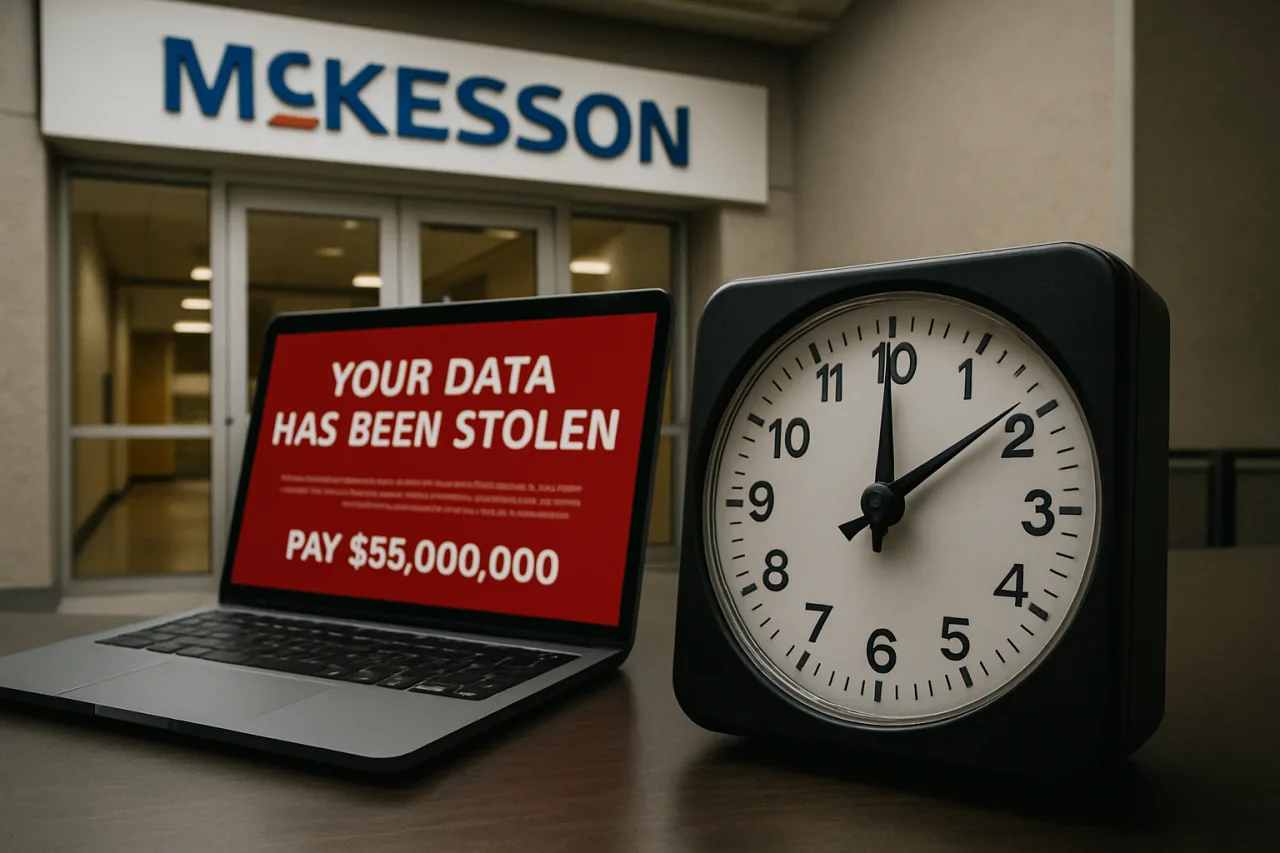
Somewhere on an extortion site, 284 million lines of American patient data are waiting for a clock to run out — and the clock hit its final day on September 1, 2026. The McKesson data breach is no longer a claim from a faceless hacker collective: the healthcare giant has confirmed in a U.S. Securities and Exchange Commission filing that attackers exfiltrated customer data from its systems, while the ShinyHunters extortion group demands $55,236,150 and threatens to dump everything if negotiations do not start by Tuesday.
This essay examines how one of the world’s largest healthcare companies ended up as the biggest extortion target of the quarter, what the attackers say they took, why the raw numbers are being misread across the internet — and what professionals in any industry that touches healthcare data should extract from a breach that was detected on August 25 and disclosed only when the deadline made silence impossible.
What We Actually Know About the McKesson Data Breach
Strip away the hype and the verified record is this. McKesson Corporation — the company that distributes roughly one-third of the prescription medicines used in North American hospitals, pharmacies, and clinics — disclosed in a Form 8-K filing that it detected a cybersecurity incident on August 25, 2026. The incident, the company said, involves unauthorized access to third-party applications and data theft affecting a subset of customers of its Oncology & Multispecialty and Medical-Surgical business units. Initial containment steps appear to have stopped further unauthorized activity, according to BleepingComputer’s breach reporting.
The attacker’s side of the story is louder. ShinyHunters — the extortion brand behind some of the most consequential cloud data thefts of the past half-decade — added McKesson to its leak site with a claim of approximately 284 million patient data records, a $55,236,150 ransom demand, and a September 1 deadline for negotiations, as SecurityWeek confirmed. The group says the haul includes names, addresses, Social Security numbers, medical records, diagnoses, medications, billing information, and details as intimate as terminal illnesses, causes of death, and sexual orientation. McKesson has not confirmed the attacker’s numbers, and the group itself has walked back the framing once already.
The 284 Million Number Everyone Is Getting Wrong
Here is the nuance most headlines missed. When ShinyHunters first listed the trove, coverage everywhere repeated “284 million patient records.” The group subsequently clarified to BleepingComputer that the figure is a raw count of data rows — lines in a database — not unique patients. As the HIPAA Journal’s analysis notes, even a fraction of that volume is a serious breach, but 284 million rows could represent tens of millions of individuals with multiple records each, not a quarter of a billion distinct humans.
Why does this distinction matter more than pedantry? Because breach arithmetic drives everything that follows: the regulatory penalty calculus, the class-action exposure, the credit-monitoring costs, and — most immediately — the credibility of the extortionist’s ask. A $55 million demand priced against 284 million individuals is a different negotiation than one priced against raw rows belonging to perhaps a tenth of that. The ransom number tells us how the attackers value the data; the true harm depends on how many people it actually describes. Both sides in an extortion standoff have an incentive to inflate, which is why the SEC filing — not the leak site — remains the only document worth building decisions on.
Why Healthcare Data Is the Crown Jewel of Extortion
A stolen credit card can be cancelled in minutes. A stolen medical record cannot be reissued. The dataset ShinyHunters claims includes diagnoses and medications that follow a patient for life, which is why healthcare records trade at multiples of financial data on criminal markets. Extortion groups have learned that a hospital supplier’s leaked oncology files carry a particular kind of terror: the threat is not merely identity theft, but the exposure of diagnoses patients never shared with their own families.
McKesson sits at an especially painful junction of this market. As a distributor connecting pharmaceutical manufacturers with hospitals, pharmacies, and the Health Mart franchise network, it holds the connective tissue of American healthcare — and, per ShinyHunters’ claims, a separate haul from a Salesforce environment alongside the clinical data. The group’s playbook, refined across prior cloud-data campaigns, is to time disclosure for maximum pressure: strike on a weekend, file the deadline for a Tuesday, and let the target’s own regulatory clock do the negotiating.
This is not an isolated pattern, and neither is the economics behind the McKesson data breach. Our previous coverage of the Crimson Collective extortion playbook and the record ASEAN breach costs documented by IBM both trace the same economics: attack the supplier, not the fortress; price the ransom below the breach’s litigation exposure; and weaponize disclosure deadlines that regulators themselves set. The McKesson data breach is the template at industrial scale.
The BPO and Outsourcing Dimension Nobody Is Discussing
For Filipino professionals, there is a second story inside this one. The attack vector — unauthorized access to third-party applications — is precisely the layer of the healthcare stack where global outsourcing lives: revenue-cycle management vendors, CRM platforms, data-analytics providers, customer-support portals. Manila’s healthcare-information-management sector serves exactly these environments, which means a breach at a U.S. distributor is also a stress test of every offshore team that touches its systems — and a reminder of why the Philippines’ national cybersecurity bill matters to the sector’s future.
The professional lessons are unglamorous but non-optional. Vendor access should be scoped to the minimum dataset that makes a contract function — the oncology business unit’s exposure suggests that was not the case here. Multi-factor authentication on third-party portals remains the cheapest control that defeats the most campaigns. And when a platform like Snowflake or Salesforce appears in an attacker’s claim list, the first question is never “is the cloud broken?” but “which integration held the keys?” — the same question that ran through our analysis of the Oracle WebLogic emergency patching cycle, where the gap between vulnerability and exploitation was measured in hours.
What Happens Next: The Disclosure Machine
Assuming no payment, the machinery of American breach law now takes over. McKesson must file formal HIPAA breach notifications with federal regulators within 60 days of the incident’s discovery, which places the deadline in late October 2026. Plaintiffs’ law firms began soliciting affected individuals within days of the disclosure, following the pattern set by previous extortion cases. The company has not yet determined whether the incident is material — a legal judgment that will shape its quarterly disclosures — and its investigation remains, by its own description, in early stages.
The deeper question is what the McKesson data breach does to the extortion market’s appetite. Every refused or delayed ransom is a signal to the next group choosing targets; every payout is a business model endorsement. ShinyHunters’ decision to publish a precise dollar figure — $55,236,150, down to the dollar — is itself messaging, a statement that the demand was calculated from the target’s own financials rather than invented. Whether the company pays will likely never be confirmed. Whether the data leaks may be a matter of days.
The Uncomfortable Lesson for Every Professional
Strip away the healthcare specificity and the McKesson data breach lands on a question every organization should ask this week: if an extortion group published your third-party vendor list tomorrow, which integration would embarrass you most? The era when a breach was an IT problem ended years ago. What remains is a governance problem with a countdown clock — and the targets that survive the next ShinyHunters campaign will be the ones that treated their data supply chain with the same paranoia they reserve for their front doors.
The McKesson data breach deadline has now passed as you read this. Watch the leak sites, watch the SEC filings, and watch which executives use the word “material.” The next 284 million rows are already being priced somewhere.
A Board-Level Reading of the 8-K Filing
Professionals who want to read breaches like an insider should study what McKesson chose to say, and when. The Form 8-K is a short document, but every clause carries weight. The company said the investigation is in early stages — legal language that preserves flexibility on every future statement. It said the incident appears to involve a subset of customers of two named business units — a scoping statement that will be tested against whatever the attackers actually publish. And it said McKesson has yet to determine whether the incident is material — perhaps the most consequential sentence of all, because materiality determinations trigger shareholder disclosure obligations that outlast any ransom negotiation.
The sequencing tells its own story. Detected August 25. Extortion listing with a Tuesday deadline. SEC filing on Friday, August 29, one business day before the deadline expired. The McKesson data breach disclosure was therefore not voluntary transparency in any ordinary sense — it was the intersection of a leak-site countdown with securities law. Companies that disclose only when clocks force disclosure pay a credibility premium afterward, and the market for breach-related litigation has learned to price that premium in. The McKesson data breach will now run on two parallel timelines: the attackers’ publication schedule and the regulators’ 60-day HIPAA window. Neither cares about the company’s preferred news cycle.
The Extortion Economy Has a Price List Now
Zoom out from this single incident and a market structure comes into focus. Extortion groups in 2026 no longer behave like vandals; they behave like structured businesses with target lists, pricing models, and negotiation windows. The same leak-site ecosystem that lists McKesson also lists an education-technology company with a claimed 275 million records, a gaming company with 78.6 million, and an e-commerce platform whose breach drew a nine-figure regulatory fine — all per the tracking databases security researchers now maintain as a matter of routine. Demands are computed, not guessed: ShinyHunters’ 5,236,150 figure against McKesson carries the signature of a number derived from the target’s own financial scale rather than a round-number bluff.
That professionalization is the real headline inside the headline. When ransom demands are priced off public filings and deadlines are tuned to regulatory calendars, every boardroom should update its assumption about who is on the other side of the network. The adversary doing reconnaissance on your vendor stack tonight is not an opportunistic teenager — it is an analyst with a spreadsheet and your industry’s average settlement value in a cell.
Frequently Asked Questions About the McKesson Data Breach
What happened in the McKesson data breach?
McKesson, the largest U.S. healthcare distributor, disclosed a cybersecurity incident first detected on August 25, 2026, involving unauthorized access to third-party applications and data theft affecting a subset of customers in its Oncology & Multispecialty and Medical-Surgical units. The ShinyHunters extortion group claims it stole approximately 284 million patient data records and is demanding a $55,236,150 ransom, threatening to leak the data after a September 1 deadline.
Did ShinyHunters really steal 284 million patient records?
The 284 million figure refers to raw data rows, not unique patients — a distinction ShinyHunters itself confirmed to BleepingComputer. The real number of affected individuals is likely far lower, though still substantial. McKesson has not verified the attacker’s count, and the company’s SEC filing does not quantify the stolen data. Treat any precise victim count as unconfirmed until formal HIPAA notifications arrive.
What data was stolen from McKesson?
According to ShinyHunters’ leak-site listing, the trove includes names, addresses, Social Security numbers, medical records, diagnoses, medications, billing information, and highly sensitive details such as terminal illnesses, causes of death, and sexual orientation. The group also claims a separate haul from a Salesforce environment, totaling roughly one terabyte. McKesson has not confirmed the contents.
Did McKesson pay the $55 million ransom?
There is no evidence of payment as of September 1, 2026. McKesson has confirmed the incident through an SEC filing but has not publicly engaged with the ransom demand. The company’s silence, combined with its early-stage investigation language, suggests it is following the disclosure-first playbook — but whether negotiations occurred privately may never be disclosed.
What should patients do after the McKesson breach?
Assume phishing will surge using breached names and diagnoses as bait, and never act on urgent healthcare-related emails requesting credentials or payments. Place a credit freeze with the major bureaus if Social Security numbers surface in the confirmed breach scope. Watch for the formal HIPAA notification letters expected by late October 2026, which will define eligibility for any credit-monitoring or compensation programs.
Why are healthcare companies such frequent breach targets?
Medical records cannot be cancelled or replaced like payment cards, so they command premium prices on criminal markets for years after a breach. Healthcare organizations also operate sprawling networks of third-party vendors — exactly the layer exploited in the McKesson incident — which multiplies the attack surface faster than security budgets grow. The combination of valuable data and expanding vendor access makes healthcare the most consistently profitable target in the extortion economy.
Cybersecurity disclaimer: This analysis is for informational purposes only and does not constitute legal, medical, or security advice. Organizations affected by the McKesson data breach should follow official notifications and consult qualified security professionals before acting.