Table of Contents
Key Takeaway
- 🧭 Two doors, one system: The Japan SSW visa path has two stages — SSW(i) caps your stay at five total years, while SSW(ii) renews with no limit and lets your spouse and children live with you.
- ✅ The entry bar: Be 18 or older, healthy enough to work, and able to do the job immediately — proven by a sector skills test plus a Japanese language test (JFT-Basic or JLPT) for Type 1.
- 🏭 16 fields: Work runs across 16 specified industries — nursing care, food service, construction, agriculture, accommodation and more — with a few fields accepting only Type 1.
- 📅 Philippine test calendar: The official JFT-Basic schedule for the Philippines runs October 3–30 and November 4–15, 2026 — sessions fill on a first-registered basis.
- 📌 The shortcut that matters: TIT (Technical Intern Training) completers move into SSW(i) in the same field without retaking the skills or language tests.
The Japan SSW visa route is Japan’s answer to a labor market that cannot fill its own jobs — a legal door for foreign workers who already carry the skills to start immediately, with no training period required. Launched in 2019 as a Status of Residence rather than an ordinary visa, the Specified Skilled Worker system now covers 16 industries and has become the main long-term foreign-work option for Filipinos outside the professional visa lanes.
The appeal is structural: five years of stay under Type 1, no stay limit under Type 2, and a documented path for a family to follow you to Japan.
This guide maps the route as the Japanese government publishes it — the two-types structure, the 16 fields, the tests, the schedules Philippine applicants are sitting in right now, and the application mechanics from Manila to a stamp at a Japanese airport. Every rule below traces to the official MOFA overview and the exam page with the Philippine schedules, checked this week and the Immigration Services Agency’s Specified Skilled Worker support site, checked this week.
What the Japan SSW Visa Is
Start with the technical distinction the official overview insists on, because it shapes every step after it. Japan separates the permission to enter from the permission to work: the visa is issued at a Japanese embassy, and the Status of Residence is granted by the Immigration Services Agency of Japan when you arrive and clear immigration.
The Specified Skilled Worker classification — SSW — is a Status of Residence. In daily use, Filipinos call the whole package the Japan SSW visa; the paperwork actually runs on two tracks with two agencies.
The system opened in 2019 for workers in sectors with serious labor shortages. It differs from the Technical Intern Training (TIT) program that many Filipinos already know: TIT is designed as skills transmission — you learn in Japan, then carry the skills home — while SSW is designed as immediate employment, for people who can work from day one without receiving any particular training.
That difference matters for eligibility. A SSW applicant must be over 18 years old, in good health, and already equipped with the occupational skills the job requires immediately. There is no apprenticeship period built into the admission; the skills test and the language test exist precisely to prove you need none.
Japan SSW Visa Requirements: Type 1 vs Type 2
The two types have different lives attached, and choosing wrong at registration shapes your whole timeline. The official comparison:
| Rule | SSW (Type 1) | SSW (Type 2) |
|---|---|---|
| Period of stay | Up to 5 years in total | No stay limit, renewable |
| Skills standard | Confirmed by exams — TIT(ii) completers exempt | Confirmed by exams |
| Japanese language | Confirmed by exams (JFT-Basic or JLPT) | No test requirement |
| Family | Basically not permitted | Spouse and children allowed when requirements are met |
| Support | Support from the Accepting Organization or a Registered Support Organization | Work experience may be required to take the exam |
Type 1 also carries obligations on the employer side: the Accepting Organization — or a registered support agency it contracts — must provide the statutory support set for SSW(i) workers. Type 2 drops the language test and the support scaffolding but demands deeper proficiency, which is why it functions as the long-haul stage for workers who have already proven themselves under Type 1.
One more eligibility note the forums get wrong: the official requirements text sets the floor at 18 with a health standard, and no upper age cap appears in the published rules. The binding constraints in practice are the exams, the health check, and the employer’s own standards — not a Japanese age ceiling on paper.
The 16 Fields and Where Filipinos Fit
Work under the system runs across 16 specified industrial fields — nursing care, food service, construction, building cleaning, agriculture, accommodation, manufacturing, automobile repair, aviation, shipbuilding and ship machinery, among others. Within that map, a handful of fields accept only Type 1 workers: Nursing Care, Automobile Transportation Business, Railway, Forestry, and Wood Industry.
The Philippine angle is direct. Filipinos deploy across the caregiving, food service, manufacturing and agricultural lanes at scale, and the embassy-side information for Filipinos — Japan maintains the SSW hub in Filipino at the Philippine embassy — covers which fields accept Filipino applicants and the recruitment routes that start from Manila. Fields like long-term care carry their own dedicated skills tests run through Prometric, with application portals separate from the language tests.
Our existing guides cover the destination economics in detail — the Japan OFW guide maps the visa doors and the year-one salary math, and the multi-country salary guide prices nursing-care and service work in pesos. The piece you are reading is the entry rules piece; those two carry the money math.
How Filipinos Take the Japan SSW Visa Tests
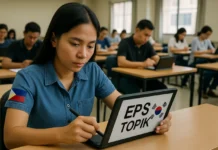
Type 1 requires two exam lanes: a Japanese language test and a skills proficiency test. The language lane accepts either the Japan Foundation Test for Basic Japanese (JFT-Basic) or the Japanese-Language Proficiency Test (JLPT) — passing either confirms the daily-life-and-workplace Japanese the rules require.
The skills lane runs per field: long-term care, for example, is a dedicated Prometric-administered exam with its own application portal. Both tests cost money, set per test, and the skills exam for your chosen field is scheduled through its own administering body.
The calendar Philippine applicants need right now, from the official exam page: JFT-Basic sessions in the Philippines run October 3–11, 13–23, 25 and 27–30, 2026, then November 4–6, 8–13 and 15, 2026. In-Japan JFT-Basic sessions run through November as well, and the JLPT’s next Japan sitting is December 6, 2026 — Filipino applicants inside Japan have those in-Japan dates as an additional lane. The skills-test calendars differ by field, so the exam page’s per-field links are the working checklist.
Preparation guidance follows the exam shape. The JFT-Basic tests communicative daily-life Japanese rather than academic grammar — the official JFT-Basic materials and sample questions define the band you need — while the skills tests sample the actual trade: caregiving candidates face care-procedure items, food-service candidates face hygiene and service items. An applicant who studies the field exam’s published sample set first spends prep time on the right questions.
The Japan SSW Visa Application Route from the Philippines
The path from Manila to a Japanese workplace runs in a sequence, and the sequence matters more than the paperwork volume:
- 1. Learn the field requirements. Confirm your target field’s skills exam, its schedule, and the language test you will sit (JFT-Basic or JLPT).
- 2. Pass both tests. The passing documents are the currency of the application — carry the results certificates.
- 3. Sign with an employer — directly or through the lawful Philippine recruitment channels, since deployment from the Philippines runs under the government-to-government and licensed-agency frameworks.
- 4. Secure the Certificate of Eligibility and visa. The employer-side sponsorship supports the Certificate of Eligibility application in Japan; the visa issuance happens at the Japanese embassy in Manila, and the Status of Residence lands at arrival.
- 5. Arrive into support. Type 1 workers receive the statutory support package — housing assistance, orientation, and follow-up from an Accepting or Registered Support Organization.
Two caution notes run through every applicant thread: never use unauthorized brokers (the licensed-agency list is verifiable on the DMW side), and keep test-result originals — replacement certificates are the slowest document to re-issue mid-application.
What Changes at SSW Type 2
Type 2 is the upgrade lane. A Type 1 worker building toward Type 2 faces a harder skills exam — Type 2 proficiency — and may need documented work experience to sit it, but the reward structure is substantial under the official rules: no more stay limit, no more language test, and family accompaniment for a spouse and children when the requirements are met.
In fields that only accept Type 1 workers — nursing care, automobile transportation, railway, forestry and wood — Type 2 does not exist, which is why field choice at the start quietly decides whether the no-limit endgame is even on the table.
A second path into Type 1 exists and cuts the exam load entirely: workers who completed Technical Intern Training (ii) successfully can transfer into SSW(i) within the same field without taking the skills or language tests — the three-year investment in TIT converts directly into the five-year SSW runway. Those who switch fields still sit the new field’s skills exam.
The Documents Filipino Applicants Prepare
The official application documents page for the Specified Skilled Worker system lists the full set, and the Filipino version of that list runs through two agencies — the Japanese-side documents and the Philippines-side records that travel with you. The working checklist most applicants assemble:
- Passport — valid through the application window, with the data page matching every downstream form exactly.
- Exam result documents — the JFT-Basic or JLPT certificate and your field’s skills-test result, both originals.
- The employment contract — your signed terms with the Japanese employer, including the support terms for Type 1.
- Certificate of Eligibility paperwork — assembled on the Japan side through the employer and the registered support organization.
- Philippines deployment records — the clearance and agency documents that the government-to-government and licensed-agency route requires on the Philippine side.
Keep one original set and one certified-copy set in separate folders. The Japan SSW visa application chain runs through two countries and two agencies — the applicants who clear it fastest are the ones whose documents match each other field by field, because mismatches between the passport and the forms are the most common point of delay.
Japan SSW Visa Costs and Pay: Reading the Numbers
The honest cost picture has three layers. Exam fees: the language and skills tests each carry a fee set by their administering bodies — check the current amounts on the official JFT-Basic and per-field exam pages when you register, because fees update. Processing: the Certificate of Eligibility and visa issuance carry standard embassy and agency fees. Living-the-route costs: recruitment must be lawful — Philippine-licensed agencies publish their placement fees, and Japan-side costs like housing are partially covered by the Type 1 support structure.
On pay: published wages vary widely by field and employer, which is why we keep the honest math in dedicated pieces rather than quoting averages here — the OFW salary guide prices Japan work in peso terms from official-rate bases, and the Japan OFW guide walks the salary lines and the demand lanes for Filipino workers in Japan.
The structural point for planning: Type 1’s five-year cap turns every Japan plan into a decision tree — either you build toward Type 2 in a field that allows it, or you bank the five years and return, and the salary math changes depending on which branch you take.
The Japan SSW visa route rewards preparation more than it rewards paperwork. Pick the field first — it decides the skills exam and whether Type 2 exists for you — sit JFT-Basic while Philippine sessions are on the calendar, and enter through the lawful recruitment lane. The documents that unlock Japan are the two exam certificates and one clean employer contract; everything else follows from them.
Frequently Asked Questions
What is SSW visa in Japan?
SSW — Specified Skilled Worker — is a Japanese Status of Residence for foreign workers in 16 labor-shortage industries. It requires being 18 or older, in good health, and able to work without training, proven through a sector skills test and (for Type 1) a Japanese language test.
What are the Japan SSW visa requirements for Filipinos?
The official requirements: age 18 or older, good health, a passed skills proficiency test in your field, and a passed Japanese language test (JFT-Basic or JLPT) for Type 1. TIT(ii) completers in the same field skip both tests. The Philippine exam schedules run on the official ssw.go.jp exam page.
What is the Japan SSW visa salary like?
Pay varies by field, region and employer. Our salary guide converts Japan earning lines into peso terms from official exchange-rate bases, and the Japan OFW guide maps the salary ranges and recent visa-fee changes — Type 1 caps the stay at five years, so salary planning should assume a finite runway or a Type 2 build.
Is there a Japan SSW visa age limit?
The published requirements set the floor at 18 years old and apply a health standard. No upper age limit appears in the official rule text — the practical gates are the exams, the health check and employer standards.
How much does the Japan SSW visa cost?
Costs run in three layers: the language and skills test fees (set per test by the administering bodies), the standard Certificate of Eligibility and visa fees, and lawful recruitment placement fees published by Philippine-licensed agencies. The exam page links each test’s current schedule and fee information.
What are the SSW Type 2 (SSW 2) requirements?
Type 2 requires passing the Type 2 skills proficiency exam in your field, and work experience may be required to take it. There is no language test at Type 2, no stay limit, and spouse and children can accompany the worker when requirements are met. Fields that only run Type 1 — nursing care, automobile transportation, railway, forestry and wood — have no Type 2.
Can SSW workers bring their family to Japan?
Under Type 1, family accompaniment is basically not permitted. Under Type 2, a spouse and children can live with the worker when the requirements are met — one of the core reasons workers build toward the Type 2 exams.