Table of Contents
Key Takeaway
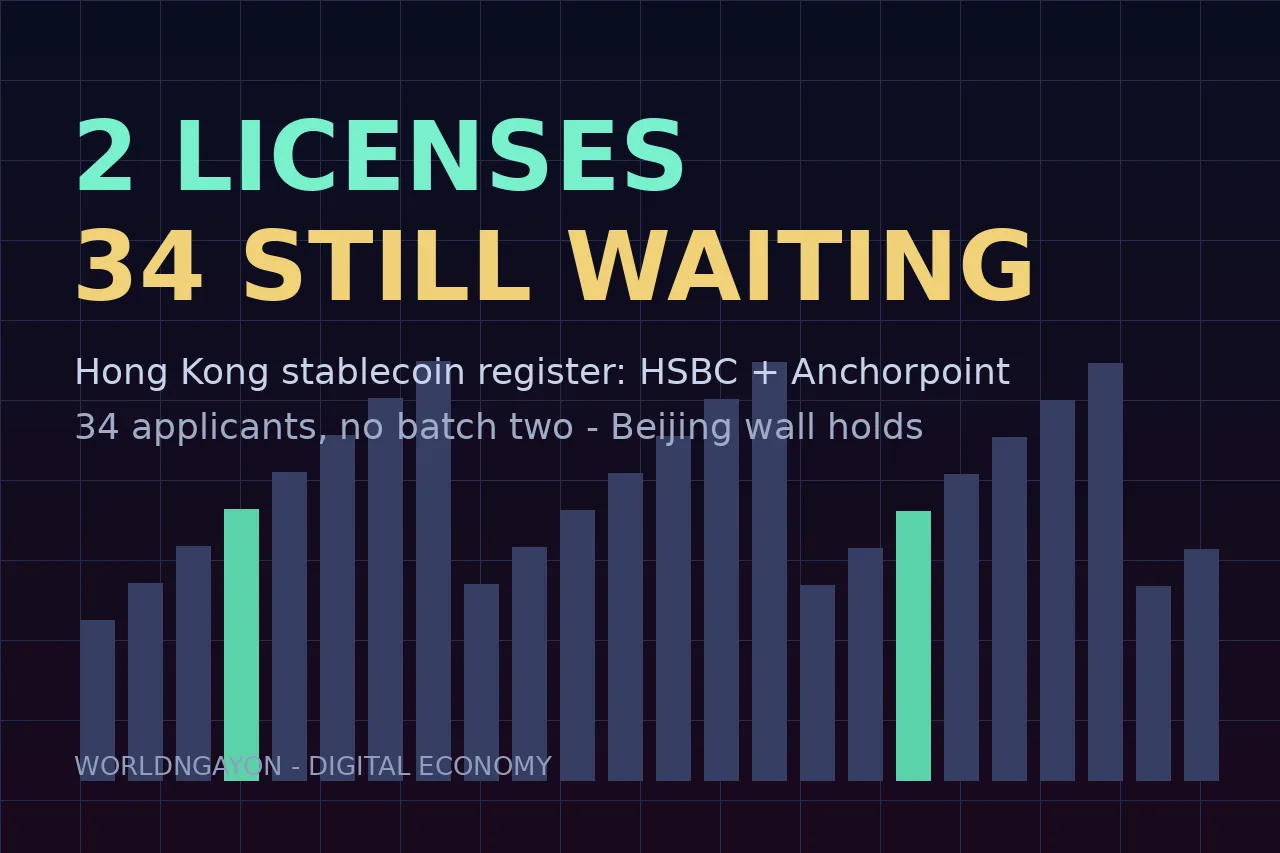
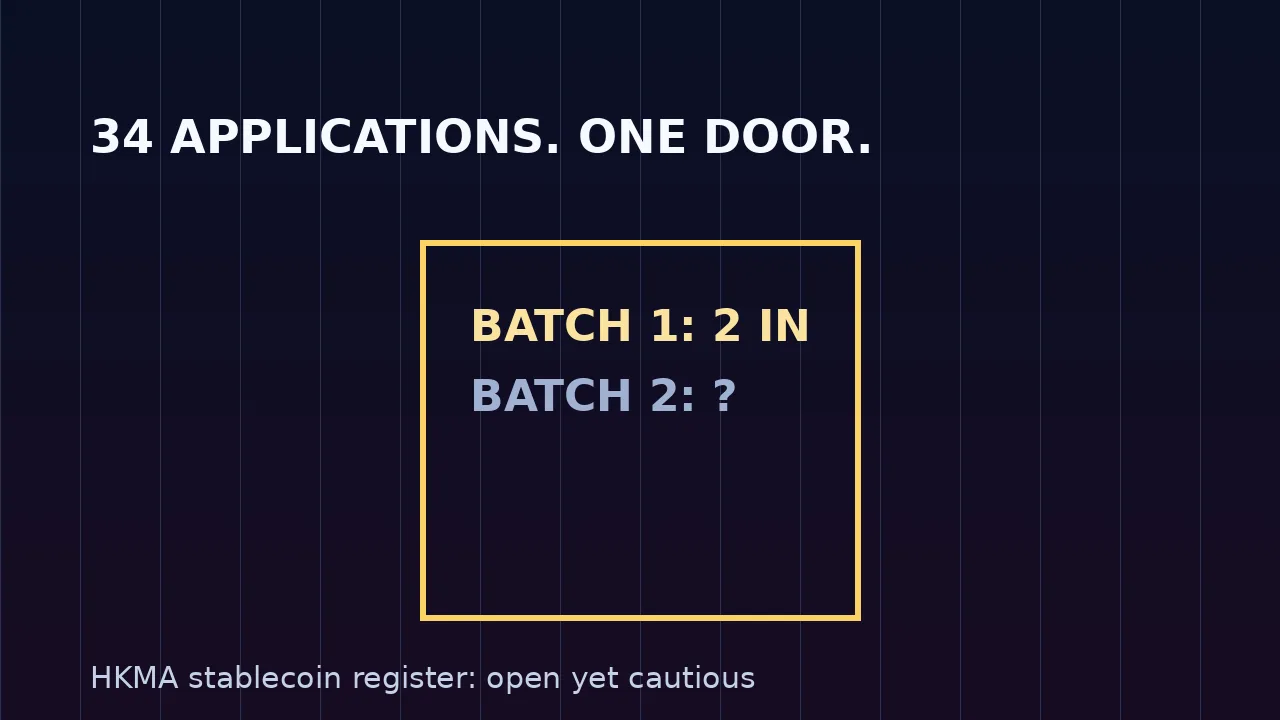
- Only two Hong Kong stablecoin issuer licenses exist — HSBC (FRS02) and Anchorpoint Financial (FRS01), both effective April 10 — while 34 applicants remain in the queue with no batch-two in sight.
- The Hong Kong Monetary Authority says it is “open yet cautious”: further approvals wait on how the first two issuers actually perform.
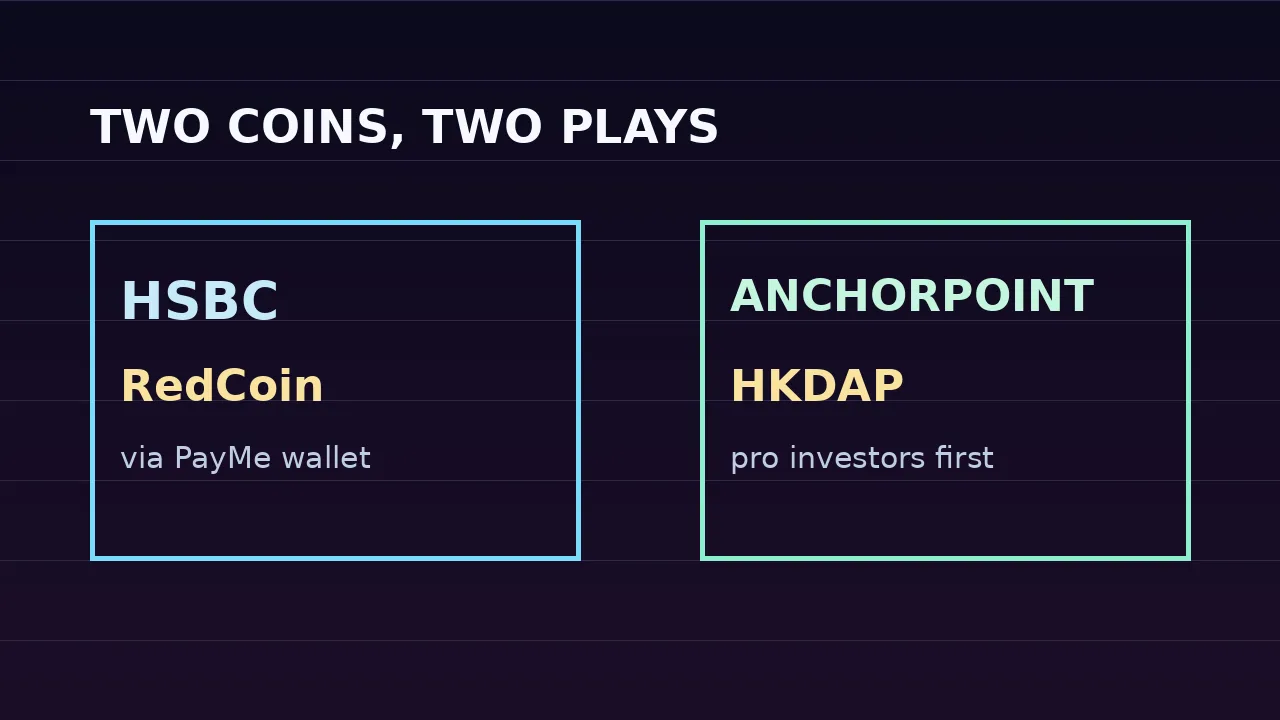
- HSBC named its Hong Kong stablecoin HKD coin “RedCoin” on September 30, with a second-half launch through PayMe; Anchorpoint is testing its HKDAP token with professional investors.
- Beijing’s shadow is the real filter: a joint eight-agency notice bars unauthorized yuan-pegged coins, and last October regulators froze Ant Group’s and JD.com’s HK stablecoin plans entirely.
A Register With Two Names on It
The Hong Kong Monetary Authority maintains a public register of licensed stablecoin issuers under the Stablecoins Ordinance, Cap. 656. It is a short document. Two Hong Kong stablecoin issuers: Anchorpoint Financial Limited and The Hongkong and Shanghai Banking Corporation Limited, both licensed on April 10 this year. Both issue Hong Kong-dollar pegs — a Hong Kong stablecoin sector that exists so far only in HKD, by design — Anchorpoint’s HKDAP, HSBC’s forthcoming RedCoin announced September 30 for a PayMe-limited second-half launch.
Thirty-six Hong Kong stablecoin applications arrived after the ordinance took effect on August 1 last year. Thirteen months later, two have cleared. The other 34 remain in what is now the region’s most-watched regulatory queue — watchable, because the answer defines who gets to mint regulated digital dollars in Asia’s offshore capital.
Why the Queue Is Moving Slowly
The HKMA’s public stance is deliberate: “open yet cautious.” A spokesperson put it in August: the priority is working with the licensed issuers, observing their use cases, business operations and market reception — then considering more. Rumors of an October 1 batch were denied by silence. The bar itself is steep: HK$25 million minimum paid-up capital, 1:1 reserves in high-quality liquid assets held separate from operational funds — capital requirements the regulator itself calls among the region’s highest, and higher than Singapore’s.
The Beijing Wall Behind the HKMA Window
Every applicant design choice bends around one fact: the February joint notice from the PBOC and seven other agencies bars unauthorized yuan-linked stablecoins onshore and offshore, warning that no firm may issue a renminbi-pegged coin abroad without approval. That is why both licensees built HKD pegs, not CNY. It is also why the loudest names in the applicant pool went quiet: last October, the Financial Times reported that Ant Group and JD.com paused their Hong Kong stablecoin plans after instructions from Chinese regulators, who warned that private currency-like issuance blurs the line between fintech and sovereign monetary policy — and overlaps the e-CNY, which remains the cornerstone of Beijing’s payments strategy.
The Market Hong Kong Is Really Building
Separately, Hong Kong’s finance chief has promised a virtual-asset licensing bill this year covering trading, custody, advisory and management services, and the Policy Address instructs the SFC to promote trading of regulated stablecoins on licensed platforms. Infrastructure remains thin. But the direction is set: regulated coins trading on regulated rails, in a city that anchors offshore RMB — a hedge Beijing appears willing to tolerate precisely because it stays inside HKD.
Inside the Two Licenses That Did Land
Both winners were chosen for how unexciting they look on paper. Hong Kong stablecoin regulation rewards exactly that. HSBC brings deposit-grade balance sheets and clears the capital bar walking; Anchorpoint Financial — the Standard Chartered, HKT and Animoca Brands joint venture headquartered in the Standard Chartered Building on Des Voeux Road — brings bank credibility, telecom distribution and Web3-native engineering into one licensee. FRS01 and FRS02 were not lottery tickets; they were the two applications a regulator could defend approving first.
Their build-outs are already diverging. HSBC named RedCoin on September 30 and aims it first at PayMe, a consumer wallet with millions of Hong Kong users — distribution-first strategy, mint later. Anchorpoint began testing HKDAP with select professional investors in August — market-first strategy, consumer later. The HKMA gets to observe two different product philosophies before deciding what batch two looks like. That is not indecision; that is the experiment running as designed, and it is why every Hong Kong stablecoin analyst keeps quoting the same spokesperson line about observing use cases and market reception.
A Queue Built for a City That Prices Policy
Hong Kong’s licensing bottleneck is not bureaucratic slack — it is the product. The city sells itself to global finance as the place where China-adjacent risk is priced honestly, and a Hong Kong stablecoin regime that approved everything at once would signal the opposite of prudence. The HKMA’s HK$25 million paid-up capital floor and 1:1 segregated reserves in high-quality liquid assets are set deliberately above Singapore’s S$1 million-or-opex benchmark. The message to the 34: the entry ticket is expensive because the experiment cannot afford a failure.
The queue itself becomes a signal market. Batch-two speculation swelled twice — once around the ordinance’s first anniversary, once before the October 1 National Day holiday — and both times the regulator declined to move. Each non-announcement repriced the odds on every applicant in the queue. Institutions that trade policy outcomes, and Hong Kong has more of them per square kilometer than anywhere, now have a clean instrument: the gap between the two registered names and the 34 waiting ones.
RedCoin, PayMe, and the Distribution Problem
HSBC’s RedCoin announcement deserves more attention than the name choice. Launching through PayMe means distribution before minting: a Hong Kong stablecoin that arrives inside a wallet millions of residents already use daily does not need an education campaign — it needs a use case. PayMe’s peer-to-peer and bill-payment rails give RedCoin Day One transaction volume that most stablecoins spend years buying. The cost is constraint: a wallet-limited launch is a walled garden, and the HKMA will read early traction inside those walls as the experiment’s honest data.
Anchorpoint’s HKDAP path inverts it: professional investors first, consumer access later. Both approaches feed the same regulator dashboard — real transactions, real redemption behavior, real reserve management — which is exactly the evidence batch-two approvals wait on. A queue that moves at all will move after these two products live in the wild for a couple of quarters.
The Yuan Question Nobody in HK Answers Directly
Every Hong Kong stablecoin pitch eventually meets the same question: where is the yuan coin? The answer is never spoken aloud in the territory. The February joint notice from the PBOC and seven other agencies — the same eight that reaffirmed the crypto ban — bars unauthorized yuan-linked stablecoins onshore and offshore, and states plainly that no firm may issue a renminbi-pegged coin abroad without approval. Hong Kong’s licensed issuers responded by building HKD pegs, and the 34 waiting applications include no viable CNY proposal. The offshore-yuan stablecoin lobbying that JD.com and Ant ran in mid-2025 produced instructions to pause, not licenses.
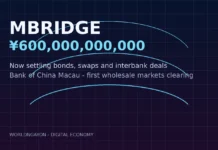
That leaves the strategic gap wide: the world’s second-largest economy, with the largest trade-settlement flows in Asia, mints no offshore digital dollar of its own while its banks build the deepest state-backed cross-border rails in existence. Beijing has decided the answer is not a private coin — it is the bridge, settling bonds and swaps at second-level speed. The Hong Kong stablecoin experiment runs in the shadow of that decision, hedged in HKD, waiting for a policy signal that has not come. France’s levy shows where regulators go next; the register shows what happens to issuers who queue first and wait longest.
The Applicant Graveyard, and Who’s In It
The 34 waiting applications include firms that were once the story’s protagonists. Ant Group and JD.com signaled Hong Kong stablecoin ambitions as recently as June last year — JD exploring global licenses to cut settlement costs, Ant’s international arm preparing to apply. Then came the PBOC and Cyberspace Administration of China instructions, reported by the Financial Times last October 18-19: pause. The official reasoning leaked through officials: private currency-like assets blur the fintech-sovereignty line, complicate capital-flow supervision, and duplicate what the e-CNY is supposed to be. Their applications are effectively zombie entries — filed, frozen, politically unapprovable.
The irony writes itself: two of Asia’s most sophisticated payments companies, with the distribution to make a Hong Kong stablecoin work overnight, are the two names Beijing will not let cross the line. Meanwhile Standard Chartered — which watched its JV and its own name clear licensing — opened Bitcoin and Ethereum trading for UAE clients this week. The bank’s digital-asset strategy now spans two regulatory regimes on opposite sides of the crypto question, which tells you exactly how global banks price the difference between Hong Kong’s hedge and Beijing’s wall.
The Sandbox Lessons Regulators Are Quietly Sharing
Two years of sandbox cycles preceded the licenses, and their fingerprints are on the ordinance’s design: full reserve segregation rather than fractional backing, redemption at par as a hard obligation, and supervisor access to issuer ledgers as a standing condition. A Hong Kong stablecoin built to those terms is structurally closer to e-money than to crypto — which is the point. The territory is not importing crypto culture; it is extending banking discipline to a new instrument and letting the word “stablecoin” describe the wrapper.
For the 34, that lineage dictates the winning posture: hire the compliance team first, the token engineers second. The applications that clear batch two will read like bank charter filings with a product annex — reserve policies, audit arrangements, wind-down plans — and the ones that read like pitch decks will keep reading that way through batch three. The Hong Kong stablecoin experiment is a regulator’s project wearing fintech clothing, and the register will stay short until every applicant’s file matches the costume.
How the First Batch Will Be Judged
The HKMA has quietly told the market what evidence moves a queue: use cases, business operations and market reception — the phrase repeats in every statement, and it divides the 34 into two groups. Applicants who can show transactions already running — payroll pilots, trade-finance settlements, tokenized-deposit bridges — present observed behavior. Applicants presenting only whitepaper RoadMap charts present promises. A Hong Kong stablecoin regime run by a banking regulator, not a crypto enthusiast club, will always pay for observed behavior first.
The observation window is closing faster than most applicants think. RedCoin’s PayMe launch and HKDAP’s professional-investor tests will generate the first real redemption, reserve-management and stress datasets this territory has ever seen — including what happens when users actually cash out at scale, the moment every Hong Kong stablecoin thesis either survives or dies. Reserve compliance gets audited against the 1:1 requirement in public for the first time; the capital floor stops being a number on a website and becomes the thing that either held or did not.
Expect batch two to reward boring utility over venture storytelling. Trade settlement between Hong Kong and Greater Bay Area factories. Corporate treasury inside licensed banks. Settlement for the virtual-asset trading venues the SFC is being told to promote. The Hong Kong stablecoin licenses that arrive next will look like infrastructure permits, not fintech trophies — and the applicants who understood that early are the ones whose files are already on the right desk, while the rest fund conference booths and wait for a political signal that the February notice has definitively reserved for Beijing.
What the 34 Should Do With the Wait
For the 34 waiting entities — several with mainland parents — the playbook the first two licenses wrote is clear: HKD peg, bank-grade reserves, observable use cases first. The queue will move when Anchorpoint and HSBC can show regulators something more than tokens in wallets. Until then, the register stays two names long — France’s stablecoin-tax precedent shows how fast regulatory weather can change — and every yuan-linked application stays politically dead on arrival.