Table of Contents
Key Takeaway
- 🏭 The verified move: General Motors announced its Nasdaq-100 eligibility bid alongside a listing transfer: (October 27, 2026, with an SEC-filed exhibit) it will transfer its listing from the NYSE to the Nasdaq Global Select Market — NYSE trading through November 16, Nasdaq trading begins November 17, ticker stays “GM,” and shareholders need no action.
- 🎯 The line that matters most: GM’s own release states a Nasdaq listing “provides eligibility for potential inclusion in the Nasdaq-100 Index®” — eligibility, not inclusion; the index’s own rules govern what happens next.
- 📈 The market’s first read: GM rose about 5.6% on the announcement day — while the tape’s AI names led the broader rally — suggesting index-fit sentiment priced in immediately (Fortune).
- 🤖 The positioning quote: CFO Paul Jacobson — “GM’s customer-focused, technology-driven strategy is creating value for our stockholders, making Nasdaq a natural home for our listing as we grow” (GM press release).
- 💸 Why index eligibility moves money: index-linked funds must buy what their indexes hold — Fortune’s framing: joining the Nasdaq-100 “would force investment funds that mimic the index” to buy GM — passive flows as a structural tailwind, if the eligibility converts.
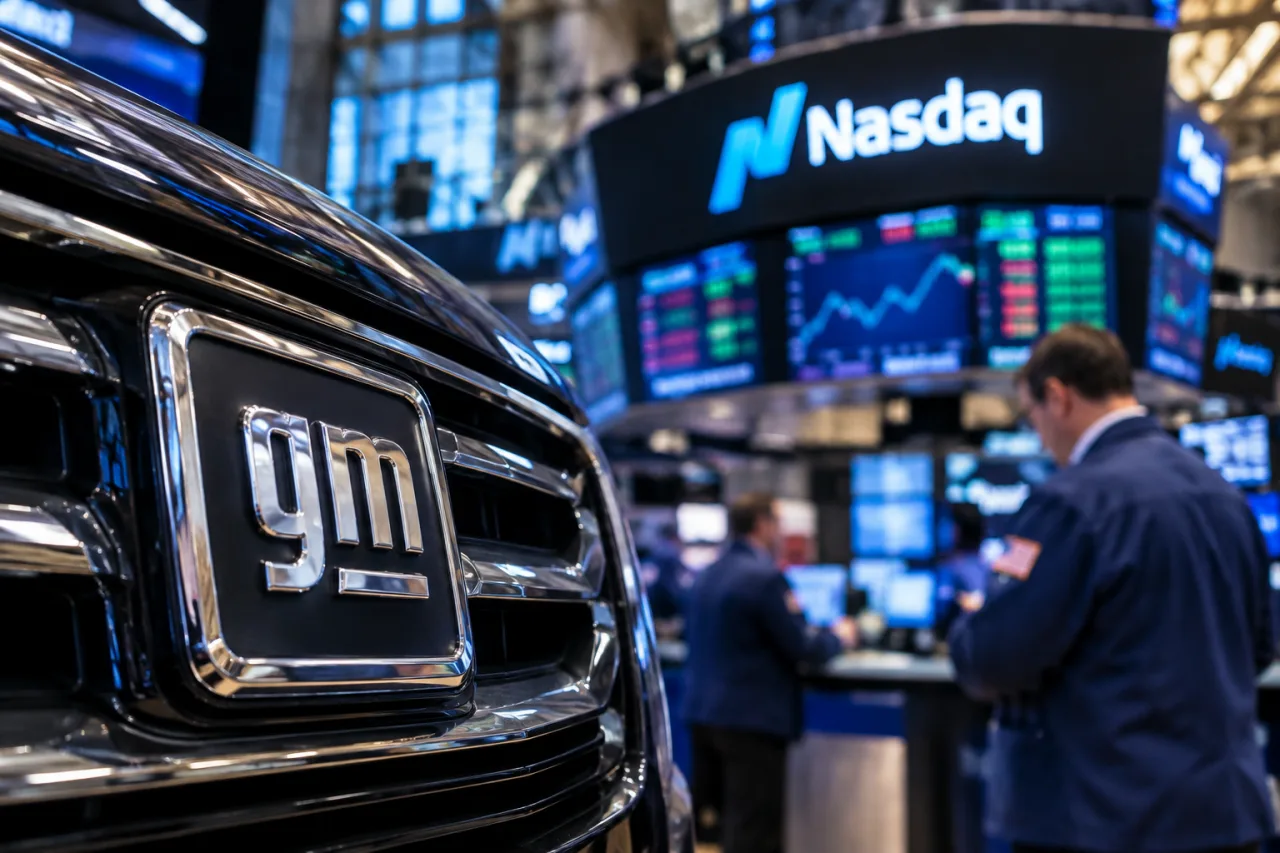
Nasdaq-100 eligibility is the quietest sentence in GM’s October 27 announcement — and probably the reason the 117-year-old automaker is moving its stock listing at all. The verified facts: General Motors (NYSE: GM) announced it will transfer its common-stock listing from the New York Stock Exchange to the Nasdaq Global Select Market, keeping the ticker; NYSE trading runs through the November 16 close; Nasdaq trading starts November 17, 2026; “No action is required by existing stockholders.” The release names the strategy in its own CFO’s voice — technology-driven, creating stockholder value — and the market answered with a ~5.6% gain on announcement day. Behind the press language sits a mechanism every investor should understand, because it is becoming the market’s most reliable force: index eligibility converts into passive ownership — funds that track an index must buy what the index contains — and exchanges know exactly what that money is worth. This piece verifies the announcement, explains the Nasdaq-100 playbook step by step, and sets the invalidators that would tell you the index bet is failing or about to pay.
The Verified Announcement: Dates, Ticker, No Action
From GM’s own release (also filed as a securities exhibit): the transfer moves the common stock listing to the Nasdaq Global Select Market from the NYSE, “expected to begin trading as a Nasdaq-listed company on November 17, 2026,” continuing under the symbol “GM.” The language of the exchange relationship stays gracious — “We’re grateful for our long-standing partnership with the New York Stock Exchange” — while the strategic statement is direct (CNBC carried the announcement): CFO Paul Jacobson tied the move to the company’s “customer-focused, technology-driven strategy.” The operational notes a holder needs: no shareholder action required; the transfer is a listing-venue change, not a share change — positions, custody, and share economics carry over with the ticker. Bloomberg’s framing named the optics: the “old-school automaker positioned as a tech-forward company” as it pushes automated driving and electric vehicles — the exchange shift as a strategy broadcast, aimed at the audience that reads Nasdaq’s constituent list the way it reads a portfolio menu.
What Actually Changes on November 17: the Mechanical Difference
Beyond the branding, the listing transfer changes operational plumbing, and the differences are worth printing for the reader who holds the ticker: the venue and its market-hours microstructure (Nasdaq’s electronic market model versus NYSE’s designated-market-maker floor traditions), the listing-rule book the company now reports under (Nasdaq’s Global Select Market standards, including its own governance and disclosure requirements), and the index family the listing plugs the symbol into (the Nasdaq-100 eligibility note, plus Nasdaq’s composite indexes — where a technology-branded tape indexes an automaker beside software names, not industrials). What genuinely does NOT change: the shareholder of record, the shares themselves, dividend mechanics, and the SEC reporting life. It is worth reading the transfer list twice — the announcement’s “no action required” line is literal: the corporate story continues, the plumbing swaps.
The Nasdaq-100 Playbook: How Index Eligibility Turns Into ETF Money
The mechanism, stated step by step with its honest labels. Step 1 — eligibility, not entry: the announcement’s own words say a Nasdaq listing “provides eligibility for potential inclusion” — the index’s rulebook (size, liquidity, listing history and other screens, applied on the index’s schedule) decides later; eligibility is the ticket, not the seat. Step 2 — the committee and calendar: the Nasdaq-100 reconstitutes annually in December with interim adjustments as rules require — a company that meets criteria must still pass the index’s selection gates on review dates. Step 3 — the money: this is where the flows come from — index-linked ETFs and tracking funds (one of the largest capital pools on Earth) must hold what their benchmark holds; Fortune’s report put it in one line: joining “would force investment funds that mimic the index to buy it.” A multi-hundred-billion-dollar complex replicating a 100-name index adds a new constituent mechanically — buying that is triggered by arithmetic, not opinion. Step 4 — the signal value even before inclusion: the announcement itself reprices expectation — the ~5.6% move shows the market pricing the probability-weighted value of future flows: eligibility news is tradable because inclusion odds improved, and the desk’s index-law family (covered in the MSTR/MSCI clock analysis) shows the same force running in reverse — index exclusion threat creates forced-selling scenarios worth billions. The index is the market’s most honest pricing machine: admission buys flow, exclusion sells it.
What Nasdaq-100 Inclusion Actually Does
The verified effects, from how index mechanics work, labeled honestly as mechanism rather than forecast: structural — a new constituent enters the ETF replication books; tracking funds buy on effective dates, indexed to the add’s weight; the buying is front-run by expectation and realized on dates. Liquidity — index membership typically deepens the tape: more fund custody, more options chains, more dealer presence. Narrative — membership in a “technology-forward” index reshapes the comparison set analysts and headlines use (an automaker listed beside chip and software names reads differently than one beside industrials). And the honest non-effects: no inclusion event changes cash flows, products, or the company’s operating reality — the index adds owners, not customers; the P/E multiple absorbs the demand, the fundamental business does not. In our view, that last distinction is the whole game: the desk reads index-fitting as a financial-engineering event with a real but bounded economic signature — the flows are large and mechanical, and the value they permanently add equals the market’s own judgment, re-priced, not new earnings.
The Nasdaq-100 Index Law Theme, in This Market’s Broader Context
GM’s move lands during the week the index-law theme went mainstream: MSCI adopted its non-operating-company exclusion rules with a November 11 final list that threatens digitally-heavy treasuries (Strategy included, with $2.8–8.8 billion of modeled forced selling on the table); the Fed held rates amid an AI-led rally that carried the S&P 500 within 1.2% of its all-time high; and the hyperscaler capex race runs at $464.6 billion on SEC-filing computation (the desk’s money-trail analysis). The common architecture: index membership and classification are now priced inputs — exchanges, index providers and the ETF complex know it; issuers engineer for it (GM’s own release writes “eligibility” into the announcement); and the market pays for the probability shifts. For the global reader (this desk’s OFW lane included): the same lesson applies at home — the PSE’s own index mechanics reprice Philippine names the same way (the desk’s PSEi explainer covers the mechanics for Filipino readers); the game is global, only the ticker symbols change.
What Would Change This Reading: the Invalidation Ledger
- A Nasdaq-100 screening miss — if the December reconstitution (or rule screens) keeps GM out despite eligibility, the flows thesis deflates and the 5.6% reprices; the index announcement pages are the record to watch.
- Inclusion arriving early — an interim special add on eligibility-and-size grounds would convert the “potential” into flows immediately and validate the announcement-day premium fully.
- GM’s technology thesis faltering — EV/AV program pull-backs that re-situate GM as an industrial would reframe the move as exchange arbitrage alone — the index tailwind survives but the strategic broadcast rings hollow.
- NYT-style backlash — NYSE-side counter-offers or listing-fee structures for departing icons could flip the optics (the “NY vs Nasdaq” narrative is itself a market story this desk would track).
What the Evidence Supports, by Reader Situation
Education desk, not an advisory service — decision inputs, never instructions.
- If you hold GM: the verified dates are your calendar — NYSE through November 16, Nasdaq from November 17, ticker unchanged, no action from you; the index watch (December reconstitution mechanics) is the structural node, and the announcement-day premium is priced, not guaranteed to persist.
- If you study how markets channel money: the case study is complete in one week — eligibility buys (+5.6% on the line), exclusion threats (the MSCI clock, billions modeled in forced flows), and the ETF mechanism that executes both; the desk’s index-family pieces are the syllabus.
- If you run a Philippine or global portfolio: the mechanism is jurisdiction-agnostic — index inclusion and exclusion move markets everywhere; check your own holdings’ index memberships on the same calendar discipline, and let the filings (not the headlines) carry the arithmetic.
FAQ: GM’s Move to Nasdaq and the Nasdaq-100 Playbook
When does GM start trading on Nasdaq?
November 17, 2026 — the common stock continues on the NYSE through the November 16 close, then transfers to the Nasdaq Global Select Market under the same “GM” ticker, per GM’s October 27 announcement and its SEC-filed exhibit.
Does GM joining Nasdaq mean it joins the Nasdaq-100?
Not automatically — GM’s release states the listing “provides eligibility for potential inclusion in the Nasdaq-100 Index®”; the index’s own screening and calendar rules decide entry, with the annual reconstitution in December the standard review node. Inclusion would mechanically force index-tracking funds to buy the shares.
Why is Nasdaq considered the tech exchange?
Nasdaq hosts the largest technology listings — including the AI cohort driving this market’s capex cycle — and its index family tracks that concentration; a transfer reads as positioning, which is exactly how Bloomberg framed GM’s move: the automaker presented as technology-forward as it pushes automated driving and EVs.
What did the market think of GM’s Nasdaq-100 eligibility announcement?
GM gained about 5.6% on announcement day — pricing the probability-weighted value of the eligibility (future index flows) plus the strategic-technology signal, on a tape where the broader AI-led rally held the S&P 500 near record levels.
Do shareholders need to do anything?
No — the release says explicitly that “no action is required by existing stockholders”; positions carry over through the transfer with the ticker unchanged.
Can index rules really force billions in buying?
Yes — index-tracking funds must hold their benchmark’s constituents, so inclusion adds mechanical buying across the ETF complex; the same mechanism in reverse underlies the MSCI exclusion scenario this desk covered (roughly $2.8–8.8 billion of modeled forced selling for one company) — flows run by arithmetic on both doors.
What happens to options and derivatives tied to GM?
Listed options track the security, not the venue — but the transfer carries operational notes that traders track: exchange-of-listing events typically re-map options symbols, clearing and market-making arrangements to the new venue, and index-option linkage changes if (and only if) the Nasdaq-100 inclusion actually arrives — index derivatives reprice only when the index membership does. That is the mechanism difference worth knowing before November 17: the stock continues, its derivatives plumbing follows the exchange, and the index-linked instruments follow the index, on its own calendar and rules.
What does this mean for global investors watching from abroad?
Practically: the ticker continues, the venue changes, and the index story is the part worth marking on a calendar — November 17 is the plumbing date, and the index calendar (reconstitution mechanics, screening updates) is the flow date. For the OFW and global-Filipino investor, the deeper lesson transfers home: index membership is a priced force in every market — the mechanics repeat at the PSE, at MSCI, and at the ETF layer sitting on them — and the desk’s index-family guides are the transferable syllabus. A stock joining a household-name index inherits a new class of natural owners; a stock leaving one inherits a class of forced sellers; the shareholder who knows which force is operating prices events by filings, not by tape noise.
Financial Disclaimer
This article is for general information and education only. It is not financial, investment, legal or tax advice, and it does not recommend the purchase, sale or holding of any security. Exchange listings, index rules and market conditions change without notice; every figure was sourced from GM’s own announcement, its SEC-filed exhibit and dated market coverage on October 27–28, 2026, and must be re-verified before any decision. WorldNgayon does not hold any position in the securities discussed, and no content on this site should be acted upon without independent verification and, where appropriate, advice from a licensed professional.
- investor.gm.com/news-releases/news-release-details/gm-announces-trans… — From GM’s own release
- Official sec.gov/Archives/edgar/data/1467858/000119312526432602/d53522dex991.h… — filed as a securities exhibit
- cnbc.com/2026/10/27/gm-nasdaq-nyse-stock-listing.html — CNBC carried the announcement
- bloomberg.com/news/articles/2026-10-27/gm-to-move-stock-listing-to-te… — Bloomberg’s framing named the optics:
- fortune.com/2026/10/28/sp-500-1-2-all-time-high-broadcom-nvidia-ai-st… — Fortune’s report put it in one line:
External sources linked in this article, in order of first mention. Spotted an error or a broken link? Tell us.
Cite this pagePublished Oct 29, 2026
Agron, E. (2026, October 29). Why GM Chose the Nasdaq: ETF Money, Tech Positioning and the Nasdaq-100 Playbook. WorldNgayon. https://worldngayon.com/gm-nasdaq-100/
Agron, Edmon. “Why GM Chose the Nasdaq: ETF Money, Tech Positioning and the Nasdaq-100 Playbook.” WorldNgayon, 29 Oct. 2026, worldngayon.com/gm-nasdaq-100/.
Agron, Edmon. “Why GM Chose the Nasdaq: ETF Money, Tech Positioning and the Nasdaq-100 Playbook.” WorldNgayon, October 29, 2026. https://worldngayon.com/gm-nasdaq-100/.
Agron, E. (2026) ‘Why GM Chose the Nasdaq: ETF Money, Tech Positioning and the Nasdaq-100 Playbook’, WorldNgayon, 29 October. Available at: https://worldngayon.com/gm-nasdaq-100/.
E. Agron, “Why GM Chose the Nasdaq: ETF Money, Tech Positioning and the Nasdaq-100 Playbook,” WorldNgayon, Oct. 29, 2026. [Online]. Available: https://worldngayon.com/gm-nasdaq-100/
@online{agron2026gmnasdaq,
  author       = {Agron, Edmon},
  title        = {{Why GM Chose the Nasdaq: ETF Money, Tech Positioning and the Nasdaq-100 Playbook}},
  year         = {2026},
  date         = {2026-10-29},
  organization = {WorldNgayon},
  url          = {https://worldngayon.com/gm-nasdaq-100/},
  urldate      = {}
}TY - ELEC AU - Agron, Edmon TI - Why GM Chose the Nasdaq: ETF Money, Tech Positioning and the Nasdaq-100 Playbook T2 - WorldNgayon PY - 2026 DA - 2026/10/29/ UR - https://worldngayon.com/gm-nasdaq-100/ Y2 - ER -
Cite the version you read; the page may be updated. Zotero and Mendeley can also import this page directly.