
Table of Contents
TLDR:
- AI literacy is becoming mandatory for OFWs across all industries by 2026
- Five core AI skills can future-proof your career: prompt engineering, data interpretation, AI tool integration, automation basics, and ethical AI understanding
- Free resources and certification programs help OFWs upskill without breaking the budget
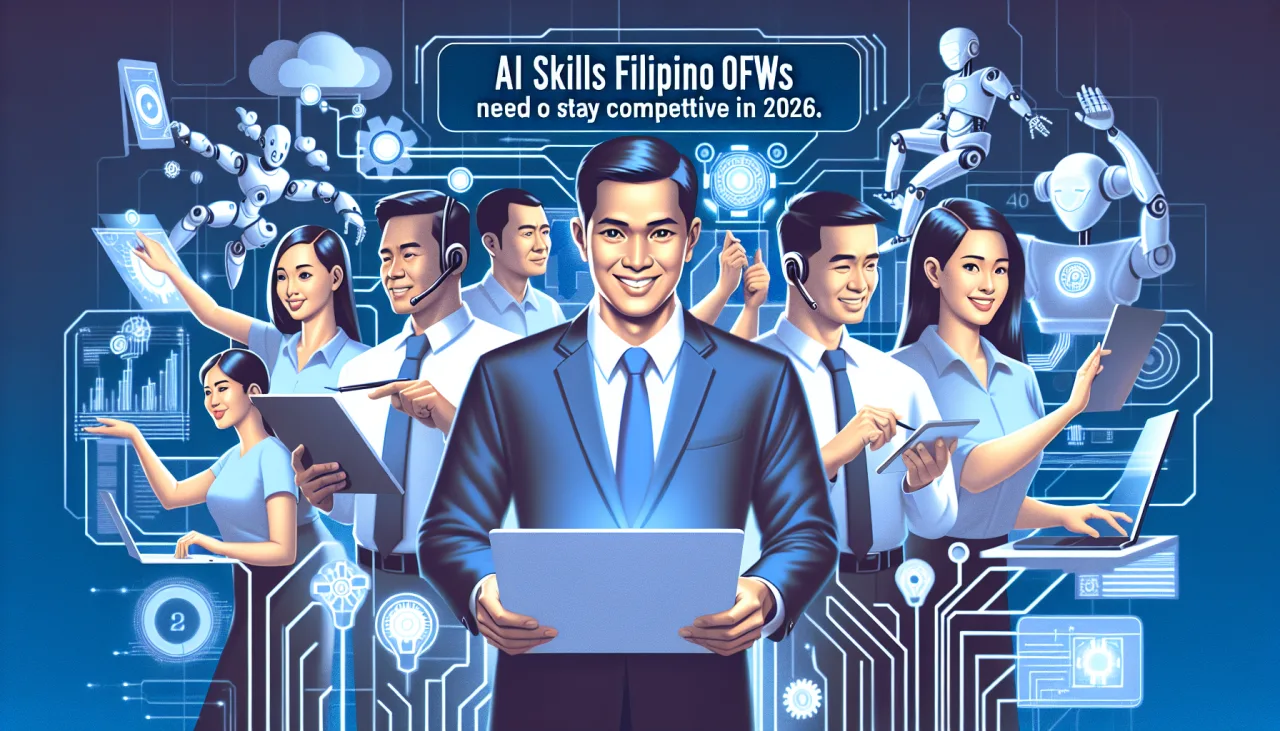
The global workforce is experiencing its most dramatic transformation since the industrial revolution. For Filipino OFWs, developing AI skills Filipino OFWs need has become critical to maintaining their competitive edge in international markets. Recent industry reports show that 73% of global employers now prioritize AI literacy when hiring, making these competencies essential rather than optional.
Why AI Skills Filipino OFWs Are Learning Matter More Than Ever
Artificial intelligence is not replacing human workers wholesale, but it is fundamentally changing how work gets done. OFWs in healthcare are using AI for patient data analysis. Construction workers rely on AI-powered safety monitoring systems. Even domestic helpers benefit from smart home technologies that require basic AI understanding.
The competitive advantage goes to workers who can collaborate with AI systems rather than fear them. Countries like Singapore, UAE, and Canada are actively seeking professionals who demonstrate AI fluency alongside traditional skills. This shift creates unprecedented opportunities for Filipino workers who position themselves correctly.
Salary premiums for AI-literate workers average 23% higher than traditional roles. For OFWs supporting families back home, this difference translates to significant financial impact over time.
Five Essential AI Competencies Every OFW Should Master
Prompt Engineering for Professional Tasks
Prompt engineering involves crafting effective instructions for AI systems to generate desired outputs. This skill applies across industries, from writing professional emails to analyzing data trends. Healthcare OFWs use prompts to help organize patient information, while administrative workers streamline report generation.
Start with simple, specific instructions and iterate based on results. Practice with free tools like ChatGPT or Claude to develop intuition for what works. The key is understanding that AI systems perform best with clear, contextual guidance rather than vague requests.
Data Interpretation and Analysis Skills
Modern AI generates vast amounts of data that humans must interpret and act upon. OFWs need skills to read dashboards, understand trends, and make informed decisions based on AI-generated insights. This competency proves valuable in logistics, finance, healthcare, and engineering roles.
Focus on understanding basic statistical concepts, chart reading, and pattern recognition. Many roles now involve reviewing AI recommendations and determining appropriate actions. Workers who can bridge AI output with practical decision-making become indispensable team members.
AI Tool Integration in Daily Workflows
Every industry now offers AI-powered tools designed to enhance productivity and accuracy. Construction sites use AI for safety monitoring and quality control. Healthcare facilities deploy AI for scheduling and resource optimization. Administrative roles benefit from AI-powered document processing and communication tools.
Research AI tools specific to your industry and practice integrating them into existing workflows. Start with one tool, master its capabilities, then gradually expand your toolkit. Understanding how to evaluate and implement new AI solutions demonstrates valuable technical leadership.
Automation Basics and Process Optimization
AI excels at automating repetitive tasks, but humans must identify automation opportunities and oversee implementation. This skill involves analyzing current processes, identifying bottlenecks, and designing AI-enhanced workflows that improve efficiency without compromising quality.
Begin by mapping your daily tasks and identifying repetitive elements. Learn basic automation principles through UNESCO’s digital literacy programs or similar resources. Focus on understanding when automation helps versus when human judgment remains essential.
Ethical AI Understanding and Implementation
As AI becomes ubiquitous, understanding its ethical implications becomes crucial. OFWs must recognize bias in AI systems, understand privacy concerns, and implement AI solutions responsibly. This knowledge protects both employers and clients while ensuring sustainable AI adoption.
Study real-world AI ethics cases relevant to your industry. Learn to identify potential bias in AI outputs and understand data privacy requirements. Workers who can implement AI responsibly while avoiding common pitfalls become trusted advisors in their organizations.
Practical Learning Resources for Budget-Conscious OFWs
Building AI skills Filipino OFWs need doesn’t require expensive courses or certifications. The Department of Information and Communications Technology offers free digital literacy programs specifically designed for Filipino workers abroad. These programs cover foundational AI concepts alongside practical applications.
International platforms like Coursera, edX, and FutureLearn provide AI courses with financial aid options for developing country residents. Many courses offer certificates that employers recognize globally. Focus on programs that combine theoretical knowledge with hands-on practice using industry-standard tools.
YouTube channels, podcasts, and professional networks offer ongoing learning opportunities. Subscribe to MIT Technology Review for cutting-edge AI developments that might impact your industry. Join LinkedIn groups focused on AI in your professional field to stay current with trends and networking opportunities.
Practice with free AI tools daily to build familiarity and confidence. Set aside 30 minutes weekly to experiment with new features or explore different use cases. Document your learning journey and successful applications to demonstrate growth to current and potential employers.
Building Your AI-Enhanced Career Strategy
Developing AI skills Filipino OFWs need requires strategic planning aligned with career goals. Research AI adoption trends in your target countries and industries. Some regions prioritize certain AI applications over others, and understanding these preferences helps focus your skill development efforts.
Create a portfolio showcasing AI-enhanced work examples. This might include reports generated with AI assistance, processes you’ve optimized using automation, or problems you’ve solved through data analysis. Concrete examples demonstrate competency more effectively than certificates alone.
Network with other OFWs who are successfully integrating AI into their professional roles. Share experiences, challenges, and solutions through digital networking platforms or local OFW communities. Collaborative learning accelerates skill development while building valuable professional relationships.
Consider specializing in AI applications specific to your industry rather than trying to master everything. Deep knowledge in healthcare AI, construction AI, or financial AI often proves more valuable than surface-level understanding across multiple domains.
Frequently Asked Questions
How long does it take to develop job-relevant AI skills?
Basic AI literacy can be achieved in 3-6 months with consistent daily practice. However, developing expertise in specific AI applications for your industry typically requires 12-18 months of focused learning and practical application. The key is starting with foundational concepts and gradually building specialized knowledge that directly relates to your work environment.
Can AI skills help OFWs transition to higher-paying roles?
Yes, AI skills often serve as a differentiator for promotions and role transitions. Many OFWs report salary increases of 15-30% after demonstrating AI competencies in their current positions. Additionally, AI skills can facilitate moves into supervisory roles, technical support positions, or specialized consulting opportunities that weren’t previously accessible.
What if my current employer doesn’t use AI technologies yet?
Proactively developing AI skills positions you advantageously when your employer inevitably adopts these technologies. You can also propose pilot projects that demonstrate AI value in your current role. This approach showcases leadership and innovation while providing practical experience. Many successful OFWs have transitioned to better positions by becoming their organization’s go-to person for AI implementation and training.
Securing Your Future in the AI-Driven Global Workforce
The transformation of work through artificial intelligence presents both challenges and unprecedented opportunities for Filipino OFWs. Those who invest time in developing relevant AI skills Filipino OFWs need will find themselves well-positioned for career advancement and financial growth. The key lies in starting now, focusing on practical applications, and maintaining consistent learning habits.
Remember that AI skills complement rather than replace your existing expertise and cultural competencies. Your unique perspective as a Filipino professional, combined with AI literacy, creates a powerful combination that employers worldwide increasingly value. The future belongs to workers who can harness AI’s capabilities while providing the human insight and creativity that technology cannot replicate.
Start with one skill area that directly relates to your current role, practice consistently, and gradually expand your capabilities. The investment you make in AI skills today will pay dividends throughout your career, ensuring you remain competitive and valuable in an increasingly automated world. For additional guidance on advancing your digital career, explore our comprehensive resource library designed specifically for Filipino professionals working abroad.