Table of Contents
Key Takeaway
- 🏆 The most credentialed protest in science this year: 25 Fields Medal winners — including Terence Tao, Pierre Deligne (1978), Ngô Bảo Châu (2010) and 2026 laureate Deng Yu — signed a joint open letter on September 11 warning that AI companies’ goals are “severely misaligned” with mathematics.
- ⚠️ The core warning: the race among AI labs to solve famous unsolved problems risks “lasting harm” to the field — and the letter frames it as “a general threat to intellectual work” far beyond mathematics.
- 📝 The letter’s sharpest line: “Problem-solving is only a tool and proxy to achieve the core goal — conceptual understanding and insight. Mass-producing ‘true/false’ propositions at an increasingly fast pace may destroy the fertile soil instead of injecting vitality into new ideas.”
- 🔥 The feud is escalating: the letter landed on Terence Tao’s blog amid a priority dispute over an AI-assisted solution to a century-old problem — the second clash between OpenAI and the math community this quarter, after the June Leiden Declaration.
- 🇵🇭 Why it travels: the argument is about all intellectual work — including the research, writing, and engineering careers Filipino professionals are building on AI. Who owns insight, and who gets credited, are questions every knowledge worker now shares.
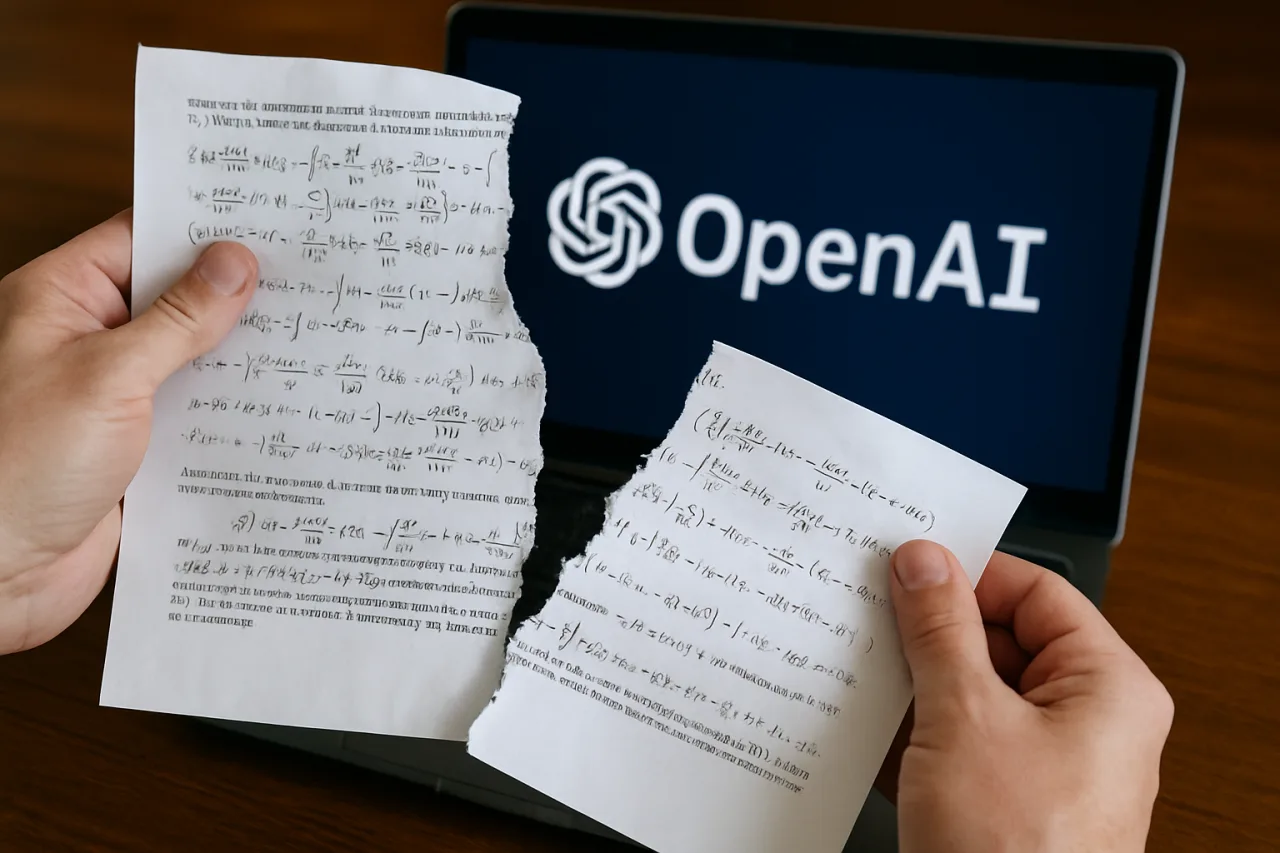
The mathematics community just did something no profession has done yet: twenty-five winners of the Fields Medal — the closest thing mathematics has to a Nobel Prize — jointly accused AI companies of endangering their discipline. The open letter, published September 11 on Terence Tao’s blog, says the goals of AI labs and the mathematical community are “severely misaligned,” and warns that machine-generated solutions to famous unsolved problems could damage the field they appear to advance. When the people who define what rigorous thinking looks like issue a formal protest, every knowledge profession should read it — because the argument is not really about mathematics. It is about what happens to any discipline when machines can produce its outputs faster than humans can understand them.
Inside This Issue
A quick map of the analysis below: what the letter says, why the feud escalated, the verification debate underneath it, and what it means for working professionals.
What the Fields Medalists Actually Said
The letter’s language is unusually direct for a community that communicates in proofs. The signatories state that the objectives of AI companies and those of the mathematical community “diverge profoundly,” that the race to solve celebrated unsolved problems risks lasting harm to mathematics, and that the trend poses a general threat to intellectual work. The mechanism of harm, as they describe it, is subtle: an AI system that announces a solution to a century-old problem — without a human-comprehensible proof, without community verification, without the slow social process by which mathematics absorbs ideas — does not enrich the field. It bypasses the field. The solution exists; the understanding does not.
Their key paragraph deserves quoting in full: “Problem-solving is only a tool and proxy to achieve the core goal — conceptual understanding and insight.” Forgetting that, the letter warns, will make the tool backfire on the goal: “Mass-producing ‘true/false’ propositions at an increasingly fast pace may destroy the fertile soil instead of injecting vitality into new ideas.” The signatories call for urgent discussion among mathematicians, AI developers and society at large about how AI could reshape intellectual work without undermining its purpose. The demand is not a ban — it is a demand that the conversation happen before the field is transformed by default.
Read that last sentence twice. The letter asks for neither prohibition nor pause; it asks for a seat at the table while the transformation is still negotiable. That is a very different kind of protest from the ones AI companies are used to receiving.
Why the Feud With OpenAI Turned Personal
The letter did not appear from nowhere. It follows the Leiden Declaration, released by a working group of mathematicians in June, which grappled with how LLM-generated proofs will change mathematical practice and offered recommendations for mathematicians, institutions and policymakers. Between the two documents sits a priority dispute: an AI lab announced progress on a problem that had resisted mathematicians for a century — as coverage of the joint statement recounts, and the community’s response was not celebration but a credit fight — who found it, who understood it, who could explain it, and whether an announcement without those answers deserves the word “solution” at all. As TechCrunch reported, the feud is “only escalating,” and the 25 signatures are its most serious escalation yet.
The context cuts both ways, and honesty requires saying so. Machine assistance has produced genuine mathematical wins: the proofs behind a 2022 Fields Medal were formally verified in February 2026 through a collaboration with an autoformalization model, and our own coverage documented a Claude system checking Fermat’s Last Theorem across 13 million lines — verification work that strengthens, rather than replaces, the discipline. Terence Tao himself has argued the field should move beyond asking whether AI can generate or verify proofs, identifying an “incentive gap” and proposing “proof digestion” — streamlining and explaining machine proofs so they connect to literature and to human understanding. The medalists’ letter is best read as the institutional version of Tao’s point: the danger is not machine capability, but machine output without the digestion that makes it knowledge.
The Deeper Fight: What Counts as a Proof When a Machine Writes It
Beneath the credit dispute sits a technical disagreement with a long pedigree. Formal verification systems have checked machine-generated proofs for decades, and nobody doubts the arithmetic — a Lean-checked proof really is a proof.
What the community disputes is what a proof is for. A traditional proof does two jobs at once: it certifies a result, and it teaches — its structure explains why the result must be true, which is what lets other mathematicians build on it. A machine-generated 13-million-line verification certifies without teaching. It settles the “whether” and leaves the “why” untouched, and the “why” is where the next generation of theorems comes from. The medalists’ phrase “destroying the fertile soil” is precisely this: a field that accumulates certified results faster than comprehension is a field sitting on a warehouse it cannot open.
The proposed remedies are already taking shape. Tao’s “proof digestion” agenda treats explanation as a first-class deliverable — machine proofs should be accompanied by distilled human narratives, connections to prior literature, and structured summaries that researchers can absorb. Others have floated “verified proof certificates” for results mathematicians cannot fully follow; one symposium participant described the prospect of relying on machine-checked proofs of problems humans do not understand as feeling like “space aliens landing.” Both visions accept that AI will generate mathematics; both insist the community must own the meaning layer. The letter’s contribution is to make ownership non-negotiable — and to put 25 of the field’s strongest reputations behind the demand.
For working professionals outside pure mathematics, the operational version is already here. Any organization consuming AI-generated analysis — audit findings, code review, medical literature synthesis — faces the same fork: outputs that cannot be explained by the humans accountable for them are liabilities wearing the costume of insight. The medalists’ letter is the first time a discipline has said so out loud, at this level of authority, in writing.
The General Threat to Intellectual Work
Substitute “case law” for “theorems,” “clinical evidence” for “proofs,” or “audited accounts” for “verified results,” and the letter’s logic transfers wholesale — which is why the phrase “a general threat to intellectual work” deserves more attention than the mathematics-world headlines it generated. The medalists’ argument is that every disciplined field has a purpose beyond its outputs: law teaches reasoning, medicine teaches judgment, mathematics teaches the construction of certain knowledge from sparse premises. Industries that mass-produce a field’s outputs while hollowing out its understanding do not just disrupt a profession — they sever the pipeline by which humans become capable of supervising the machines. That is the “fertile soil” the letter fears losing.
It is also the same argument, in different clothing, as the AI-safety debate running through this same week.
There is also an economic reading. The medalists are, in effect, the highest-status knowledge workers alive, and their letter is a formal statement of the terms on which they will collaborate with AI companies: credit, comprehension, community norms. The Leiden Declaration tried the soft version; the joint letter escalates to a public stand. Every profession that negotiates with AI vendors — publishers included — will recognize the pattern, and the precedents set here will be cited in all of them. Our coverage of newspapers asking a court to redefine ChatGPT’s relationship to their work is the same negotiation in litigation form.
What Happens Next — and What Professionals Should Watch
Three developments are worth tracking. First, whether any AI lab answers the letter directly — an acknowledgment, a collaboration framework, or silence, each of which tells the community something. Second, whether the “understandability” standard enters procurement: institutions buying AI-assisted research may start demanding human-comprehensible verification, a shift that would convert the medalists’ principle into a market requirement. Third, the parallel fight in formal methods: the gap between machine-checkable proofs and human-meaningful ones is where the next dispute will land, and tools for “proof digestion” — the explanation layer Tao proposed — are about to become the most valuable bridge in the field.
WorldNgayon Analysis: The temptation is to file this under “mathematicians versus machines,” a curiosity with no operational meaning for working professionals. That would miss the letter’s actual function: it is the first formal specification of a new professional norm — outputs are not knowledge until the community can understand them. Every Filipino engineer who has inherited an AI-generated codebase they cannot explain, every analyst handed a model’s conclusion without its reasoning, every writer asked to publish what they cannot verify, is already living inside that norm. The medalists simply wrote it down first, with 25 of the strongest signatures science can produce.
Bottom Line: Twenty-five Fields Medalists just told the AI industry that solving problems is not the same as understanding them — and that distinction is about to be priced into every intellectual profession, including yours.
And the timing is not accidental. The letter dropped between the researcher resignations and the pacing essay, in the same fortnight the Senate opened its agent-safety investigation — a season when every discipline with something to lose is deciding, in public, what it will demand from the AI industry. Mathematics went first because mathematics can measure understanding most precisely. The professions that follow will have to improvise, which is exactly why the smartest among them are drafting their terms now.
Frequently Asked Questions
What did the 25 Fields Medalists say about AI?
In a joint open letter published September 11, 2026, on Terence Tao’s blog, 25 Fields Medal winners warned that the goals of AI companies and the mathematical community are “severely misaligned,” that racing to solve famous unsolved problems risks lasting harm to mathematics, and that the trend poses “a general threat to intellectual work.”
Who signed the Fields Medalists’ letter?
The signatories include Terence Tao (UCLA), Pierre Deligne (1978), Ngô Bảo Châu (2010), and Deng Yu (2026), among 25 Fields Medal recipients in total — spanning more than four decades of the prize’s history.
Why are mathematicians angry at OpenAI?
The letter follows an escalating dispute over AI labs announcing solutions to famous unsolved problems — including a century-old problem — faster than the community can verify, understand, or attribute them. The mathematicians argue that problem-solving without comprehension undermines the field’s actual purpose, and a priority dispute over credit intensified the conflict.
What is the Leiden Declaration?
A June 2026 statement by a working group of mathematicians addressing how LLM-generated proofs will change mathematical practice, with recommendations for mathematicians, institutions and policymakers. The Fields Medalists’ letter is widely seen as its harder-edged successor.
What does this mean for non-mathematicians?
The letter’s warning — that mass-producing outputs without understanding threatens intellectual work generally — applies to law, medicine, engineering, finance, and writing. It signals a coming professional norm: AI-generated results will need human-comprehensible explanations and community verification before they count as knowledge.
Financial Disclaimer
This article is for general information and editorial analysis only and does not constitute financial, investment, or legal advice. Statements quoted reflect public reporting as of September 13, 2026. Company mentions are not recommendations to buy or sell securities. Readers should conduct their own research and consult a licensed professional before making financial decisions. WorldNgayon.com publishes under Edmon Agron.