Key Takeaway
- 🔁 The definition, clean: circular deals are arrangements where Company A invests in Company B, and B uses that capital to buy A’s products — these circular deals can be legal — supplier and customer funding each other; Bloomberg’s anatomy distinguishes it from fraudulent “round-trip” trades (no economic substance) — circularity can be legal, rational and mutually profitable WHEN demand grows.
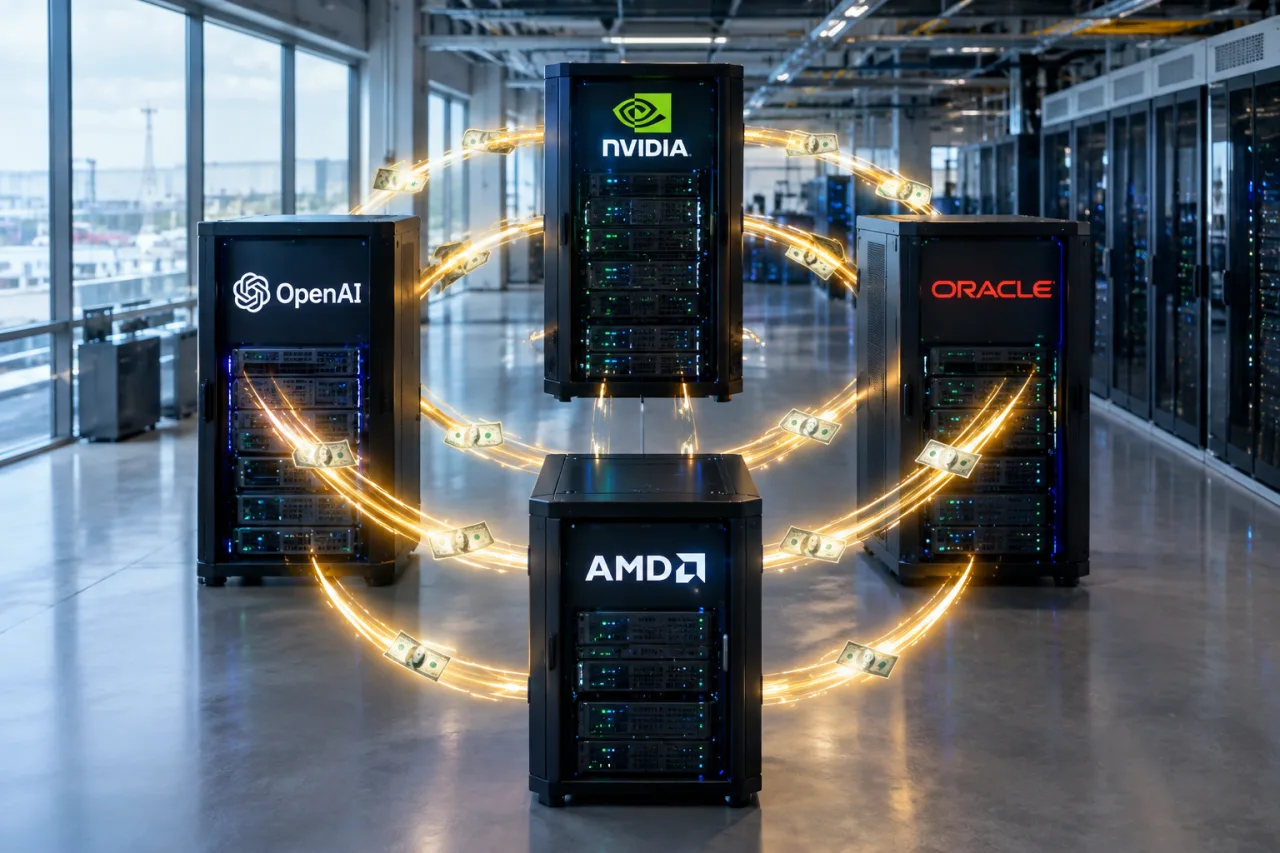
- 🕸️ The web, named: Nvidia invests up to $100B in OpenAI, which buys Nvidia systems at 10-GW scale; Oracle signs a $300B OpenAI compute deal; Microsoft holds a major OpenAI stake; OpenAI buys from AMD in a warrant-linked deal; OpenAI turns around and buys chips from Google amid the same rivalry — the five-strand web behind 2026’s headline deals, all documented.
- 🧠 Why smart people defend it: the flywheel reading (Janus Henderson: a “virtuous circle” lining up suppliers, builders and customers; Amodei at DealBook: “one player has capital… the other is confident they’ll have revenue” — in principle appropriate when the chips are scarce).
- 🃏 Why smart people fear it: the house-of-cards reading — one dollar of end-user demand can inflate to many dollars of reported revenue around the loop; Bloomberg’s own analysis: circular deals “can create skewed incentives … and magnify losses if demand … fails to match today’s lofty expectations”.
- ⚖️ The deciding instrument: end-user revenue growth — the OpenAI $20B annualized-revenue revision (October 2026) is the exact instrument class to watch; the web converts the demand question into the crash question, which is why the crash pieces in this slate cite the same deals.
Circular deals are the financial architecture of the AI boom — the circular deals web — the web of investments and purchase commitments connecting Nvidia, OpenAI, Oracle, Microsoft, AMD, Google and the rest, in which the companies building the AI infrastructure also invest in the companies buying it, and vice versa. One chart (Bloomberg’s, widely reproduced) made the web famous; one policy paper (Vanderbilt’s) proposed banning pieces of it; one industry defense (Amodei’s) made it respectable. This piece explains the structure for readers who keep hearing the term: what a circular deal is, exactly which deals form this web, why the strongest financial minds disagree about it, and how the web behaves if the AI demand story disappoints.
Table of Contents
Why this is the explainer you actually needed: the debate lives in fragments — a chart here, a quote there; the mechanism (why the web matters) and the counterarguments (why it is mostly normal) rarely appear in one place. That is this piece’s job; the AI crash question piece in this series carries the consequence side.
Circular deals, defined: the structure and the duty of honesty
The structure, precisely: circular deals are arrangements in which one company invests in another firm that buys its products and services. Example shape: chipmaker A invests $X in AI lab B; B uses the capital (and A’s credits) to build data centers filled with A’s chips; A gains a committed customer at 10-gigawatt scale; B gains capital and supply at privileged access. Bloomberg’s definitional work matters here: a circular deal is NOT the same as a fraudulent “round-trip” transaction — round-tripping is sham trading with no economic substance ( regulators’ language for fake revenue); circularity can be legal, disclosed, and value-creating when demand grows. The honest explainer keeps that distinction sharp — the debate is about RISK, not fraud.
Why circular deals exist at all (the sympathetic reading first): building AI is extraordinarily expensive, and the most advanced chips are scarce; in that market, companies do not merely place orders — they lock in supply by pairing long-term buying commitments with financing. The buyer gets capital and supply; the seller gets a customer of record. In a demand-explosion market, every participant is doing rational deal design — the same structural observation Bloomberg documents.
The deal web, named: the five strands
Strand 1 — Nvidia ↔ OpenAI (the founding circular deal): Nvidia’s announced investment of up to $100 billion in OpenAI, designed alongside OpenAI’s deployment of Nvidia systems at 10-gigawatt scale — the web’s founding strand, explicitly pairing capital with offtake. Strand 2 — Oracle ↔ OpenAI: the ~$300 billion compute contract (one of the largest single-customer commitments in infrastructure history) — Oracle builds for OpenAI; OpenAI’s revenue promises service Oracle’s debt. Strand 3 — Microsoft ↔ OpenAI: the long-standing majority-stake relationship plus compute commitments — and OpenAI’s simultaneous diversification AWAY from single-vendor dependence (the reason the other strands exist). Strand 4 — OpenAI ↔ AMD: multi-billion-dollar GPU purchases with AMD warrant participation — OpenAI became one of AMD’s largest shareholders by deal design; the buyer holds seller equity. Strand 5 — the rivalry reversal: OpenAI’s chip deal with Google (Google supplying a would-be GPT rival at scale — this site’s OpenAI-Google chips analysis carries the read) — the web’s newest strand crossing previous battle lines. The web’s property: no single strand is crazy; the aggregate is a money-loop where suppliers fund their customers and customers own their suppliers — the configuration the circular-financing literature studies.
The flywheel reading: the defense, in its best form
Argued in its strongest published form: 1 — the scarcity argument: advanced compute is supply-constrained; pairing capital with commitments is how a capital-starved builder secures its runway (Amodei, DealBook, December 2025: “One player has capital and has an interest, because they’re selling the chips, and the other player is pretty confident they’ll have the revenue at the right time, but they don’t have $50 billion at hand. So I don’t think there’s anything inappropriate about that in principle.”) 2 — the virtuous-circle reading: asset managers (Janus Henderson) frame the wave as lining up suppliers, builders and customers to meet exploding compute demand — a coordination instrument, not a speculation. 3 — the diversification reading: the web lets OpenAI de-risk single-vendor dependence (Microsoft exclusivity ended; Nvidia-Oracle-AMD-Google strands are hedges) — a rational capital-structure choice in a scarce-chips market. 4 — the alignment reading: when both counterparties own pieces of each other, bad decisions (overbuilding, under-delivering) hurt the deal-maker directly — the web is a governance instrument as much as a financing one, while demand cooperates.
The house-of-cards reading: the criticisms, in their sharpest form
1 — the circular deals revenue-inflation reading: one end-user dollar can generate multiple dollars of reported revenue around the loop (A sells to B, having financed B; B books revenue from C, which A part-funds…) — the aggregate looks like enormous demand; the measured end-user base is smaller. Bloomberg’s own framing: these deals “can create skewed incentives that may lead to bad decision making and magnify losses if demand for AI fails to match today’s lofty expectations.” 2 — the incentive-skew reading: a supplier that is a major shareholder of its customer has reasons to keep selling whether or not the purchase is commercially rational for the customer — the misallocation risk. 3 — the contagion reading (the policy papers’ version): the Vanderbilt analysis (circular financing as crash accelerant — vendor financing history attached) argues the web converts a single company’s credit problem into a sector cascade: the equity stakes get written down WHILE the offtake contracts die, magnifying every participant’s loss simultaneously. 4 — the OMI/AFR reading (Oct 2026): circular financing, opaque debt and off-balance-sheet structures as the bubble’s three amplifiers — their report recommends policymakers prepare to NOT bail out the participants. 5 — the fresh datapoint: OpenAI’s annualized revenue came in $20B below a widely-circulated figure (October 2026, per the Open Markets report release) — the first crack where the end-user measurement diverged from the loop’s reported revenue — the exact failure mode the house-of-cards reading predicts.
The contagion logic: what a web does in a downturn
What circular deals do in an unwind, structurally: 1 — the trigger: any member’s revenue/capital shock (the Firmus IPO walk-away is the template — an investor balking at one web node repriced the rest). 2 — the equity writedown: circular stakes get marked down (the seller’s balance sheet takes the hit twice — once in equity value, once in forward offtake risk). 3 — the offtake contraction: the customer that was buying on committed schedules slows purchases; the supplier’s growth guidance adjusts; guidance-down moments cascade (the web transmits news fast). 4 — the debt layer feels the revenue path first: neocloud and data-center debt priced against the web’s committed revenue reprice when the commitments’ quality comes into question (the neocloud explainer carries the debt structure). 5 — the market-level read: because the same few names anchor index concentration (~30% of the S&P in five companies), the web’s stress transmits to the whole index — the contagion is not hypothetical infrastructure; it is the concentration arithmetic.
The honest counterweight: circular deals ALSO transmits strength — the web of circular deals transmits strength — a demand upcycle propagates commitments into orders into revenue around the same loop; the structure amplifies BOTH directions. The web is a volatility machine, not a doom machine; the deciding variable is the demand trend.
The history: vendor financing and why regulators watch this shape
The precedent, named: the late-1990s telecom buildout ran on vendor financing — equipment makers (Lucent and peers) financed their customers’ purchases of their own equipment; the customers’ revenue was booked from network capacity nobody yet needed; the unwind hit vendors AND customers at once and erased both equity classes together. The structural parallel to the AI deal web is documented across the boom-criticism literature (the AI-bubble analysis carries the comparison ledger). The differences, equally named: the AI buildout’s core suppliers carry real earnings (the +632% quarter); the demand base is measurable; the financing runs partly on the biggest balance sheets on earth. Why regulators watch the shape: the OMI/AFR report’s policy push (no-bailout commitments, circular-financing disclosure, a proposed ban on the practice if it proves the proximate cause of a crash — the Vanderbilt paper’s recommendation) — the shape is on the policy agenda because the history says the unwind is violent when it comes.
WorldNgayon Insight: follow the end-user dollar
The web’s complexity defeats narrative analysis — no commentator can price six interlocked deals by feel. But the structure has one honest instrument: the end-user dollar — the revenue the AI sector receives from ACTUAL customers outside the loop (enterprise subscriptions, inference usage, tooling). When the end-user dollar compounds at the pace the capital structure requires, every circular deal is a flywheel; when it compounds slower (the $20B revision is the instrument’s 2026 reading), every circular deal becomes leverage. The measurement requires only discipline: use the published, revised numbers (revenue revisions, usage rates, per-token price times volume) — never the loop’s self-reported aggregate. Follow the end-user dollar; the web’s verdict writes itself.
What this means for money, work and the Philippines
For portfolios: the web means single-name exposure is web exposure — owning a “safe” supply-chain name can route to the same handful of balance sheets (read the 10-K risk factors for customer-concentration lines; the fund-exposure piece carries the institutional check). For the industry’s suppliers: the PH-relevant angle is the supply chain — the semiconductor and packaging work (Malaysia, the Philippines’ assembly corridor) rides the web’s capex; a web contraction slows orders (the region has historical precedent — read the memory-chip cycles). For Filipino professionals and OFWs: the career read: jobs inside the hyperscale buildout (data centers, the infrastructure-jobs map) are web-adjacent — a demand slow phase freezes hiring there first while the software and services tier continues; keep one’s skills at the application layer where the crash pieces document the durable jobs. For investors in the region: the web’s unwind sequence is US-led; the PSE’s AI-correlated names (the dividend map) transmit weakly — the region’s exposure runs through trackers and the supply chain, not through the web’s equity stakes directly.
Verdict: measure the web, not the mood
Circular deals, settled: legal, disclosed, rational-at-deal-time arrangements where suppliers fund customers and customers own suppliers — the five-strand web (Nvidia $100B, Oracle $300B, Microsoft stake, AMD warrants, Google chips) behind the AI boom’s financing. The defense (capital scarcity, virtuous-circle coordination) and the criticism (revenue inflation, incentive skew, contagion acceleration) are BOTH documented in the strongest published forms; history’s vendor-financing precedent explains the regulators’ watch. The structure amplifies whatever the demand trend does — which is why the honest instrument is the end-user dollar, measured monthly, revised numbers only. Measure the web; the mood measures nothing.
Sources on the record: Nvidia-OpenAI announcement · WEF burst-anatomy analysis.
Financial Disclaimer
This article is editorial analysis of publicly reported information, not investment or financial advice, and no outcome is promised. Deal terms are as reported by the named sources and change frequently; verify before acting. Markets carry substantial risk, including loss of capital.
- nvidianews.nvidia.com/news/openai-and-nvidia-announce-strategic-partn… — Nvidia-OpenAI announcement
- weforum.org/stories/2026/01/how-would-the-bursting-of-an-ai-bubble-ac… — WEF burst-anatomy analysis
External sources linked in this article, in order of first mention. Spotted an error or a broken link? Tell us.
Cite this pagePublished Oct 31, 2026
Agron, E. (2026, October 31). Circular Deals Explained: the Web of Money Behind the AI Boom. WorldNgayon. https://worldngayon.com/circular-deals/
Agron, Edmon. “Circular Deals Explained: the Web of Money Behind the AI Boom.” WorldNgayon, 31 Oct. 2026, worldngayon.com/circular-deals/.
Agron, Edmon. “Circular Deals Explained: the Web of Money Behind the AI Boom.” WorldNgayon, October 31, 2026. https://worldngayon.com/circular-deals/.
Agron, E. (2026) ‘Circular Deals Explained: the Web of Money Behind the AI Boom’, WorldNgayon, 31 October. Available at: https://worldngayon.com/circular-deals/.
E. Agron, “Circular Deals Explained: the Web of Money Behind the AI Boom,” WorldNgayon, Oct. 31, 2026. [Online]. Available: https://worldngayon.com/circular-deals/
@online{agron2026circulardeals,
  author       = {Agron, Edmon},
  title        = {{Circular Deals Explained: the Web of Money Behind the AI Boom}},
  year         = {2026},
  date         = {2026-10-31},
  organization = {WorldNgayon},
  url          = {https://worldngayon.com/circular-deals/},
  urldate      = {}
}TY - ELEC AU - Agron, Edmon TI - Circular Deals Explained: the Web of Money Behind the AI Boom T2 - WorldNgayon PY - 2026 DA - 2026/10/31/ UR - https://worldngayon.com/circular-deals/ Y2 - ER -
Cite the version you read; the page may be updated. Zotero and Mendeley can also import this page directly.