Table of Contents
Key Takeaway
- ⚖️ The two laws every OFW buyer runs first: PD 957 (the subdivision and condominium decree — every pre-selling project needs its DHSUD license-to-sell before money moves) and RA 6552 (the Maceda Law) — the buyer-protection act whose grace-period and refund classes govern what happens when a contract breaks (lawphil.net’s own texts are the desk’s links).
- 🛡️ The check that kills most developer scams: the DHSUD class – and it is the piece’s theme the DHSUD (HUDCC-class) license-to-sell + the developer’s registration — the uproperty guide’s own top listed mistake; a project without it = walk away, no exceptions.
- 🔑 Against developer scams, the SPA is the OFW’s power — and the scammer’s door: the absent buyer’s Special Power of Attorney must carry the apostille-class authentication, name the acts precisely, and get revoked on completion — the forum’s fake-SPA and unauthorized-transfer vectors die at those three rules.
- 🏚️ The refund reality, verified honestly: delayed turnover can justify a refund — “but not every delay automatically does” (the desk’s own the dated law-office analysis on buyer rights carries the classes); the Maceda classes pay refunds by years-paid — no compensation-for-delay guarantee exists.
- 🌍 The cap that shapes everything: the 40% foreign-ownership limit shapes every diaspora buyer’s structuring — the desk’s OFW piece prices the choices before any deposit leaves the remittance account.
Buying real estate in the Philippines while abroad is the OFW’s biggest-money purchase — and the biggest-money developer scams surface: the country’s own guides list the costly pattern-set (skipping the DHSUD checks, the foreign-ownership cap surprises, the SPA-handled transfers gone wrong), while the money itself leaves through the same remittance rails everything else rides. This piece is the absent-buyer’s protection stack: the verified legal architecture (the two laws + the license class), the developer-scam families with their tells, the SPA’s construction rules for the absent buyer, the pre-deposit checklist, and the OFW money layer that keeps the purchase’s funding defensible — every claim anchored to the laws’ own texts or the dated sources, nothing invented.
The Legal Architecture Against Developer Scams
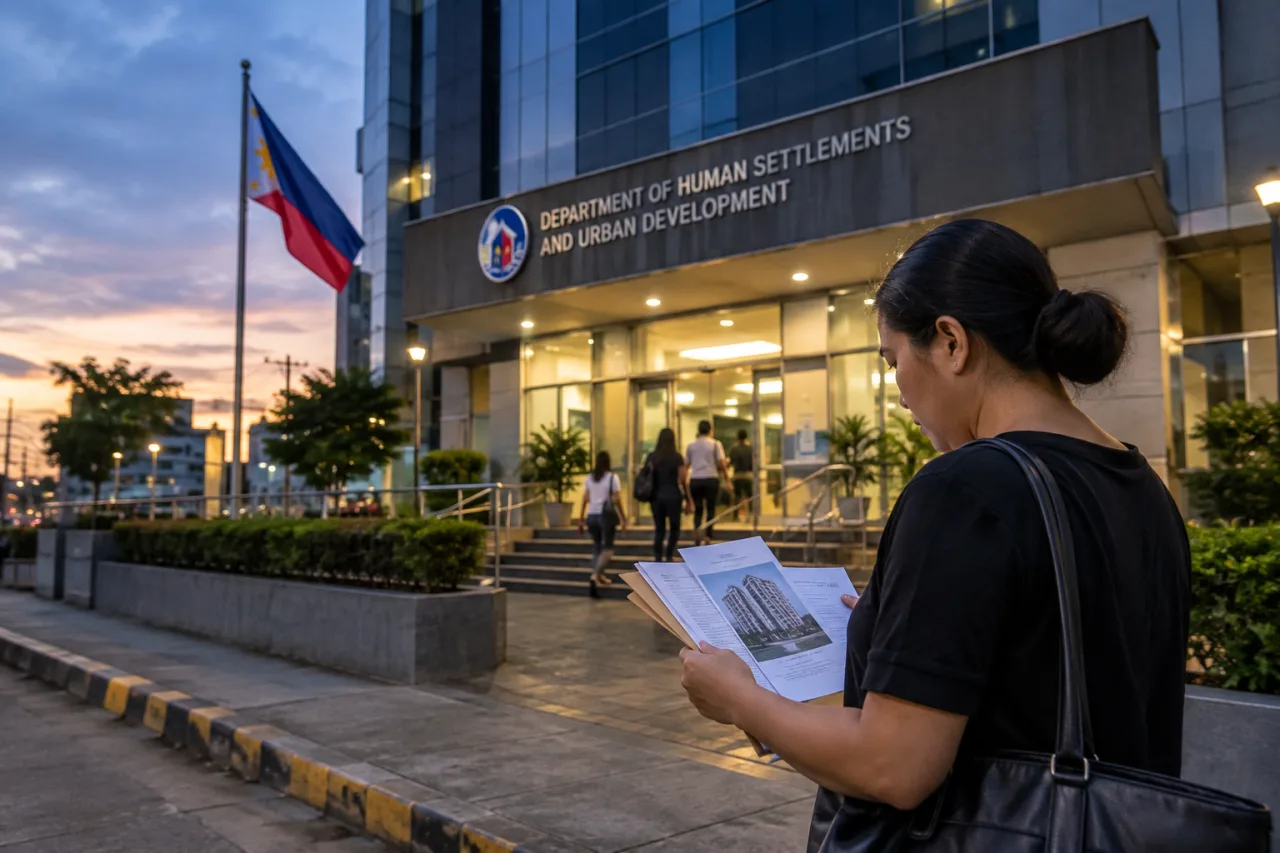
PD 957 (1976) — the Subdivision and Condominium Buyers’ Protective Decree — requires every subdivision and condominium project to carry the License to Sell and the DHSUD (formerly HLURB-class) registration before any unit sells; a project selling without it is the fastest developer scams check the buyer runs, and the permit’s details (project name, license number, the approved plan) are public at the DHSUD’s own registry. RA 6552 — the Republic Act the “Maceda Law” popularized (1972) — governs installment-to-own cancellations: the grace-period classes (the two-months-per-year-class rule after at least two years paid), the refund percentages by years-paid class, and the contract’s own forfeiture lines — the framework that answers “what happens to my money if this breaks.” The desk’s anchors: both statutes’ full texts live on the lawphil archive’s RA 6552 page and PD 957’s own — read them before signing anything; the dated law-office analysis carries the turnover-delay classes in detail (delayed turnover and refunds, the law-office analysis).
The Developer Scam Families and Their Tells
- The no-license pre-selling: units promoted without the license-to-sell — the tell: the project’s own DHSUD entry missing; the desk’s rule: no license listing = no deposit, whatever the model unit shows.
- The too-good payment plan: the zero-down/zero-interest classes that collapse into forfeiture terms inside the CTS — the tell: the contract’s own cancellation schedule (read the forfeiture class before the promos).
- The double-sale: the same unit sold twice — the tell: the title’s own status at the Registry of Deeds (the transfer class’s record the desk’s title-verification checklist below runs); the OFW’s absence is what the second-sale scammers count on.
- The fake-SPA transfer: the absent owner’s “signature” moving titles or selling lots — the desk’s SPA rules below are the whole defense.
- The turnover-delay drift: the months-to-years class where the family visits a shell — the rights side carries in the desk’s refund-analysis piece; the prevention side = the contract’s own turnover schedule + penalties read before signing.
The SPA Against Developer Scams: the Absent Buyer’s Power of Attorney
The instrument that does the most damage when sloppy. What it is, plainly: the Special Power of Attorney authorizes a named relative/agent to perform named acts (inspect, pay a specific amount, sign specific documents, receive title) on the buyer’s behalf — the acts must be NAMED, not generalized; a broad SPA is the scammer’s license. The construction rules: (1) the SPA names the agent, the property, and each authority precisely; (2) the document carries the consular/notarial authentication class valid where the buyer signs — the Philippine consulates abroad run their own SPA notarization and authentication lanes (the same offices the desk’s passport-renewal guide maps); (3) the SPA carries an expiry and gets REVOKED in writing when the transaction closes — the unrevoked SPA sitting in a drawer years later is the quiet breach the estate disputes feed on. The desk’s framing, no advice: the SPA’s three rules (named acts, authenticated, revoked) are what the scammer’s whole playbook fails against.
The Developer-Scams Pre-Deposit Checklist: the Desk’s Verified Order
- The license check first (the DHSUD registry’s own lists) — the uproperty guide’s top-of-listed mistake; the check runs before any broker’s pitch earns attention.
- The developer’s own record: the company’s registration, the delivered-project history (the turnover-classes), the complaints’ surface — the guides’ practical test: the delivered projects’ residents themselves.
- The CTS’s own clauses: the turnover date + its delay penalties + the forfeiture schedule + the price-escalation class — read in full before any deposit; the desk’s refund piece prices the post-signature reality.
- The title’s status at the Registry of Deeds: the TCT/CCT class’s own record (the developer’s ownership + any encumbrances) — the registry’s certified copies are the buyer’s own receipt of the fact-check.
- The agent’s identity: the broker’s/agent’s own registration (the DHSUD’s real-estate-service classes) — the unregistered-agents’ class is where the too-good developer scams lives.
- The money’s rails: all payments through the developer’s own named bank accounts (never the agent’s personal accounts — the desk’s wrong-send lessons carry why – the developer scams class has no better defense than a documented account name), with every receipt archived; the remittance-funding class runs through the desk’s corridor guides (the markup board for large tranches — a one-point spread difference on a ₱5M purchase is a month’s salary class).
The OFW Money Layer: Funding the Purchase Defensibly
The funding pattern keeps the money (and the buyer) safe: the purchase’s peso conversions run staged (the desk’s peso playbook’s rules on the record-low run); the transfers carry documentary trails (the remittance receipts + the bank’s inward records = the anti-money-laundering class the banks run anyway — the OFW’s clean paper trail IS the protection); the account structure runs the purchase’s own dedicated receiving account (the desk’s OFW account pieces carry the setup); and the household’s boundary ledger decides the purchase’s affordability BEFORE the deposit — the desk’s family-budget frameworks apply their hardest test at the biggest purchase. The family-side execution: the SPAs + the receipts + the inspections (the turnover’s own walkthrough) = the relative’s named jobs — bounded, documented, revocable.
What Would Change This Reading: the Invalidation Ledger
- A regulatory change: the DHSUD’s own rules’ evolution (the licensing classes, the buyer-protection updates) — the registry and the agency’s pages are the re-verify points.
- The foreign-ownership question: any movement on the non-Filipino ownership classes reshapes the diaspora buyer’s structuring — the agencies’ own interpretations govern.
- The SPA/authentication channel changes: the consular lanes’ rules or the apostille classes moving — re-verify with the consulate before any trip.
- The market’s own state: the pre-selling market’s cycle (the oversupply/demand classes) changes the developer-scam pressure — the guides’ market notes re-verify each year.
The Money-Movement Scams Beside Developer Scams
The purchase’s money carries its own scam layer, and the OFW lane’s records carry it well. The agents’ personal accounts: any seller’s agent asking deposits into their own account name – the piece’s rule: the developer’s own documented accounts only, and the desk’s wrong-send lessons explain why. The fake-acknowledgment fraud: the receipt that proves nothing because the agent wrote it – only the bank’s own inward-remittance records and the developer’s official receipts count. The remittance-side vectors: the buyer’s own funding runs through the corridor’s rails with clean trails; the “help me convert” class (the friend’s peso-exchange favor at the airport rates) breaks both the paper trail and the safety net – conversions happen at the banks, receipted. The relative-side vectors: the SPAs’ misuse class (the piece’s three rules) plus the household’s own financial pressure – the boundary framework applies with real force at a house-sized purchase. The desk’s closing system: every peso’s path named, every receipt archived, every authority verified at its own office – the structure that lets the big purchase close safely from half a world away.
What the Evidence Supports, by Reader Situation
Education desk, not an advisory service — decision inputs, never instructions.
- If you’re an OFW planning the family home: the checklist’s order (license → developer record → CTS clauses → title status → the SPA’s three rules) is the sequence the scam-checklist runs before money moves; the funding layer’s trails are the belt.
- If you already bought and the turnover lags: the desk’s rights piece prices the refund classes and the delay’s options — the decision inputs live there; this piece’s prevention stack feeds the next purchase.
- If a relative signs for you: the SPA’s named-acts rule + the receipt-archiving habit + the revocation on completion = the whole system; the relative’s own account never touches the purchase money.
FAQ
Can an OFW buy property in the Philippines from abroad?
Yes — Filipino citizens abroad buy without restriction; buyers who are NO LONGER Filipino citizens face the 40% foreign-ownership cap’s classes (condominium-unit percentages under RA 4726’s framework) — the structure decision runs before the deposit. Dual citizens’ class runs its own rules; the piece’s structuring note carries the honest frame.
What is the first check before paying a Philippine condo developer?
The first defense against developer scams: the DHSUD license-to-sell and the project’s registration — PD 957’s own requirement and the buyer-guides’ top listed mistake; the registry’s public lists confirm the project before any model-unit visit earns trust.
What does the Maceda Law actually give me?
RA 6552’s own classes: the grace periods on installment cancellations and the refund percentages by years-paid — with forfeiture terms where the contract’s classes apply. The law’s texts live on the lawphil archive; the piece’s refund analysis carries the turnover-delay classes beside it.
How does an SPA work for an OFW buying property?
The Special Power of Attorney names the relative/agent, the property, and EACH authorized act — then carries the consular/notarial authentication where you sign, and gets revoked in writing once the transaction closes. The three rules (named acts, authenticated, revoked) are also the scam-defense — broad, unauthenticated, unrevoked SPAs are the fraud vectors.
How do I verify a property title from abroad?
Through the Registry of Deeds’ certified copies (the relative’s or the lawyer’s errand under the SPA’s named acts): the TCT/CCT’s current state, the developer’s ownership, and any encumbrances — the certified copy is the buyer’s own evidence; the desk’s checklist runs it before the deposit, not after.
What payment method keeps OFW purchases safe from developer scams?
All amounts through the developer’s own documented bank accounts (never personal/agent accounts), fully receipted, with the remittance’s own trails kept — the anti-money-laundering classes the banks run do the rest; the dedicated receiving account + the staged conversions complete the desk’s verified funding layer.
The OFW’s Own Case File: the Checks Run End to End
A worked example with real numbers, the prevention-stack applied. Month one: the OFW spots a pre-selling project online; run one – the DHSUD registry’s list for the project name: the license-to-sell exists, the developer’s registration matches; run two – the Registry of Deeds certified copy through the SPA-named relative: the TCT carries the developer’s own name, no encumbrances; run three – the developer’s delivered history: three completed towers, the residents’ Facebook groups live and mostly quiet. Month two: the CTS read line by line – the 30-month payment plan, the turnover clause at 36 months with a class penalty, the escalation schedule at X percent – the red-flag class the desk’s prompt-of-the-day guides teach to spot; the lawyer’s hour (the SPA-named act) reads the instrument once; the SPA drafted narrow (inspect + pay + receive, nothing else, expiring at the turnover). Month three: the deposit moves through the developer’s documented account from the OFW’s own receiving account, receipted on both sides; the staging (the peso conversions run at the corridor’s rules) – the transfer’s trail saved to the claims folder. Months four to six: the payment schedule runs; the receipts archive monthly; the status re-verified at the registry yearly. The case file’s own lesson, verified by everything the piece carries: the developer scams defense is not one big check but a calendar of small ones – and the absent buyer runs it without ever flying home.
Financial Disclaimer
This article is for general information and education only. It is not financial, investment, legal or tax advice, and it does not recommend any property, developer, broker or transaction. Laws, agency rules, fees and market conditions change; every figure and legal citation was verified against the cited sources (the statutes’ own texts, the agencies’ frameworks and the dated guides) as of November 2026 and must be re-confirmed with the DHSUD, the Registry of Deeds and your own legal counsel before any property decision. WorldNgayon is not affiliated with any developer or agency named, and no content on this site should be acted upon without independent verification and, where appropriate, advice from licensed professionals.
- respicio.ph/commentaries/delayed-pre-selling-condo-turnover-in-the-ph… — the dated law-office analysis on buyer rights
- lawphil.net/statutes/repacts/ra1972/ra_6552_1972.html — the lawphil archive’s RA 6552 page
- lawphil.net/statutes/presdecs/pd1976/pd_957_1976.html — PD 957’s own
External sources linked in this article, in order of first mention. Spotted an error or a broken link? Tell us.
Cite this pagePublished Nov 2, 2026
Agron, E. (2026, November 2). Buying Real Estate in the Philippines While Abroad: How to Avoid Developer Scams and SPA Pitfalls. WorldNgayon. https://worldngayon.com/buying-property-abroad-developer-scams/
Agron, Edmon. “Buying Real Estate in the Philippines While Abroad: How to Avoid Developer Scams and SPA Pitfalls.” WorldNgayon, 2 Nov. 2026, worldngayon.com/buying-property-abroad-developer-scams/.
Agron, Edmon. “Buying Real Estate in the Philippines While Abroad: How to Avoid Developer Scams and SPA Pitfalls.” WorldNgayon, November 2, 2026. https://worldngayon.com/buying-property-abroad-developer-scams/.
Agron, E. (2026) ‘Buying Real Estate in the Philippines While Abroad: How to Avoid Developer Scams and SPA Pitfalls’, WorldNgayon, 2 November. Available at: https://worldngayon.com/buying-property-abroad-developer-scams/.
E. Agron, “Buying Real Estate in the Philippines While Abroad: How to Avoid Developer Scams and SPA Pitfalls,” WorldNgayon, Nov. 2, 2026. [Online]. Available: https://worldngayon.com/buying-property-abroad-developer-scams/
@online{agron2026buyingproperty,
  author       = {Agron, Edmon},
  title        = {{Buying Real Estate in the Philippines While Abroad: How to Avoid Developer Scams and SPA Pitfalls}},
  year         = {2026},
  date         = {2026-11-02},
  organization = {WorldNgayon},
  url          = {https://worldngayon.com/buying-property-abroad-developer-scams/},
  urldate      = {}
}TY - ELEC AU - Agron, Edmon TI - Buying Real Estate in the Philippines While Abroad: How to Avoid Developer Scams and SPA Pitfalls T2 - WorldNgayon PY - 2026 DA - 2026/11/02/ UR - https://worldngayon.com/buying-property-abroad-developer-scams/ Y2 - ER -
Cite the version you read; the page may be updated. Zotero and Mendeley can also import this page directly.