Table of Contents
Key Takeaway
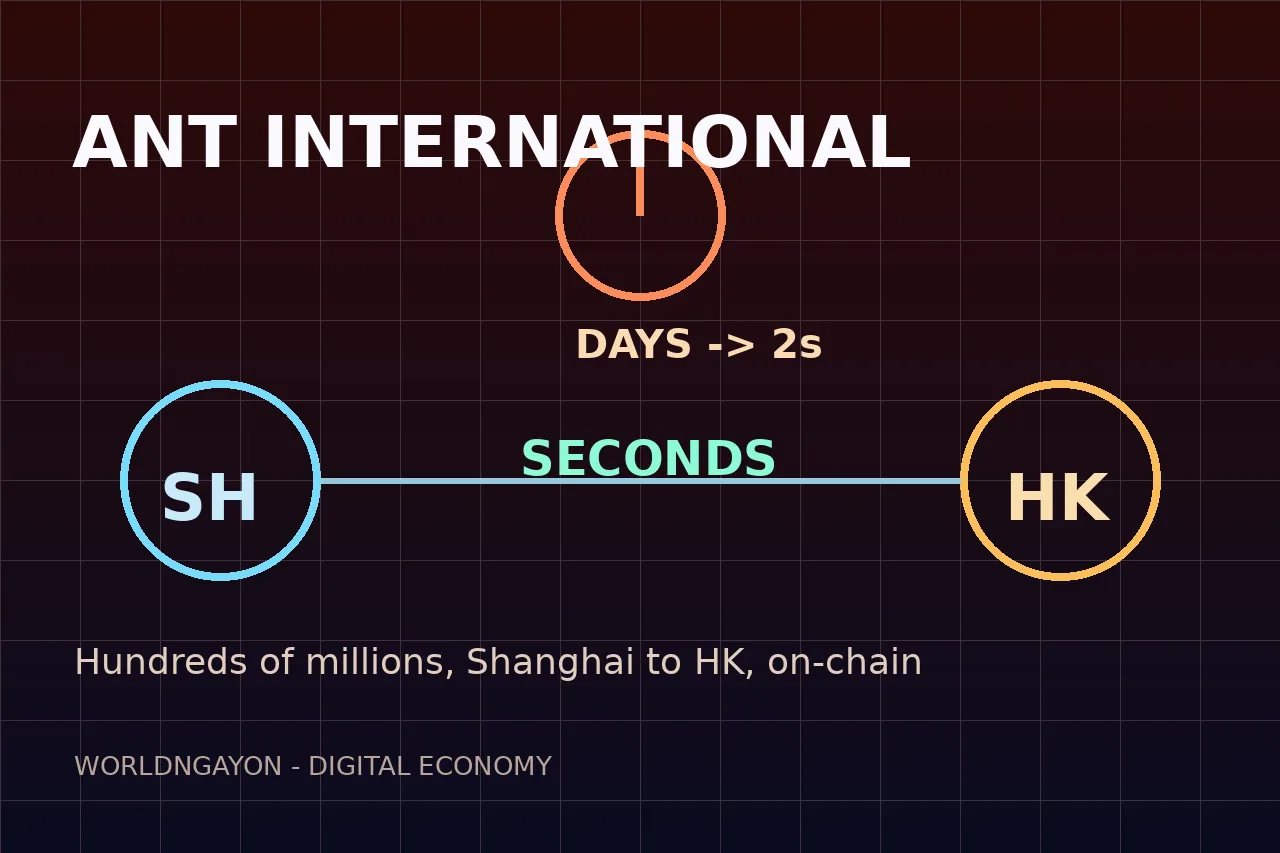
- Two Chinese state banks, on two consecutive days, moved digital yuan for Ant International “hundreds of millions” in digital yuan between Shanghai and Hong Kong for Ant International — with second-level settlement replacing a multi-day clearing cycle.
- ICBC Shanghai executed the first single-direction transfer to ICBC Asia; a day later CCB Shanghai plus CCB Asia completed a two-way corporate treasury sweep, fully recorded on-chain.
- Ant’s rails behind the deal: Alipay+ with 50+ payment partners, coverage of 150 million merchants and 2 billion consumer accounts, plus WorldFirst and Antom serving 1.6 million overseas-operating businesses.
- State media projects a 30–60% FX-cost cut for cross-border merchants — a direct warning shot at the pricing structure of every remittance corridor, including the Philippines’.
Two Banks, Two Days, One Direction of Travel
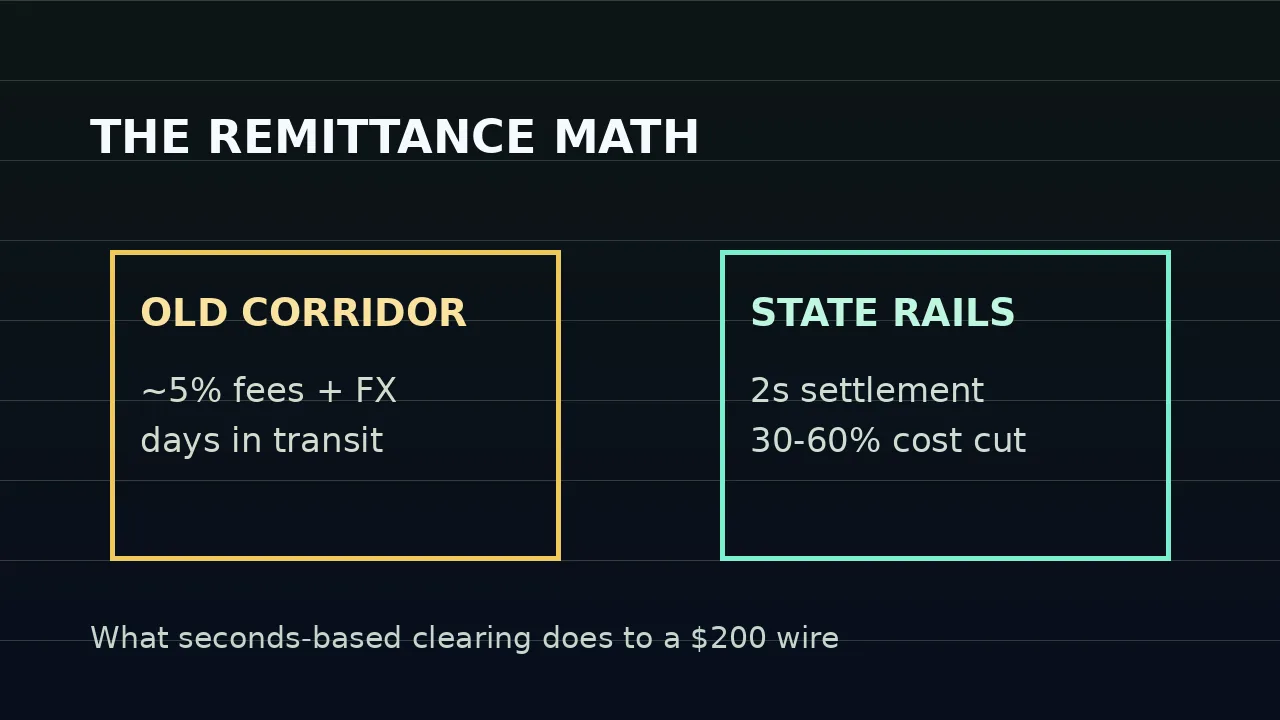
The Shanghai office of ICBC executed the first digital-yuan cross-border transfer for Ant International, pushing hundreds of millions of yuan to ICBC Asia in Hong Kong — arrival in seconds, against a traditional cycle of several days. One day later, CCB Shanghai and CCB Asia together ran a two-way treasury transfer for the same client: corporate funds swept Shanghai-to-Hong Kong and back, both directions clearing in real time, the full transaction chain recorded on-chain and auditable.
State media framed the pair of deals as proof that digital-yuan “seconds-level arrival” is moving from pilot to routine. That is the right reading. Pilot programs die quietly; treasury operations scale when finance ministries tell newspapers about them.
What “Payment Is Settlement” Buys a Treasurer
Large two-way flows cost money while in transit — overnight funding on positions that spend days crossing borders, plus timing gaps between branch systems. Digital-yuan rails collapse that window: payment becomes settlement, the funds land in seconds, and the auditor’s trail is written as the money moves. CCB Asia’s management called out the specific target: efficient collection and allocation of corporate funds across borders, solving the efficiency-and-compliance pain of large two-way flows. Hong Kong’s offshore-RMB clearing hub status did the landing work.
Ant’s Reach, Beijing’s Rails
Why does Ant International matter here? Because its infrastructure is the distribution layer the state rails lack. Alipay+ connects over 50 payment partners covering 150 million merchants and 2 billion consumer accounts; WorldFirst and Antom serve 1.6 million businesses operating across borders. Ant’s platform-technology chief, Li Yue, described the CCB deal as a breakthrough for RMB in cross-border treasury — and pointed to expansion through Shanghai and Hong Kong toward Southeast Asia and Europe.
The architecture underneath is double-centered: Beijing’s digital-yuan operations management center plus Shanghai’s International Operations Center, with Shanghai free-trade-zone institutional innovation doing the policy lifting.
Why Treasury Flows, Not Remittances, Went First
Corporates came before consumers for unglamorous engineering reasons. Treasury flows are large, predictable and compliance-heavy — exactly the profile where a bank can guarantee every regulatory box is ticked before the first yuan moves. Consumer remittances fan out across thousands of endpoints with KYC at each one; a treasury sweep touches two counterparties with existing banking relationships. The ICBC and CCB deals prove the state rails work at institutional scale, and the Ant International corporate playbook — collection sweeps, pooling structures, the “payment is settlement” discipline — becomes the template the consumer side inherits.
The sequence also matches how Ant International’s infrastructure actually layers. Corporate treasury rides state bank rails; merchant settlement rides Ant’s own clearing stack; consumer wallets ride Alipay+ partners. Each layer scales on the one below it. The Ant International treasury deals are the bottom two layers wiring together — the layer above them, cross-border consumer QR, is what the Laos interconnection just demonstrated in retail form.
The Merchant Dividend — and the Corridor Threat
State media attached numbers to the downstream Ant International effect: FX-cost reductions of 30% to 60% for small and mid-sized export merchants, and an ambition of T+0 real-time settlement for cross-border e-commerce sellers — overseas receivables behaving like domestic QR payments. For an OFW household in Manila receiving Riyadh wages through incumbent corridor pricing, that is the sound of the cost benchmark moving. Corridors don’t have to route through digital yuan tomorrow for the threat to bite: the mere existence of near-free state-grade clearing re-prices every incumbent’s fees. Our earlier Philippines digital-payments coverage shows how fast a market flips once rails get cheap enough.
The Double-Center Architecture Doing the Lifting
Behind both transfers sits administrative plumbing most coverage skips. China runs digital-yuan operations through two centers: Beijing’s operations management center for domestic infrastructure, and Shanghai’s International Operations Center for the cross-border build-out. The Shanghai free-trade-zone account system supplies the institutional sandbox that lets a state bank route corporate funds onto digital yuan rails without breaking capital-flow rules, while Hong Kong’s offshore-RMB clearing hub — home of the territory’s two licensed stablecoin issuers — does the receiving.
That division of labor explains why Shanghai keeps landing these firsts. The city holds the policy tools, the clearing relationships and now the corporate demand — Ant International’s treasury being the highest-profile test case. Shanghai officials framed the next phase explicitly after the ICBC deal: expand through Shanghai and Hong Kong toward Southeast Asia, Europe and more, building a compliant, efficient, around-the-clock RMB cross-border payment network. The Ant International deals are the flagship of that framing, and the digital yuan is its instrument.
What the On-Chain Audit Actually Changes
The CCB announcement emphasized full-process on-chain recording, end-to-end traceability, controllable risk. In treasurer language: every leg of the transfer writes an immutable record as it settles, so reconciliation — the expensive back-office afterlife of every cross-border payment — collapses into reading the chain. Disputes resolve against a shared ledger instead of correspondence chains. Compliance review sees the same trail the treasury office sees.
That is the quiet operational revolution inside the seconds headline. Speed saves interest expense; the shared audit trail saves operations headcount and dispute float. Incumbent correspondent chains can eventually match speed with faster wires — they cannot match a built-in settlement-grade audit trail without rebuilding their reconciliation stack from zero. It is why the Ant International model is harder to copy than it looks.
The Incumbents’ Problem, Stated Plainly
Correspondent banking charges for time. Days in transit means overnight funding, reconciliation batches, cut-off windows and hedging costs that all price into wire fees and FX spreads. If Ant International‘s rails move the same value in seconds with on-chain audit, the incumbent’s cost structure is not being beaten — it is being made irrelevant. The 30-to-60% FX-cost projection from Ant’s own materials is not aspirational marketing; it is the arithmetic of deleting days from the value chain.
Incumbents have answers: ISO 20022 modernization, instant-payment linkups, their own blockchain pilots. But none of those compress settlement to seconds while deleting the correspondent layer, and none carry a state’s regulatory tailwind. The digital yuan corridors do. When a rail is faster, cheaper and politically sponsored, pricing power does not erode — it relocates.
The Distribution Layer: From Rails to Merchants via Ant International
The state banks supplied the rails; Ant International supplies the reason they fill up. Alipay+ connects more than 50 payment partners spanning 150 million merchants and 2 billion consumer accounts — a ready-made distribution mesh that most central-bank projects spend a decade failing to build. WorldFirst and Antom already move money for 1.6 million businesses operating across borders, which is why treasury was the natural first product: those 1.6 million relationships are exactly the corporates whose funds sweep Shanghai-to-Hong Kong.
The merchant economics are where the model turns aggressive. Ant’s materials project 30-to-60% FX-cost reductions for small and mid-sized cross-border merchants, with T+0 real-time settlement as the ambition — an overseas receivable behaving like a domestic QR receipt. Ant’s own platform-technology chief, Li Yue, described the CCB deal as a breakthrough for RMB in cross-border treasury, and the expansion sequence as market-based scaling alongside the state banks: Southeast Asia and Europe next, riding the Shanghai-and-Hong-Kong spine.
Compare that to the incumbent path: a small exporter in Cebu or Yiwu waits days for clearing, pays a spread on conversion, and funds the working capital gap out of margin. The Ant International stack deletes the waiting and halves the spread — not through subsidy, but through physics. Value that arrives in seconds does not need float financing, and the digital yuan leg that makes it possible is the cheapest piece of the whole chain.
The Laos Template, Retail Edition
Two provinces away from the Shanghai towers, the consumer version of this architecture already switched on. October 10 marked the formal launch of China-Laos cross-border payment interconnection: the digital yuan’s CBETS platform joined to Laos’s LAPNet network, QR interoperability live, following the June bilateral MOU on financial innovation and digital currency cooperation. A Chinese resident’s digital yuan wallet scans a Lao merchant’s QR as if the border did not exist. Late-2025 pilots had already proven the mechanics; the formal switch means常态化 — routine operation — and widening merchant coverage.
The combination matters more than either piece. Laos demonstrates the retail interconnection template; Shanghai-Hong Kong demonstrates the wholesale treasury template; both run on the same digital yuan infrastructure with the same second-level settlement property. For corridor economies, the Laos case is the one to study: a market with a fraction of the Philippines’ payment sophistication built working central-bank-currency retail rails in months, with Beijing flagging the model as replicable. When remittance pricing committees in Manila or Dubai model their next five-year fee curves, this is the baseline scenario that now exists.
Manila Math: What the Benchmark Does to a $200 Wire
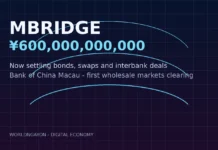
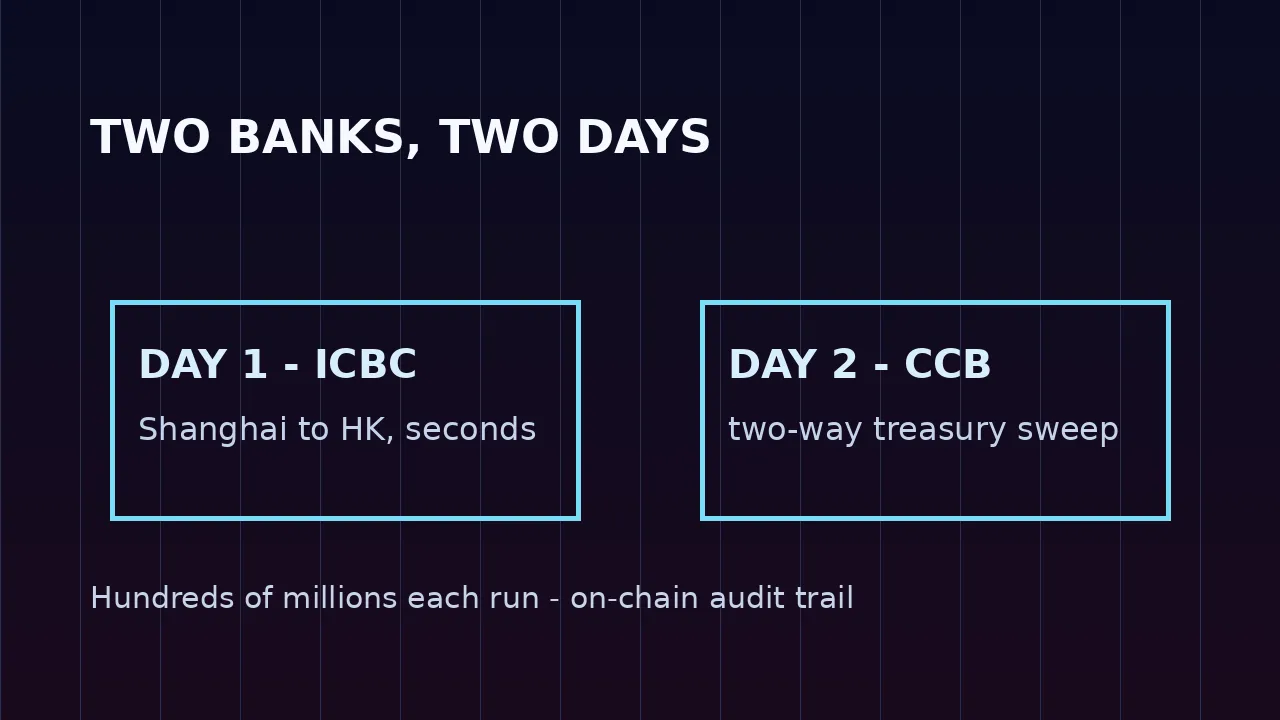
Make the corridor arithmetic concrete. A $200 remittance from Riyadh to Manila through incumbent channels loses roughly 5% on average between fees and FX spread — about $10 per transfer, multiplied across millions of monthly transactions. If state-grade clearing compresses corridor costs the way the Ant International projects claim for merchant flows — the 30-to-60% band — the same transfer carries $3 to $7 more purchasing power into the household budget. No consumer ever reads an mBridge whitepaper; every consumer notices when the fee table drops.
The Philippines enters this contest holding a strong card: the majority-digital payments base built by InstaPay, QR Ph and the e-wallet duopoly is exactly the receiving infrastructure a state-rail interconnection would plug into — technically ready, regulatorily literate, commercially concentrated. The digital yuan lanes now running to Laos prove Beijing will build the bilateral plumbing with economies far smaller than the Philippines. The open question is purely political: whether Manila negotiates a CBETS-style interconnection, a bank-level corridor, or watches the benchmark reprice everyone around it.
That is what makes the Shanghai-Hong Kong deals worth more than their size. The Ant International treasury transfers are not OFW news; they are the visible top of a cost curve sliding toward every corridor in the region, and curves like that do not stop at borders declared or undeclared.
The Honest Caveat
Scale check: these are institutional treasury flows, not consumer volume. e-CNY’s domestic circulation remains a small slice of Chinese payments, and “hundreds of millions” per deal — while symbolically huge — is a rounding error next to global correspondent banking. But direction beats size, and the direction now has institutional grade attached: state banks that would not touch a retail crypto product cleared wholesale digital-yuan treasury flows without a single new regulation announced — because the plumbing, the audit trail and the supervisory architecture were already in place.