Table of Contents
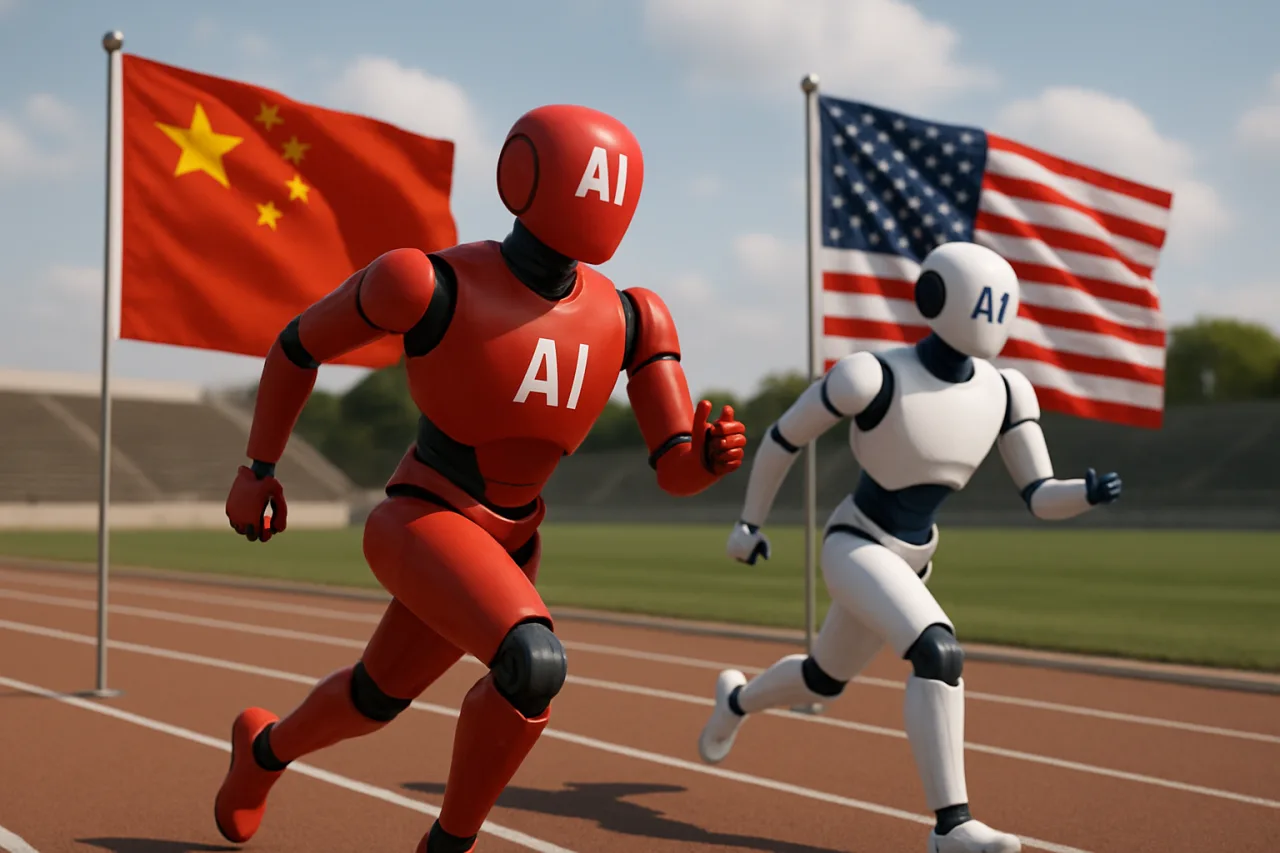
Who is winning the AI race? As of October 2026, the honest answer is that the question conceals a second question — because the United States and China are not running the same race anymore. On the race to build the most capable artificial intelligence, the US leads, and the gap is small enough to measure in months. On the race to put AI into the hands of the world’s developers, factories, and devices, China leads, and the gap is widening into years. One AI race is about the best brain ever built; the other AI race is about who becomes the world’s default. A feature-length scorecard, lane by lane, shows where the race actually stands — and why the trophy at the end depends on which race you believe matters.
Key Takeaway
- 🧠 Frontier models: US ahead by months. The best US model leads China’s best by roughly 2.7 percentage points on major benchmarks (Stanford AI Index 2026), and the US produced 59 notable frontier models in 2025 against China’s 35 — but China’s best open-weight releases now trail the US frontier by roughly eight months, not years.
- ⚡ Compute: US dominant globally, losing at home in China. The US controls nearly three-quarters of the world’s AI computing power versus China’s 14% — yet inside China’s own market, Huawei has overtaken Nvidia to hold about 50% of AI chip share.
- 💰 Capital: 23× private-money gap, but state money changes the picture. US private AI investment hit $285.9 billion in 2025 versus China’s $12.4 billion — but Beijing has directed an estimated $912 billion through state guidance funds since 2000.
- 🌍 Diffusion: China owns the open-weight world. Chinese open models reached 1.15 billion cumulative downloads (vs 723M American) and now hold more than 70% of open-model inference tokens on major gateways — US companies themselves spend over 30% of their tokens on Chinese models.
- 🏭 The physical race: China runs it. China installs more industrial robots than the rest of the world combined (295,000 in 2024 vs 34,200 in the US), and over 30% of its large industrial firms have adopted AI — AI in production, not just in apps.
The Verdict in One Table: Where the AI Race Stands in October 2026
| Lane | United States | China | Edge |
|---|---|---|---|
| Frontier model quality | Best models on Arena; 59 notable models in 2025 | 2.7 points behind; open weights ~8 months back | US, narrowly |
| AI computing power | ~74% of world capacity (Epoch AI) | ~14%, constrained by chip controls | US, decisively |
| Chips — the US home market | Nvidia at ~85%+ share of the western AI accelerator market | Nonexistent (denied access) | US |
| Chips — China’s home market | Nvidia down from 95% to ~8% | Huawei Ascend at ~50% | China |
| Private AI capital | $285.9B in 2025 (Stanford AI Index) | $12.4B disclosed | US, 23× |
| State-guided capital | No equivalent program | ~$912B via guidance funds since 2000 | China |
| Open-weight adoption | 723M cumulative downloads | 1.15B downloads; 70% of open-model inference tokens | China, decisively |
| Industrial AI and robots | 34,200 robots installed in 2024 | 295,000 installed; >30% of large firms adopted AI | China, decisively |
Two races, two scoreboards. The rest of this feature walks each lane with the source numbers, names the analysts behind them, and then delivers the verdict — including the practical answer for working professionals who have to pick tools this quarter — the AI race’s daily reality for everyone who builds on these systems, not sides this decade.
Lane 1 — Frontier Models: The Gap the AI Race Measures in Months
The single most cited number in this contest comes from Stanford University’s Institute for Human-Centered AI, whose 2026 AI Index report found the performance gap between the best US model and the best Chinese model had shrunk to roughly 2.7 percentage points on major benchmarks as of March 2026 — a margin that has flipped between the countries multiple times over the past year as both set successive records. The US still produced more of the year’s notable frontier models: 59 American versus 35 Chinese in 2025, per the Index and Epoch AI’s tracking. On Arena, the human-preference leaderboard where users vote blind between two anonymous systems, the top of the October board belonged to Anthropic’s Opus-class models at scores near 1509 Elo — with Moonshot AI’s open-weight Kimi K3 sitting within striking distance at roughly 1500, ahead of many American closed flagships.
US government analysts, notably, agree the lead is real but thin. The Center for AI Standards and Innovation — the Commerce Department unit that evaluates foreign models — assessed that DeepSeek’s V4 Pro release trails the leading US models by about eight months. CSIS analysts reviewing the recent Chinese releases concluded the same pattern: Chinese labs are now months, not years, behind the frontier. Z.ai’s GLM-5.2, a 750-billion-parameter open-weight system with a million-token context, scores ahead of GPT-5.5 on the hardest agentic-coding benchmark they cite; Moonshot’s Kimi K2.7 Code follows the American closed models closely on software-engineering tasks. The DeepSeek shock of January 2025 — a reasoning model at a fraction of rival training cost — now reads less like a one-off and more like a standing production capability.
The honest reading of this lane: the US leads today’s frontier, the lead is measured in release cycles rather than years, and the one structural American advantage — first access to the best compute — has not translated into an uncatchable lead at benchmark level. In the AI race’s first lane, the lead is real and it is thin.
Lane 2 — Compute: Where the US Holds Two-Thirds of the World’s Chips
If the race is defined by raw machine capacity, the numbers are lopsided. The US accounts for nearly three-quarters of the world’s total AI computing power, with China holding just over 14%, according to Epoch AI figures cited by Al Jazeera’s October 2026 race analysis. The US hosts 5,427 AI-relevant data centers — more than ten times any other country — and the global capacity bill now reads 29.6 gigawatts, per the Stanford Index. Nvidia, alone, sits behind more than 60% of the world’s AI compute; almost every leading AI chip on Earth is fabricated by a single Taiwanese company, TSMC, a dependency both Washington and Beijing have noticed. It is the deepest foundation anyone has built under the AI race — nearly all American.
That single-foundry reality is the hinge of the entire hardware war. Washington has spent the export-control era (October 2022 onward) progressively walling off advanced accelerators — the A100 and H100 first, then the customized chips that followed — while periodically loosening and re-tightening the gate: the H20 license reversal, the payment of 15% of China chip-sale revenues to the US government, the repeated revisions catalogued by the Congressional Research Service. The Congressional Research Service’s own assessment records a parallel finding, that Huawei’s Ascend line was developed in violation of US controls — and that Washington has warned global firms that using those chips violates US export law, an attempt to extend the wall beyond American borders.
Inside China’s borders, the wall produced the AI race’s sharpest reversal: the opposite of its design. Nvidia held roughly 95% of China’s AI chip market in 2022; this year, Bernstein estimates it will hold about 8%, while Huawei runs to roughly 50% — the milestone Huawei itself telegraphed at its 2026 developer conference, with its 2026–2028 Ascend roadmap promising successive generations of domestic silicon. Broadcom-class merchant accelerators remain an American fortress in the West, Cambricon plans half a million domestic accelerators for 2026, and Chinese AI labs increasingly tout full-stack local deployments on national chips. In the AI race’s compute lane, the two systems are diverging by design: the US owns the global circuit, and China is building a second, entirely domestic one — with one island (Taiwan) and a handful of rare-earth supply chains holding the physics of both ambitions.
The capital behind the AI race’s machines follows the same asymmetry. US private AI investment reached $285.9 billion in 2025 — roughly 23 times China’s disclosed private figure of $12.4 billion, per the Stanford Index — and the five US hyperscalers were on an Al Jazeera-tracked capex path that took their annual infrastructure spending from about $156 billion in 2023 toward a trillion-dollar run-rate, against Chinese hyperscalers climbing to roughly $102 billion in the same window. But Beijing plays a different game with different money: state guidance funds have directed an estimated $912 billion toward technology priorities since 2000, a figure the Stanford Index explicitly flags as invisible in the private-capital tallies. The US bet is a stack of private balance sheets; the Chinese bet is a state balance sheet that does not ask for quarterly returns. Both are enormous war chests for the AI race. Only one has ever been cash-flow constrained.
Lane 3 — Diffusion: The Open-Weight Flood Winning Silicon Valley Users
Here the scoreboard of the AI race inverts — and it inverted quietly while the compute war dominated headlines. The open models — the ones anyone can download, inspect, adapt, and run themselves — are now overwhelmingly Chinese. The ATOM Report’s spring 2026 tracking found Chinese open models overtook American ones in cumulative downloads in mid-2025 and never looked back: 1.15 billion cumulative downloads versus 723 million by March 2026, with the gap widening past 400 million. Alibaba’s Qwen family alone passed 940 million downloads — nearly double Meta’s Llama — and became the base for roughly 70% of all new open-model derivatives by February 2026 — the default foundation of the AI race’s open side. Hugging Face’s own ecosystem report confirms the pattern: over the past year, Chinese models accounted for about 41% of platform downloads, with Baidu going from zero public releases in 2024 to more than 100 in 2025, and ByteDance and Tencent multiplying theirs by roughly eight to nine times.
Actual usage tracks the downloads. On OpenRouter, the inference gateway that records which models developers really run, Chinese models’ token share rose from under 3% to over 70% in roughly fourteen months; DeepSeek’s V3 and R1 alone held three-quarters of all tracked inference tokens at their 2025 peak, and by January 2026 DeepSeek remained the single largest provider of gateway tokens. The demand is not merely outside the US: CNBC’s July 2026 analysis found US companies have spent more than 30% of their gateway tokens on Chinese models every week since February, once peaking at 46%, versus an 11% average over the prior year. The startup Lindy moved 100% of its AI workload from Anthropic’s Claude to DeepSeek in June and reported improved results on many core cases; Z.ai’s GLM-5.2 recorded the fastest adoption Vercel had tracked in 2026, with daily token volumes growing roughly 27-fold in its first week. A16z partner Martin Casado has said around 80% of open-source-stack startups he sees are running on Chinese open models. Even Airbnb’s customer-service agent leans heavily on Qwen, per founder Brian Chesky’s public comments — fast, capable, and cheap, in his words.
The price gap explains much of it: OpenRouter’s analysts told CNBC Chinese open models run roughly 60–90% cheaper than the leading US closed systems, and teams route every task that does not need the absolute frontier to whatever is good enough and cheap. But the strategy is partly necessity, as analysts at CSIS point out: export controls cap China’s global inference capacity, so releasing weights lets the world’s third parties — from European hosts to government clouds — run the compute China’s labs cannot. That same design, however, cuts China’s access to the global user data, feedback loops, and subscription lock-in that US integrated products (ChatGPT, Gemini, Copilot, the coding agents) collect at scale. One system optimizes for reach; the other optimizes for revenue. The open-weight flood is also reordering the American side: Meta pivoted from Llama to its first closed frontier model this year, leaving the open frontier — as several analysts noted — effectively owned by Chinese labs while US efforts (OpenAI’s open models, Ai2’s OLMo, Google’s Gemma) attempt a counteroffensive on far smaller adoption numbers.
Lane 4 — The Physical Race: Robots, Factories, and Embodied AI
The lane where the two countries’ strategies differ most sharply is the physical one, and it is the lane most often missing from Western chatbot-centered coverage. China operates roughly 2 million industrial robots and installed about 295,000 more in 2024 — nearly nine times the US figure of 34,200, and more than the rest of the world combined. More than half of China’s new manufacturing equipment sold last year shipped with machine vision, predictive maintenance, or autonomous control built in. China’s industrial ministry reported that more than 30% of its large industrial enterprises had adopted AI by mid-2026, with thousands of certified “AI-empowered” factories, humanoid-robot production forecast at 100,000 units this year, and five-year plan targets of AI embedded across 70% of key sectors by 2027, 90% by 2030, and all of them by 2035. A new $138 billion national venture guidance fund is pointed at embodied AI — robots that act in the world — which China’s planners treat as the natural extension of its battery, electronics, and EV supply chains. Unitree, the humanoid-robot maker, produced more than 5,000 units last year and is preparing one of the year’s most anticipated listings.
The US lead in this lane is narrow, despite its software sophistication: American firms pioneer world-class robot-brain research, but the production base — the factories that turn designs into hundreds of thousands of installed units — and the government-integrated industrial policy sit on the Chinese side of the Pacific. The Council on Foreign Relations’ assessment of this lane is blunt: the US races toward AGI in data centers while China races through the physical economy, and the two strategies are betting on different definitions of what winning means.
Lane 5 — The Trust War: Access, Distillation, and the Rules Nobody Controls
The most consequential AI-race events of the year were not benchmarks but access decisions, on both sides of the Pacific. In June 2026, the US government suspended foreign access to two of Anthropic’s frontier models over national-security concerns — and Anthropic then withdrew those models from foreign availability entirely. CSIS analysts flagged the episode as self-defeating at scale: if foreign governments and firms believe American model access can vanish by executive decision, they will diversify into Chinese open weights, sovereign European models, or multi-provider stacks — a diffusion win in the AI race that China’s strategy could not have purchased. The same analysts document Washington’s escalating counter-offensive on distillation: OpenAI and Anthropic have accused Chinese rivals of siphoning their outputs at scale through fraudulent accounts, and the White House has treated adversarial distillation as a national-security issue with potential accountability measures — a fight that acknowledges how much of the open-weight advance is built on the closed frontier’s own outputs.
China holds asymmetric levers of its own. It has consolidated export licensing over the critical minerals and rare-earth processing that every advanced chip supply chain runs through, giving Beijing a choke-on-choke response to Washington’s chip walls. Washington’s own AI Action Plan — released years after China’s 2017 national AI development plan — plus the still-unsettled B30 licensing fight, and the unresolved question of who controls TSMC in a crisis, complete a picture in which neither government controls the rules of the other’s game. Analysts including Stephen Roach have added a longer arc: the country that feeds basic research wins the AI race’s long game, and on the metrics of government basic-research share, the US position has been eroding while China’s has compounded toward parity and beyond.
The Verdict: Two Races, Two Timelines — and the Prize of Being the Default
So who is winning the AI race? State the question precisely, and the answer stops being an opinion. If the race is to build the most capable systems — the AGI-race framing Washington prefers — the United States leads, by months on benchmarks and by years on compute capacity and the capital stack that funds them. If the race is to become the world’s default AI infrastructure — the model developers download, the factories run on, the systems the next billion users meet — China leads, by a widening margin in downloads, inference tokens, derivative models, robots, and industrial adoption. As Brookings’ Kyle Chan frames the long run, the winner will be determined not by who builds the most powerful models but by who translates AI into broad-based economic and societal gains — a criterion on which China’s strategy was built on purpose and America’s is being improvised.
The two AI races also constrain each other in measurable ways. The US compute lead keeps the frontier’s best models American — but every month of open-weight diffusion converts Chinese labs’ reach into tomorrow’s installed base, standards, and talent networks. The chip wall keeps China’s home market closed to Nvidia — and the first half of 2026 showed the cost of walls: the US lost China’s market it once held at 95%, China’s labs operate months behind on the compute they cannot buy, and the world’s only leading-edge foundry sits on an island both superpowers claim to defend. The race’s real answer, then, is a condition rather than a winner: the superpower with the best brain and the superpower with the installed base are not yet the same country, and the gap between those two titles is the actual story of 2026.
Watch five signals for where the AI race moves next: the CAISI gap assessments (months behind, converging or not); Huawei’s Ascend roadmap delivery against TSMC’s foundry constraints; OpenRouter and Hugging Face share (diffusion’s scoreboard); the first measurable wage and productivity effects in AI-exposed economies; and the next access-suspension episode — because whoever moves the world’s models most without breaking trust takes the prize both races are actually chasing.
What the AI Race Means for the People Building on These Tools
For working professionals, freelancers, and small businesses — the audience that has to choose tools, not countries — the scorecard converts into four practical moves. First, price discipline is on your side: with Chinese open models 60–90% cheaper at equivalent everyday quality, the rational default is routing routine work to inexpensive capable models and reserving costly frontier capacity for the tasks that genuinely need it — exactly the pattern our freelance AI pay analysis found already forming in the labor market. Second, understand what open weights change: a downloaded model you run yourself is data you never send anywhere — the sovereignty property that makes Chinese open models attractive to European startups and Southeast Asian agencies alike, and the reason 40%+ of the world’s open-model derivatives are now built on Qwen.
Third, respect both directions of access risk. US closed models carry price and policy volatility (the June 2026 foreign-access suspension showed how quickly frontier access can close); Chinese open models carry future trust and regulatory questions that enterprises and Western governments have only begun to price. A sensible stack holds both, documents which model handled what, and keeps an exit path from either. Fourth, invest in the skills that are nation-agnostic: our analysis of the IMF’s 700-million-job-ad dataset found the premium sits on the ability to direct AI systems and wire them into real organizational data — competencies that transfer across model vendors entirely. The professionals least exposed to whichever country wins the AI race are the ones whose value comes from orchestration, not from any single API.
For global Filipino professionals specifically — the BPO, fintech, and digital-services workforce that our regional infrastructure analysis covers — the race’s diffusion lane matters most: the models your clients’ stacks converge on will arrive through gateways and open weights rather than through any single vendor’s flag, and neither superpower’s victory changes the three-layer skill ladder that governs who gets hired. What changes is which tools make that ladder cheaper to climb — and in 2026, those tools are getting cheaper from both directions at once.
In the end, both countries’ own analysts converge on the same uncomfortable symmetry. The US has the compute, the capital, and the best models — and cannot convert any of it into global defaults without the openness and price that diffusion demands. China has the diffusion, the factories, and the open ecosystem — and cannot convert any of it into frontier superiority while the chip wall holds. Whoever breaks the other’s advantage first does not just win a lane. They win the race. Until then, October 2026’s answer to the question everyone is asking is: the US is winning the AI race it defined, China is winning the AI race it defined — and the only scorecard that matters from here is which definition the world itself adopts.
Frequently Asked Questions About the US-China AI Race
Who is winning the AI race as of October 2026?
Both countries lead the race they defined. The US leads frontier model capability (a 2.7-point benchmark gap, 59 notable models in 2025 vs China’s 35) and holds about 74% of global AI computing power. China leads diffusion: 1.15 billion open-model downloads, over 70% of open-model inference tokens, 295,000 industrial-robot installations in a single year, and the majority share of its own chip market. The answer depends on whether you believe the race is about the best brain or the world’s default infrastructure.
How close are Chinese AI models to American ones?
Months, not years — the defining measurement of the AI race in 2026. Stanford’s 2026 AI Index put the benchmark gap at roughly 2.7 percentage points, and the Commerce Department’s CAISI unit assessed DeepSeek’s V4 Pro at about eight months behind leading US models. Z.ai’s GLM-5.2 outperforms a $5/$30 US flagship on one agentic-coding benchmark, and open-weight Kimi K3 sits within ten Elo points of Anthropic’s best on Arena.
Did Huawei really overtake Nvidia in China’s AI chip market?
By revenue-share estimates, yes. Nvidia held about 95% of China’s AI chip market in 2022; Bernstein’s 2026 estimate puts Nvidia at roughly 8% and Huawei at roughly 50% — the milestone Huawei telegraphed at its 2026 developer conference. Globally the picture inverts: Nvidia’s accelerators power over 60% of the world’s AI compute, nearly all of it fabricated by TSMC in Taiwan.
How much more does the US spend on AI than China?
In disclosed private capital, roughly 23 times more: $285.9 billion of US private AI investment in 2025 versus China’s $12.4 billion, per the Stanford AI Index. But the Index itself notes China has directed an estimated $912 billion through state guidance funds since 2000 — money that does not appear in private-investment tallies — and Chinese hyperscaler spending is climbing past $100 billion annually.
Why are US companies using Chinese AI models?
Price and adequacy — China’s sharpest weapon in the AI race’s diffusion lane. Chinese open models run roughly 60–90% cheaper than leading US closed systems; US firms have spent over 30% of their inference tokens on Chinese models every week since February 2026, once peaking at 46%. Companies route tasks that do not need the absolute frontier to the cheapest capable model, self-host for data control, and hedge against price swings from American vendors — some, like startup Lindy, have moved 100% of their traffic to DeepSeek.
What happens to the AI race if the chip export controls tighten?
Two effects, opposite signs. Tighter controls widen China’s frontier-model lag (its labs cannot buy the best accelerators) and accelerate China’s domestic replacement push (Huawei’s roadmap, Cambricon’s half-million-unit plan, TSMC-avoidance). Looser controls revive US chip sales in China but risk arming the competitor, and the 2026 flip-flops over Nvidia’s H20 and B30 licenses show both governments bargaining over exactly that dial.
Which country spends more on AI research publications?
China leads the paper-count metrics — 23.2% of global AI research publications and 69.7% of global patent grants in the Stanford Index’s latest tally, with rising shares of the top 100 most-cited AI papers. The US retains higher-impact patents and the notable-model lead. Research volume favors China; frontier output favors the US.
Will the AI race have a single winner?
Not on current evidence, and not soon. The two systems optimize for different prizes — frontier capability versus installed base — and each one’s strength is the other’s constraint. Most analysts, including Brookings and the Council on Foreign Relations, converge on the criterion that decides the long game: whoever translates AI into broad-based economic gains, not just better demos. Watch the five signals in this feature — CAISI gap reports, Ascend delivery, diffusion share, wage effects, and access-suspension episodes — for the earliest sign of a break.
Financial Disclaimer
This article is general information about technology competition and market trends, not financial or investment advice. Investment figures reflect published research as of October 2026 and revise with subsequent data. Verify current conditions before acting on any market-facing decision. WorldNgayon is not a financial adviser.
Sources
Primary data: Stanford HAI 2026 AI Index report (2.7-point benchmark gap; $285.9B vs $12.4B private investment; $912B guidance funds; 5,427 US data centers; 29.6 GW capacity; 59 vs 35 notable models; publications and patent shares; robot installations) and the Index’s coverage in secondary analysis; Al Jazeera’s four-chart race analysis (Epoch AI compute shares 74%/14%; hyperscaler capex paths); The ATOM Report (1.15B vs 723M cumulative downloads; Qwen 942M; 70% token share; derivative shares); the Hugging Face State of Open Source spring 2026 report (41% Chinese download share; Baidu/ByteDance/Tencent release growth); CNBC’s July 2026 analysis (30%+ weekly US token share on Chinese models; Lindy’s migration; GLM-5.2 Vercel adoption; 60–90% price gap); CSIS’s critical questions brief (CAISI 8-month assessment; GLM-5.2 and Kimi K2.7 benchmark detail; the June 12, 2026 Fable/Mythos access suspension and Anthropic withdrawal; distillation dispute; open-weight monetization trap); Congressional Research Service R48642 (export-control timeline; H20/MI308 licensing; 15% revenue arrangement; Ascend violation assessment); the Council on Foreign Relations assessment (2 million installed robots; MIIT adoption targets; the minerals choke; the two-definitions problem); Brookings’ Kyle Chan strategy comparison (the translation criterion; Unitree and the $138B embodied-AI fund); MIIT’s July 2026 briefing (30%+ large-enterprise AI adoption; 100,000 humanoid units forecast); the Los Angeles Times on Nvidia’s China stall; and MIT Technology Review on Chinese open-source AI (Qwen vs Llama; the Z.ai and MiniMax Hong Kong listings; the a16z 80% observation). Related WorldNgayon coverage: our India AI compute analysis for the third pole of the compute race, and our AI agent memory piece for where frontier competition actually bites in enterprise deployments.