Table of Contents
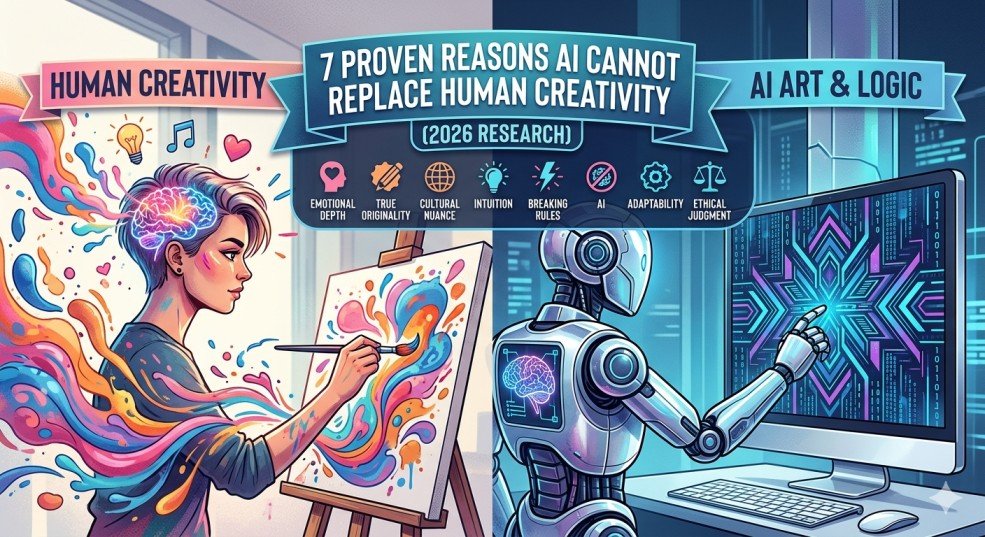
TLDR: A University of Montreal study published in May 2026 tested GPT-4, Gemini Pro, and Claude against 100,000 humans and found that AI now scores higher than the average person on standardized creativity tests. For the estimated 1.5 million Filipino freelancers working in writing, design, video editing, and digital marketing — fields where creativity is the product — this is a direct threat to livelihoods. But 7 proven findings from Stanford, Carnegie Mellon, Johns Hopkins, and the BBC confirm AI cannot replace human creativity. The difference between those who thrive and those who don’t comes down to understanding where AI ends and human value begins.
1. AI Has Never Lived an OFW’s Life — And It Shows
This is the most fundamental reason AI cannot replace human creativity: it has no life to draw from.
No AI has ever worked 12-hour shifts in Saudi Arabia. No AI has sent remittances through Western Union at 2 AM after missing a child’s birthday. No AI has felt the specific loneliness of Christmas away from family, or the pride of building a house in the province from savings earned abroad.
These are not sentimental details. They are the raw material of creative work. When an OFW writes about remittance fees, she writes from the experience of losing peso after peso to hidden charges. When a Filipino freelancer designs a campaign for an overseas recruitment agency, he draws on what it actually feels like to go through POEA processing.
AI cannot do this. It can only paraphrase what others have written about these experiences. The BBC warned in May 2026 that over-reliance on AI risks “turning your brain to mush” by replacing genuine creative struggle with recombined outputs.
A University of Connecticut study confirmed that human creativity still surpasses AI precisely because of lived cultural and emotional depth that cannot be encoded in training data. This gap is not a bug that better algorithms will fix. It is a feature of being human.
2. AI Makes Creative Output More Uniform — The Opposite of Real Creativity
True creativity means producing something new and different. AI does the opposite.
A PsyPost study published in May 2026 found that as more creators use generative AI, creative output converges. The same large language models trained on the same internet data produce similar phrasing, similar structures, and similar ideas regardless of who is using them.
This is economically dangerous for freelancers. If every OFW writer uses ChatGPT to draft their articles, every article starts to sound the same. Clients notice. Google notices. The market becomes a “sea of sameness,” as Tech Policy Press described it.
Here is the paradox: AI cannot replace human creativity because the very mechanism that makes it useful — pattern recognition and recombination — is the opposite of what makes creativity valuable. Originality requires deviation from patterns. AI is engineered to stay within them.
The freelancers who will survive are those who use AI as a tool but refuse to let it flatten their voice. The ones who sound like everyone else will compete on price. The ones who sound like themselves will command a premium.
3. AI Cannot Navigate Filipino Cultural Context
This is not a matter of opinion. It is a measurable limitation of current AI systems.
A University of Connecticut study found that AI models consistently fail at tasks requiring deep cultural understanding. This matters enormously for Filipino OFWs because so much of their work depends on bridging cultural gaps.
A Filipino virtual assistant working for an Australian client does not just answer emails. She interprets tone, manages expectations across time zones, and navigates the unspoken rules of a workplace culture different from her own. A Filipino content writer knows which financial concepts resonate with Visayan versus Ilocano readers, which metaphors work for overseas workers versus local employees, and which topics require sensitivity.
These are not skills that can be encoded in a training dataset. They are built from lived participation in a culture. For a full breakdown of which skills remain AI-proof, read our guide on 10 In-Demand Skills OFWs Need to Stay Employed by 2030. This is why AI cannot replace human creativity in contexts that demand cultural intelligence — which is most of them.
4. AI Still Loses to the Most Creative Humans — Even on Its Own Tests
The same University of Montreal study that made headlines for showing AI beats the average human also revealed a critical finding that most coverage ignored.
When researchers compared AI against the top 50 percent of human performers on the Divergent Association Task — a standardized creativity test — every AI system lost. When compared against the top 10 percent of humans, the gap widened further. The most creative humans, the study concluded, remain out of reach for current AI.
Dr. Karim Jerbi, the University of Montreal professor who co-authored the study, put it plainly: “Even the best AI systems still fall short of the levels reached by the most creative humans.”
This is proven reason number four that AI cannot replace human creativity: AI can mimic average performance, but breakthrough creativity — the kind that opens new categories, invents new genres, and solves problems no one has solved before — remains a human monopoly.
For OFW freelancers, the implication is clear. Being average is increasingly dangerous. Being exceptional is increasingly valuable. The market is bifurcating: AI handles the mediocre, and humans who can produce exceptional work will be rewarded more than ever.
5. Human Work Carries Emotional Authenticity AI Cannot Fake
Carnegie Mellon University researchers studied a domain where creativity is unmistakable: music. Their May 2026 findings confirmed that while AI can now produce technically competent compositions, human musicians still lead decisively in emotional resonance, structural innovation, and cultural relevance.
Listeners can tell the difference. When asked to choose between human-composed and AI-composed music, listeners consistently preferred the human versions — even when they could not articulate why.
This has direct implications for content creation. An article about OFW financial struggles written by someone who has experienced those struggles carries a weight that AI-generated text, no matter how well-researched, cannot replicate. A video edited by a Filipino creative who understands what moments matter to an OFW audience will connect more deeply than one assembled by an algorithm.
AI cannot replace human creativity because emotional authenticity is not a feature that can be added through better prompting. It is a byproduct of being human.
6. The Best Results Come From Human-AI Collaboration — Not Replacement
Stanford University researchers took a different approach to the AI creativity question. Instead of asking whether AI can replace humans, they trained AI models specifically to augment human creativity.
Their January 2026 findings were striking: the most creative outputs came from human-AI teams, not from either working alone. The AI generated options at scale. The human selected, refined, evaluated, and gave meaning. Neither could match the other’s performance without the partnership.
This aligns with a ScienceDaily report on tests involving 100,000 human participants. For OFWs looking to start using AI tools strategically, see our list of best free AI tools for side hustles, which found that AI, under the right conditions, actually makes humans more creative by functioning as a brainstorming catalyst.
This is reason six that AI cannot replace human creativity: the most valuable output does not come from choosing one over the other. It comes from using each for what it does best. AI generates possibilities. Humans decide which ones matter.
7. Clients Pay for Relationships — And AI Cannot Build Them
Johns Hopkins University’s 2026 analysis on AI and labor displacement drew a critical distinction: commodified creative tasks are at risk, but strategic, relationship-based work is not.
An OFW virtual assistant who has worked with a client for three years knows how that client likes their reports formatted, what time of day they are most receptive, which topics they are sensitive about, and how to communicate bad news without causing alarm. This knowledge is accumulated through hundreds of interactions. It cannot be transferred to an AI.
Clients do not pay for words per hour. They pay for reliability, judgment, cultural fluency, and the peace of mind that comes from knowing their projects are in capable hands. These are human-to-human skills that no AI can automate.
This is the seventh and most practical reason AI cannot replace human creativity: the most valuable part of creative work is not the output. It is the relationship within which the output is produced.
The evidence from the University of Montreal, Stanford, Carnegie Mellon, Johns Hopkins, UConn, PsyPost, and the BBC is consistent: AI cannot replace human creativity. It can match the average on standardized tests. It can accelerate production. It can generate options. But it cannot live an OFW’s experience, navigate Filipino cultural context, produce emotional authenticity, build client relationships, or make breakthrough creative leaps.
The Filipino freelancers who will thrive are not those who ignore AI or compete with it. If you are building a freelance career, our step-by-step Fiverr guide for OFWs covers the practical first steps. They are those who understand where it ends and where they begin — and who invest in what only they can provide.