Key Takeaway
- 🧪 The AI bubble definition, load-bearing: an AI bubble is not “prices are high” — it is prices exceeding what future fundamentals can realistically DELIVER, sustained by the belief that the pattern will continue; the ECB’s own analysis says the test is unknowable with hindsight only, which is why the honest verdict runs on evidence tiers, not on the label.
- ⚖️ The evidence for “yes, bubble”: CAPE above 40 (first since dot-com), forward P/E ~23 on the S&P, ~30% of the index in five companies, circular financing at hundreds of billions (the Bloomberg-documented deal web), off-balance-sheet debt, and fresh signs — OpenAI’s $20B revenue miss vs the reported figure and the Firmus IPO walk-away.
- 📊 The evidence for “no, not obviously”: the ECB’s own reading — earnings growth has largely MATCHED price increases for the AI infrastructure leaders; enterprise adoption is measurable; the core suppliers print real margins (SK hynix +632% operating profit in one quarter); and Amodei’s defense: pairing commitments with financing is how capital-hungry revolutions get built.
- 🧭 The honest AI bubble verdict: by the definition-based framework the market is “not obviously a bubble — yet”; by the behavioral framework (overconfidence, narrative momentum) the risk is priced-in-visible; the ECB’s conclusion — prepare regardless of which label wins — is the operative takeaway.
- 📅 What to watch: the four economic tests (valuation-to-cashflow gap, demand growth vs capital commitments, credit spreads, financing-window behavior) — measurable monthly, and the same series this site’s crash and watchlist pieces track.
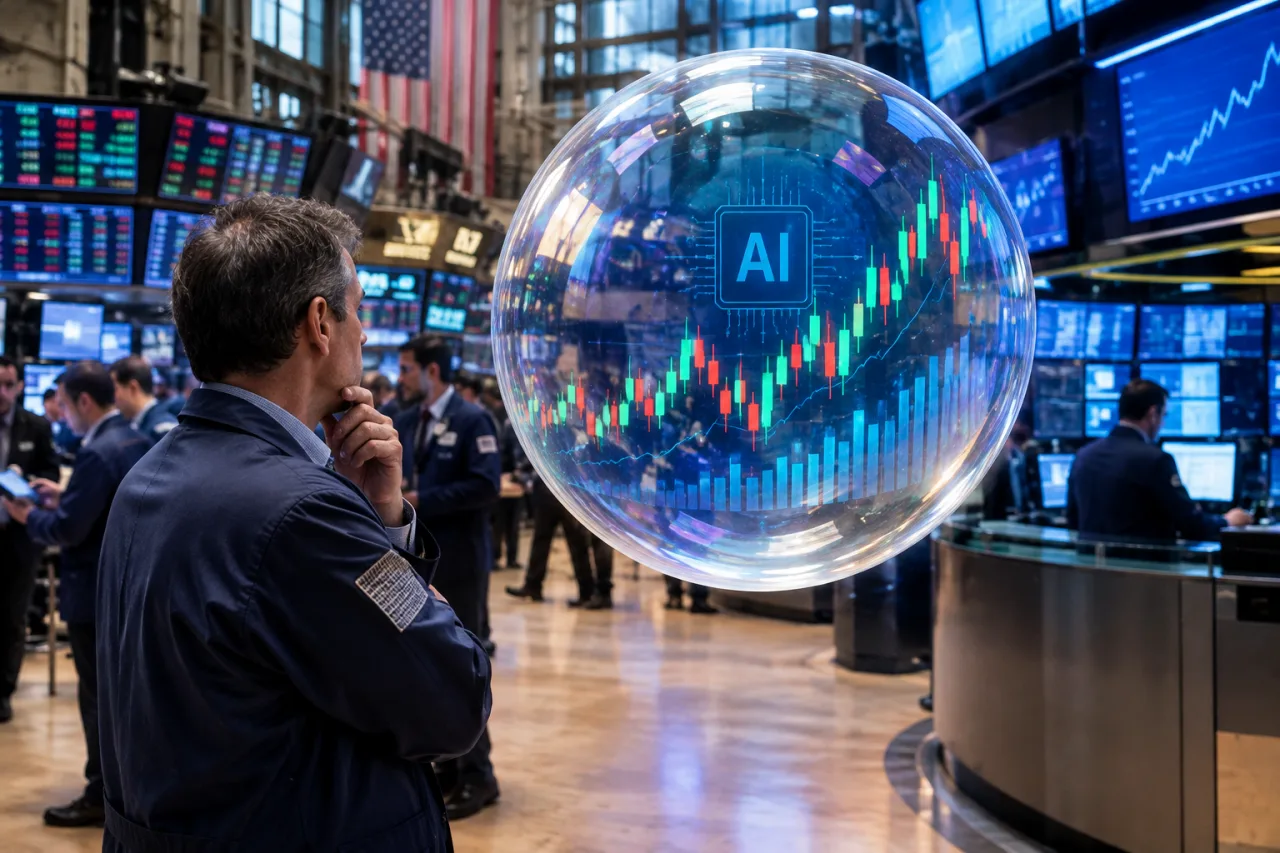
Are we in an AI bubble? The honest answer is not a slogan, because the AI bubble question hides two different questions. The evidence is genuinely split: the valuation metrics read like 2000 (CAPE above 40 for the first time since the dot-com crash, five companies holding about 30% of the S&P 500, the widest concentration in half a century) while the profit statements read like something new (the AI supply chain reporting genuine, growing earnings — one memory supplier alone posted +632% operating profit in a single quarter this year). This piece takes the question seriously the way a reader deserves: with a real definition, both ledgers checked, the mechanism theories named, and a verdict you can defend in a boardroom or a family group chat.
Table of Contents
Why the AI bubble label matters less than the test: institutions (the ECB, the Bank of England, the IMF) have stopped arguing about the label and started publishing preparation guidance — that shift itself is information; the pieces in this slate follow their lead and measure rather than declare.
Related: AI Bubble Stocks: the Watchlist of Warning Numbers
Bubble, properly defined: the test the word carries
The AI bubble definition, operational: an AI bubble exists when prices exceed when prices exceed not just today’s fundamentals but what future fundamentals can realistically deliver — when the market behaves as if expected future returns were certain, extrapolates recent growth rates indefinitely, and stops analyzing sustainable cash flows. The academic frameworks add the mechanism: irrational exuberance (behavioral overconfidence), speculative reflexivity (rising prices confirm the narrative that justified the rise), and mispricing of risk (risk-taking capacity shifting from risk-averse to risk-loving). A bubble is a belief structure with price attachment — which is why the label is always contested: the believers see the growth; the skeptics see the extrapolation.
Why the definition test is hard in real time: the ECB’s boom-bust paper is explicit — “these boom-bust patterns are only identifiable with hindsight”; the exact timing is unknowable; and even a proven-transformative technology can carry bubble valuations along the way (the same note: today’s prices do not represent a ceiling IF the technology proves transformative enough — a correction can precede higher future valuations). The test, honestly stated, cannot deliver certainty — it delivers probability tiers. That is what the two-ledger format below provides.
The evidence saying yes: AI bubble
The ledger of the bull-market skeptics (documented, named): 1 — the valuation metrics: the Shiller CAPE ratio exceeded 40 for the first time since the dot-com era; forward P/E about 23 on the S&P; FTSE-comparison analysis calls the American premium historically stretched. 2 — the concentration: roughly 30% of the S&P 500 and 20% of the MSCI World held by five companies — the greatest concentration in half a century; index-level risk now equals five-name risk. 3 — the circular financing: Nvidia investing up to $100B in OpenAI while selling OpenAI the chips; Oracle’s $300B compute deal with OpenAI; Microsoft’s stake; AMD’s warrant-linked purchases — the deal web documented in Bloomberg’s circularity chart, with the structure’s risks (skewed incentives, magnified losses if demand disappoints) stated by the same source. 4 — the fresh warning layer (Oct 2026): OpenAI’s annualized revenue reported $20B below the widely-quoted figure; Firmus (Nvidia/Blackstone-backed) abandoning its IPO after investors balked; the IMF naming AI-correction as a salient risk; Fitch’s recession-warning line; the BoE’s standing valuation caution. 5 — the expert voices: Ray Dalio (“very similar” to dot-com), Jamie Dimon (some money now will be wasted; a meaningful drop is likelier than priced), Sam Altman’s own bubble-exists concession (Aug 2025).
The skeptic ledger’s weakness, honestly: every warning above concerns PRICE, FINANCING and NARRATIVE — none of it proves the underlying technology fails. The dot-com parallel proves bubbles can coexist with genuinely transformative technology — both true at once is the actual hypothesis to test.
The evidence saying no: the other ledger
1 — the profits are real: the AI supply chain’s earnings — chipmakers, memory (the +632% operating-profit quarter), foundries, networking — grew alongside price gains; the ECB’s analysis states earnings growth has largely matched price increases for AI infrastructure leaders: the valuation stretch is about CONTINUED growth assumptions, not fake present profits. 2 — adoption is measurable: enterprises report real usage contracts, the per-token markets reprice monthly (this site’s inference-cost coverage), and business workflows demonstrably changed — the demand-side evidence dot-com lacked at its core. 3 — the financing has a defense: Janus Henderson’s “virtuous circle” reading (deals lining up suppliers, builders, customers); Amodei’s DealBook defense (Dec 2025: “one player has capital… the other is confident they’ll have revenue — I don’t think there’s anything inappropriate about that in principle”). 4 — the macro is not 2008: most of the buildout’s financing rides on balance sheets flush with real cash flows (the hyperscalers), not on subprime-shaped credit splices; the debt-heavy edges (neoclouds, SPVs) ARE concentrated and ARE the honest worry — a structural worry, not yet a systemic fact.
The bull ledger’s weakness: the arguments all rest on “demand will keep compounding” — the same assumption the capital structure assumes, which is the definition of self-reference. The circular web means the bull case cannot be validated from inside it; the demand numbers alone validate it — and the demand numbers are exactly where the fresh warnings landed.
The mechanism theories: rational, behavioral, structural
The rational reading (the ECB’s primary account): uncertainty shifts as technologies spread — a successful tech starts as a diversifiable sector risk and becomes economy-wide risk as adoption spreads; the market prices the rising risk premium, and boom-bust patterns emerge REGARDLESS of rationality: “historical experience suggests that technological revolutions carry risks of a boom-bust cycle in asset prices, and this risk does not depend on today’s valuations being rational or irrational” — the paper’s load-bearing sentence. The behavioral reading: overconfident investors bid prices beyond fundamentals, and when confidence fades, prices fall MORE sharply than the rational account predicts. The structural reading (the crash pieces’ account): financing architecture — circular deals, private-credit concentration, opacity — can create the crash’s accelerant even when every individual deal was rational; the structure turns a correction into a cascade. All three mechanisms AGREE on the honest conclusion: the risk exists under any label; preparation is not optional.
The history: what past bubbles were actually like
| Episode | What was true at the peak | What happened after |
| Tulips (1637) | Pure speculation, no cash-flow anchor | Full collapse of the trade |
| Dot-com (2000) | Vendor financing, loss-making listings, CAPE extremes | ~78% NASDAQ drawdown; survivors revalued a decade later |
| US housing (2008) | Leverage in the credit system itself | Global financial crisis; banking contagion |
| AI (today) | CAPE >40, concentration, circular deals — with REAL core profits | (unknown) — the WEF timeline models “more consequential than a novelty bubble, less than 2008” |
The honest use of history: history’s bubbles fall into two families — the novelty collapses (tulips, Beanie Babies, the WEF’s Labubu reference) and the credit-architecture collapses (2008) — with dot-com as the ambiguous middle (speculative finance attached to a genuinely transformative technology). The AI case sits closest to dot-com’s shape; the WEF’s own anatomy piece models consequences “less severe than the global financial crisis of 2008 — though more consequential than last year’s bursting of the Labubu bubble, or the 2000 crash in the price of Beanie Babies.” That calibrated sentence is the best short answer to the crash question in the public literature.
The honest verdict: two frameworks, two answers
Framework 1 — the AI bubble definition test: today’s AI bubble market is “not obviously a bubble — yet” (the ECB’s phrase): earnings growth largely matched price gains; the stretch lies in priced assumptions of continued exceptional growth. The AI bubble verdict under this framework: conditionally no — while the demand assumption holds. Framework 2 — the behavioral/structural test: narrative momentum is visibly high, financing architecture is visibly circular and opaque, and fresh warning signs (the revenue miss, the IPO walk-away) landed THIS quarter; the verdict under this framework: early-warning conditions present — watch the flags. Both verdicts coexist because they measure different things — and both converge on the same action: preparation without prediction, exposure measured, flags tracked.
The verdict’s honesty requirement: anyone promising you a date is selling. The ECB: unknowable in advance; the WEF: modelable but scenario-dependent; the record above: split evidence with named weaknesses on both sides. The verdict this site will publish when a flag-set turns: an explicit, sourced UPDATE — never a vibe.
WorldNgayon Insight: the label is a policy decision, not a measurement
The institutional shift in 2026 deserves its own sentence: the EU’s banking authorities, the Bank of England and the IMF have all moved from “is it a bubble?” to “what do we do if it bursts — and what guardrails keep it from spreading?” (the OMI report’s push for non-bailout commitments is the activist version; the regulators’ pre-positioning is the official version). That shift means the LABEL has become a policy decision — declaring the boom a bubble would freeze financing, which the powers that be will not do while demand data grows; the declaration will come, if it comes, from the data turning rather than from anyone’s conviction. For readers, the practical translation: ignore the label debates entirely; track the demand-and-debt series (the watchlist piece in this slate carries the exact numbers). The mountains of commentary all lean on the same few numbers — go to the numbers.
What this means for money, work and the Philippines
For portfolios: label-independence is the skill — the ECB’s channel analysis (Europeans hold the Mag7 through global trackers; the same is true in PH feeder funds) says your exposure, not the label, is the manageable variable; check it once (the pension-fund risk piece shows the institutional version of the same check).
For careers: the ECB/WEF timeline matters for the AI-jobs market — a burst phase slows hiring first in the financing-linked tiers (data-center construction, neoclouds) BEFORE it touches the tooling and application layers; skill investments in durable layers (the applied-AI workflows this site documents) outrank exposure to the financing-linked tiers. For Filipino professionals and OFWs: the honest layer: remittance-flow resilience, tracker-exposure checks on retirement money, and scenario notes on the peso (the dollar’s unusual safe-haven status in an AI-adjacent crisis per the WEF analysis) — plus the region’s buildout repricing (the SEA data-center race would slow with the capital cycle). Preparation is knowable; the crash is not. For the local AI community: the burst’s technology-layer consequence is a GOOD one for users — the tools get cheaper as the financing layer compresses; the honest read is that your personal AI leverage grows in both scenarios.
Verdict: prepare is the verb
Are we in an AI bubble? The honest answer, on the record: the definition framework says not obviously — yet; the behavioral and structural frameworks say the early-warning conditions are present; the profits are real, the financing is circular, the valuation metrics read like 2000, and the institutions have pre-positioned. The verb that follows from all of it is PREPARE: measure your exposure, watch the flags, ignore the label wars, and let the numbers — not the noise — call the turn. The mountain watches; the numbers decide.
Sources on the record: ECB boom-bust analysis · Wikipedia AI-bubble entry.
Financial Disclaimer
This article is editorial analysis of publicly reported information, not investment or financial advice, and no outcome is promised. Figures are as reported by the named sources and change frequently; verify before acting. Markets carry substantial risk, including loss of capital.
- Official ecb.europa.eu/press/blog/date/2026/html/ecb.blog20260817~754a8a4418.e… — ECB boom-bust analysis
- en.wikipedia.org/wiki/AI_bubble — Wikipedia AI-bubble entry
External sources linked in this article, in order of first mention. Spotted an error or a broken link? Tell us.
Cite this pagePublished Oct 31, 2026
Agron, E. (2026, October 31). Are We in an AI Bubble? the Definition, the Evidence and the Honest Verdict. WorldNgayon. https://worldngayon.com/ai-bubble/
Agron, Edmon. “Are We in an AI Bubble? the Definition, the Evidence and the Honest Verdict.” WorldNgayon, 31 Oct. 2026, worldngayon.com/ai-bubble/.
Agron, Edmon. “Are We in an AI Bubble? the Definition, the Evidence and the Honest Verdict.” WorldNgayon, October 31, 2026. https://worldngayon.com/ai-bubble/.
Agron, E. (2026) ‘Are We in an AI Bubble? the Definition, the Evidence and the Honest Verdict’, WorldNgayon, 31 October. Available at: https://worldngayon.com/ai-bubble/.
E. Agron, “Are We in an AI Bubble? the Definition, the Evidence and the Honest Verdict,” WorldNgayon, Oct. 31, 2026. [Online]. Available: https://worldngayon.com/ai-bubble/
@online{agron2026aibubble,
  author       = {Agron, Edmon},
  title        = {{Are We in an AI Bubble? the Definition, the Evidence and the Honest Verdict}},
  year         = {2026},
  date         = {2026-10-31},
  organization = {WorldNgayon},
  url          = {https://worldngayon.com/ai-bubble/},
  urldate      = {}
}TY - ELEC AU - Agron, Edmon TI - Are We in an AI Bubble? the Definition, the Evidence and the Honest Verdict T2 - WorldNgayon PY - 2026 DA - 2026/10/31/ UR - https://worldngayon.com/ai-bubble/ Y2 - ER -
Cite the version you read; the page may be updated. Zotero and Mendeley can also import this page directly.