
Table of Contents
Key Takeaway
- 💰 The renewal fee depends on category: SAR 650 per year for company and institution workers, SAR 600 for domestic and agricultural workers, and SAR 500 for dependents over 18, with the dependent levy adding SAR 400 per month per person.
- 📜 The employer carries the legal duty: under Article 40 of the Saudi Labour Law, the employer pays iqama renewal fees, work permit fees and associated costs, and deducting them from your salary is a violation.
- 🚧 Renewal fails on blocks, not paperwork: unpaid traffic fines, lapsed CCHI health insurance, expired biometrics, a huroob report, missing GOSI registration, or a Red Nitaqat employer each stop the process before fees matter.
- ⏰ The fine ladder escalates fast: SAR 500 on a first late renewal, SAR 1,000 on the second, and a third can end in deportation, with penalties starting three days after expiry.
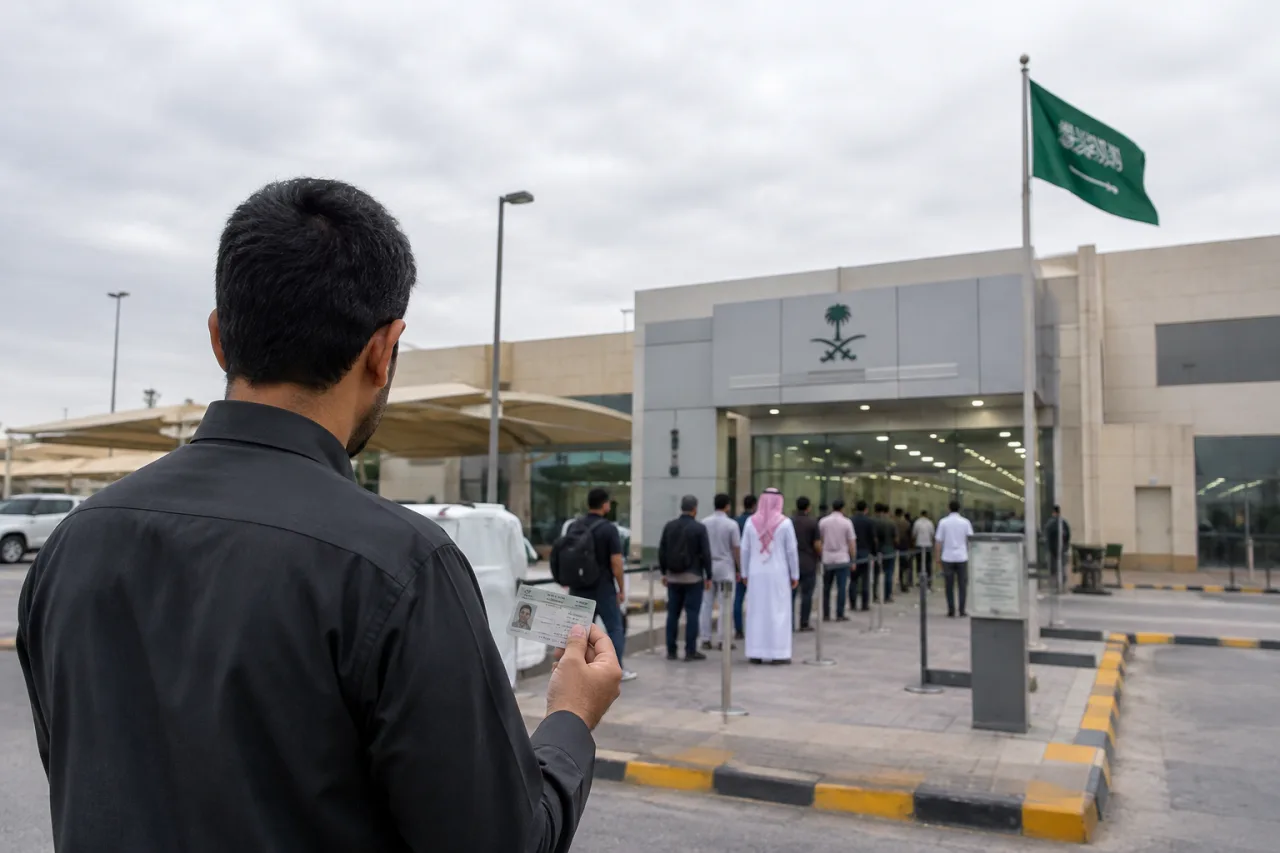
Iqama renewal is the single annual obligation that touches everything else in a Saudi resident’s life: banking, the Ejar rental contract, hospital treatment, school enrollment, and a SIM card all validate against a residence permit, which is why the General Directorate of Passports (Jawazat) treats late renewal as a real offense rather than paperwork. The current fee schedule, the employer’s legal duty to pay it, the six blockers that stop a renewal cold, and the fine ladder are all published and current for 2026, and every number in this guide is stated the way the Jawazat schedule and the platforms present it. Run the checklist a week early and the whole exercise is two taps; run it a day late and it becomes a fine, a suspension of services, or worse.
The fee figures and process mechanics below come from Saudi Life Guide’s Jawazat-tracking guide, updated November 12, 2026, which compiles the official fee schedule by worker category (Saudi Life Guide, iqama renewal fees, updated November 12, 2026).
The Iqama Renewal Fee Schedule, Category by Category
The base government fee depends on who the worker is, and shorter terms price proportionally:
| Worker category | 3 months | 6 months | 9 months | 1 year |
|---|---|---|---|---|
| Company / institution workers | SAR 163 | SAR 325 | SAR 488 | SAR 650 |
| Agricultural / livestock workers | SAR 150 | SAR 300 | SAR 450 | SAR 600 |
| Domestic workers, drivers, guards | annual only | annual only | annual only | SAR 600 |
| Dependents over 18 | SAR 125 | SAR 250 | SAR 375 | SAR 500 |
Two layers sit outside the table. The dependent levy is separate from the iqama fee: SAR 400 per month, SAR 4,800 per year, per dependent, which is the figure that surprises households most. And the employer’s work permit levy, which runs far larger than the residence fee, is a monthly headcount cost with its own exemption rules. Domestic workers sit outside the short-term options and renew annually only.
The short-term tiers exist for a reason worth knowing even if you always take the year. A worker on a short project contract, a household waiting out a family situation, or an employee riding out an employer transition can keep the iqama alive at SAR 163 for three months instead of front-loading SAR 650, and the residence card itself stays valid for all the same services either way. The trap inside the flexibility is the arithmetic the guide states plainly: the employer’s work permit levy runs monthly regardless of the term chosen, so a shorter iqama does not reduce the employer’s real cost proportionally, and employers who do the math rarely volunteer the shorter terms.
Who Pays Under Article 40: the Employer’s Legal Duty
The rule that matters most to Filipino workers is Article 40 of the Saudi Labour Law, and it is unambiguous: the employer is legally responsible for iqama renewal fees, work permit fees, and associated costs. Deducting them from your salary is a violation. The remedy runs through the same labor machinery as pay disputes: complaints go through the HRSD ministry portal or the 19911 hotline. The practical advice that protects workers most is timing: send HR a written reminder as your expiry approaches rather than waiting, because a written trail is what a labor case examines, and many delays end at the employer’s desk, not the government’s.
The dependent levy is the gray zone. Whether the sponsor absorbs it, shares it, or writes it into the package varies by contract, so the negotiation happens at signing, not at renewal. Keep the timeline argument in one sentence: the law names the employer responsible, the fine ladder names the worker’s life as collateral, and the written reminder to HR is where those two documents meet. What is never negotiable under Article 40 is the worker’s own iqama: that fee, the work permit behind it, and any fines for late renewal belong on the employer’s ledger.
The Iqama Renewal Steps, Platform by Platform
The sequence runs check, initiate, pay, collect:
Check first, always. Outstanding fines and blocked statuses are common enough that a pre-check is the whole game. The MOI portal (moi.gov.sa) via Nafath login, the Absher platform, and the employer-side Muqeem portal all expose your fees and blockers before money moves. Finding a SAR 150 traffic fine a week early is a routine payment; finding it on expiry day is a blocked renewal.
Initiate on the employer side. Renewal starts on the official platforms by the employer, through Absher Business (the recommended route) or Muqeem, with the fee paid through SADAD or a bank app. Self-renewal by the worker is not the standard flow; the worker’s job is to keep the blockers clear and the deadline visible.
Collect and verify. Processing usually takes one to three business days after payment. SADAD payments reflect within minutes but can show as pending for up to two days depending on the bank, so print the new iqama status and carry the digital copy until the card arrives.
The Six Blockers and How to Clear Them Before the Window
The 2026 renewal checklist is less about documents and more about status. Six items block a renewal cold:
| Blocker | Where it clears |
|---|---|
| Unpaid traffic fines (the most common) | MOI traffic payments; confirm the zero balance before initiating |
| Lapsed CCHI health insurance | The insurer or employer’s HR renews the policy; insurance must be current before Jawazat processes |
| Expired biometrics | A biometrics session at an approved center or Jawazat office |
| An active huroob report | A labor-status issue, resolved only through the Akrab/HRSD process with the employer |
| Missing GOSI registration | The employer corrects the GOSI record |
| Employer in the Red Nitaqat band | The employer’s Saudization standing; services for their workers freeze until the band improves |
Every blocker is invisible from the street and visible on the platforms, which is the entire argument for checking a week out. A worker whose papers are perfect in a folder can still be blocked by an unpaid parking fine from months ago.
The Deadlines, the Fine Ladder and the Three-Day Window
The deadline is the iqama expiry date itself, and Jawazat treats a renewal not done within three days after expiry as late. The fine ladder then runs SAR 500 on the first late offense, SAR 1,000 on the second, and a third offense can lead to deportation. Beyond the fines, an expired iqama locks the life built on it: banking, the Ejar rental contract, non-emergency hospital treatment, school enrollment, and SIM purchases all fail validation. There is a three-day window before penalties begin, but the guidance is blunt that it is not a grace period to plan around: the working rule for Saudi residents is renewal at least a week before expiry, with the reminder to HR in writing.
The Paperwork Around the Year, Not Just the Week
Iqama renewal does not sit alone; it interacts with the documents an OFW touches across the year. Exit and re-entry visas validate against a valid iqama, so a late renewal strands a planned leave; the full sequence lives in the OFW exit strategy guide. Passport validity runs on its own clock through the embassy system, tracked in the passport renewal guide for the Middle East. Engineers renew their professional registration on the SCE side, covered in the SCE registration guide. Contract moves during the year touch the employer record that files your renewal, mapped in the employer-change guide. And the money this paperwork protects moves home through rails costing known fees, laid out in the Saudi remittance fee breakdown. The annual calendar that keeps all five clocks visible is the difference between a routine week and an emergency one.
The OFW Hour: Timing Around Flights and Leaves
A renewal that lands badly costs more than a fine: it strands the leave you already bought tickets for. The safe pattern runs five checkpoints against the expiry date. Seven days out, run the fees-and-blockers check on MOI, Absher, or Muqeem and clear anything that lights up: the traffic fine, the insurance lapse, the biometrics session. Five days out, confirm HR has initiated on Absher Business or Muqeem and the SADAD payment is queued. Three days out, verify payment posted, remembering the two-day pending window the banking side can add. On clearing, print or screenshot the new status and carry it with the card until both arrive. And one layer of the same week belongs to the leave itself: an exit or re-entry visa validates against the renewed iqama, so the flight calendar and the renewal calendar should be one calendar, reviewed at the same sitting.
The same hour also covers the reminder that Article 40 turns into leverage: a written message to HR naming your expiry date creates the trail that a labor complaint reads later. A worker who sent the reminder on day minus-30, and an employer who still missed the window, have left a record that HRSD can act on; the 19911 hotline and the ministry portal exist for that case, and the case is stronger the earlier the trail starts.
FAQ: Iqama Renewal in Saudi Arabia
How much does iqama renewal cost in 2026?
The base residence fee is SAR 650 per year for company and institution workers, SAR 600 for agricultural, domestic, driver and guard categories, and SAR 500 for dependents over 18, with partial terms at SAR 163, 325 and 488 for the company category. The separate dependent levy is SAR 400 per month per person, and the employer’s work permit levy runs on top of all of it.
Who pays for iqama renewal, the worker or the employer?
Under Article 40 of the Saudi Labour Law the employer pays the renewal fee, the work permit fee, and associated costs, including late-renewal fines. Deducting any of it from the worker’s salary is a violation, reportable through the HRSD portal or the 19911 hotline. The dependent levy is the exception households negotiate into contracts.
What happens if iqama renewal is late?
Jawazat fines a renewal not completed within three days of expiry: SAR 500 for a first offense, SAR 1,000 for a second, and a third late renewal can lead to deportation. An expired iqama also degrades daily life immediately, from banking to hospital access. The working rule is renewal at least a week before the expiry date.
Why is my iqama renewal blocked?
The 2026 blocker list starts with unpaid traffic fines and continues through lapsed CCHI health insurance, expired biometrics, an active huroob status, missing GOSI registration, and an employer sitting in the Red Nitaqat band. All six are checkable on the MOI, Absher, and Muqeem platforms before the renewal window opens.
How long does iqama renewal take after payment?
Processing usually completes in one to three business days after the fee posts. SADAD payments reflect within minutes but can show as pending for up to two business days depending on the bank, so the safe pattern is paying early and verifying the new status before the old card’s date passes.
Can I renew an iqama for my family while abroad?
The worker generally needs to be present, but remote renewal is available for dependents and domestic workers where the main sponsor remains in the Kingdom. The dependent fees run on the same schedule, SAR 500 per year of iqama plus the SAR 400 monthly levy per person.
Sources and Further Reading
The fee schedule, blockers, fine ladder, and processing timelines were verified against Saudi Life Guide’s Jawazat-tracking guide, last updated November 12, 2026 (iqama renewal fees for 1 year), which compiles the official MOI, Absher, Muqeem and Jawazat information. Related on our pages: SCE registration, changing employers in Saudi, the exit strategy calendar, and Saudi remittance fees.
Cite this pagePublished Nov 16, 2026
Agron, E. (2026, November 16). Iqama Renewal in Saudi Arabia: the Steps, the Fees and the Deadlines. WorldNgayon. https://worldngayon.com/iqama-renewal-saudi-arabia/
Agron, Edmon. “Iqama Renewal in Saudi Arabia: the Steps, the Fees and the Deadlines.” WorldNgayon, 16 Nov. 2026, worldngayon.com/iqama-renewal-saudi-arabia/.
Agron, Edmon. “Iqama Renewal in Saudi Arabia: the Steps, the Fees and the Deadlines.” WorldNgayon, November 16, 2026. https://worldngayon.com/iqama-renewal-saudi-arabia/.
Agron, E. (2026) ‘Iqama Renewal in Saudi Arabia: the Steps, the Fees and the Deadlines’, WorldNgayon, 16 November. Available at: https://worldngayon.com/iqama-renewal-saudi-arabia/.
E. Agron, “Iqama Renewal in Saudi Arabia: the Steps, the Fees and the Deadlines,” WorldNgayon, Nov. 16, 2026. [Online]. Available: https://worldngayon.com/iqama-renewal-saudi-arabia/
@online{agron2026iqamarenewal,
  author       = {Agron, Edmon},
  title        = {{Iqama Renewal in Saudi Arabia: the Steps, the Fees and the Deadlines}},
  year         = {2026},
  date         = {2026-11-16},
  organization = {WorldNgayon},
  url          = {https://worldngayon.com/iqama-renewal-saudi-arabia/},
  urldate      = {}
}TY - ELEC AU - Agron, Edmon TI - Iqama Renewal in Saudi Arabia: the Steps, the Fees and the Deadlines T2 - WorldNgayon PY - 2026 DA - 2026/11/16/ UR - https://worldngayon.com/iqama-renewal-saudi-arabia/ Y2 - ER -
Cite the version you read; the page may be updated. Zotero and Mendeley can also import this page directly.