Table of Contents
Key Takeaway
- 🚨 The AI Race Is Real: DeepSeek V4, released April 24, 2026, is China’s most powerful open-weight AI model yet — and it’s shaking up the global AI competition that directly affects Filipino tech workers.
- 📊 Price Gap Is Massive: DeepSeek V4-Flash costs $0.14 per million input tokens vs. GPT-5 at $1.50/M — more than 10x cheaper for comparable outputs.
- 💡 China’s Open-Source Bet: DeepSeek V4 weights are fully open (MIT license) on Hugging Face, meaning anyone — including Filipino startups — can use, modify, and deploy them without paying US companies.
- 🎯 OFW Impact: 35-37% of Philippine jobs face AI disruption risk (World Bank, April 2026). Filipino tech workers who understand both US and Chinese AI tools will have a competitive advantage.
- ⚠️ Don’t Be Left Behind: Whether you’re a developer, content creator, or OFW exploring tech careers, understanding the DeepSeek vs. OpenAI landscape is no longer optional — it’s survival.
What Is DeepSeek V4 and Why Should Filipino Tech Workers Care?
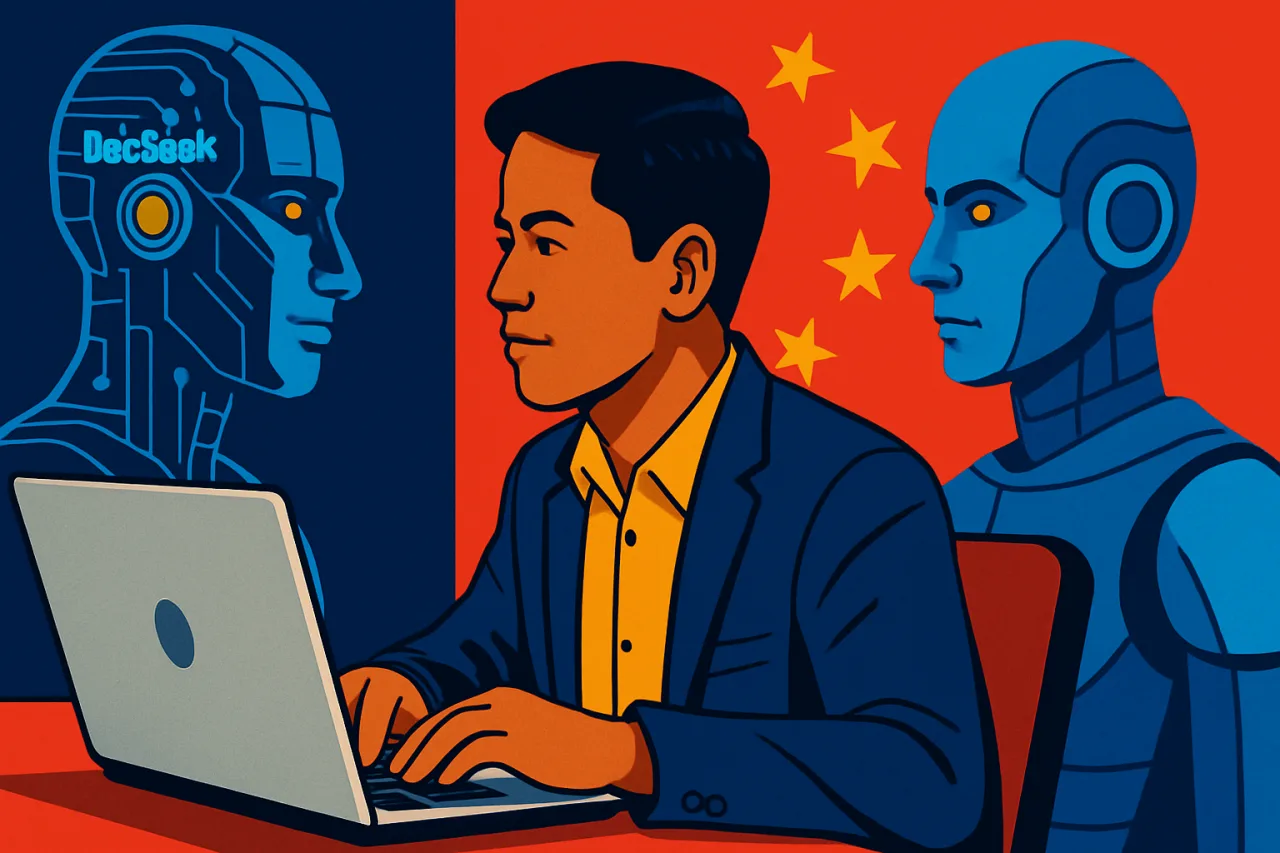
The DeepSeek V4 vs OpenAI competition is no longer just a Silicon Valley story. When China’s DeepSeek team released V4 on April 24, 2026, it sent shockwaves through the global AI industry — and those waves are now reaching Filipino tech workers, OFWs exploring career shifts, and Philippine-based startups trying to compete.
DeepSeek V4 is a family of open-weight mixture-of-experts (MoE) models built by the Chinese AI lab AI, a Hangzhou-based research lab. It ships in two main variants:
- DeepSeek V4-Pro: 1.6 trillion total parameters, 49 billion active per token, designed for complex reasoning, coding, and scientific tasks.
- DeepSeek V4-Flash: 284 billion total parameters, 13 billion active per token, optimized for fast, low-cost inference.
Both models default to a 1-million-token context window with up to 384K max output tokens — dwarfing what most competing models offer. The weights are published on Hugging Face under the MIT license, meaning any developer, any startup, any Filipino freelancer can download and use them for free.
Why does this matter to you as a Filipino tech worker? Because the tools you choose to learn today determine whether you’ll be employable — or replaceable — in the next 2-3 years.
DeepSeek V4 vs OpenAI GPT-5: The 2026 Benchmark Showdown
The most honest way to compare DeepSeek V4 vs OpenAI is to look at verified benchmarks — not marketing claims. Here’s how the top models stack up as of mid-2026:
Coding & Software Engineering
On SWE-bench Verified (the gold standard for real-world coding ability):
- GPT-5: 74.9% (per OpenAI system card)
- DeepSeek V4 Pro: ~55-58% (varies by benchmark version; LLM Reference reports 55.4% on SWE-bench Pro)
- OpenAI o3: ~72% (close behind GPT-5)
Analysis: OpenAI still leads in raw coding ability. But here’s the catch — DeepSeek V4 Pro achieves this at roughly 1/10th the price of GPT-5. For Filipino tech companies and freelancers, that cost difference is not trivial. It’s the difference between an AI tool that’s viable for daily use versus one that eats your entire project margin.
Scientific Reasoning & Knowledge
On GPQA Diamond (graduate-level science questions):
- DeepSeek V4 Pro: 90.1% (per Regolo.AI benchmarks)
- This places it at or near the top of all open-weight models
On MMLU (massive multitask language understanding), DeepSeek V4 Pro scores competitively with GPT-4.1 and approaches GPT-5 territory on several sub-benchmarks, particularly in mathematics and STEM subjects.
Price Comparison: Where DeepSeek Changes Everything
| Model | Input Price (per M tokens) | Output Price (per M tokens) |
|---|---|---|
| DeepSeek V4-Flash | $0.14 | $0.28 |
| DeepSeek V4-Pro | $1.74 | $3.48 |
| OpenAI GPT-5 | $1.50 | $10.00 |
| OpenAI o3 | $2.00 | $8.00 |
| OpenAI o4-mini | $0.15 | $0.60 |
The bottom line: DeepSeek V4-Flash is roughly 10x cheaper than GPT-5 for input and 35x cheaper for output. Even the more powerful V4-Pro undercuts OpenAI’s premium models significantly. For Filipino OFWs building side projects, freelancing with AI tools, or running small agencies — this pricing changes the math entirely.
Why China Is Betting Everything on Open-Source AI
To understand the DeepSeek V4 vs OpenAI competition, you need to understand China’s strategy. While OpenAI, Anthropic, and Google keep their best models behind API walls, China is aggressively open-sourcing its AI.
DeepSeek V4 under MIT license means:
- Any Filipino startup can fine-tune V4 on their own data without paying US companies a single cent.
- Any OFW developer can run V4 locally on their own hardware (with sufficient GPU resources).
- Any Filipino university can use it for research without worrying about API costs or US export restrictions.
- The Philippines can build sovereign AI capabilities without being locked into a single US provider.
This is not charity. It’s competitive strategy. By making the best models free and open, China is:
- Building a developer ecosystem — Developers who learn DeepSeek tools today will build on Chinese infrastructure tomorrow.
- Undermining US pricing power — If free models are 90% as good, why pay $30/M tokens to OpenAI?
- Winning the Global South — Countries like the Philippines, Indonesia, Vietnam, and India are price-sensitive markets where open-source AI has an overwhelming advantage.
For Filipino tech workers, this means the AI skills you build NOW may run on different infrastructure in 2-3 years. If you’re already using AI tools for OFW work, understanding the the Chinese AI lab vs. OpenAI landscape will help you choose the right tool for each task. The playing field is shifting.
What This Means for Filipino Tech Workers and OFWs
The World Bank warned in April 2026 that 35-37% of Philippine jobs face AI disruption risk. That’s not a future threat — it’s happening now. Here’s how the DeepSeek vs. OpenAI race affects Filipino workers specifically:
1. Entry-Level Tech Jobs Are Most at Risk
Tasks that entry-level developers, content moderators, and data entry workers do daily — basic coding, content writing, data formatting — are now handled by both DeepSeek V4-Flash and OpenAI’s cheaper models. If your job can be described in a prompt, it’s at risk.
2. The Advantage Goes to Bilingual AI Workers
Filipino tech workers who can use both US and Chinese AI tools will be more versatile and valuable. Companies are already looking for developers comfortable across the full AI stack — not just OpenAI’s ecosystem. DeepSeek skills are becoming a differentiator, especially for companies serving Southeast Asian markets.
3. OFWs Have a Unique Opportunity
Many OFWs abroad have access to better internet, more powerful hardware, and exposure to international tech trends. Learning the Chinese AI lab tools now gives OFWs a competitive edge when they eventually return to the Philippines — or if they pivot to remote tech work from abroad.
4. Filipino Agencies and Freelancers Can Compete Globally
With DeepSeek V4’s ultra-low pricing, a small Manila-based AI agency can now offer services that competing firms in the US or Europe can’t price-match. The barrier to entry for AI-powered services has dropped dramatically.
5. New Specializations Are Emerging
Roles like prompt engineer, AI fine-tuning specialist, and multi-model orchestration engineer didn’t exist 2 years ago. Today, they’re among the fastest-growing job categories. Filipino workers who specialize in getting the best out of multiple AI models — not just one — will be in highest demand.
How to Get Started: Practical Steps for Filipino Workers
Understanding the DeepSeek V4 vs OpenAI landscape is one thing. Acting on it is another. Here’s a practical roadmap:
Step 1: Try DeepSeek V4 for Free
Visit the DeepSeek chat interface and test both V4-Flash and V4-Pro. Compare outputs side-by-side with ChatGPT. See for yourself where each model excels.
Step 2: Learn API Integration
Both DeepSeek and OpenAI offer APIs. Learn to call both from Python. the Chinese AI lab API documentation is at api-docs.deepseek.com. Being comfortable switching between providers is a skill employers value.
Step 3: Fine-Tune on Your Domain
Download DeepSeek V4 weights from Hugging Face and experiment with fine-tuning on Filipino-language or Philippines-domain data. This is where the real competitive advantage lies.
Step 4: Build a Portfolio Project
Create a project that uses DeepSeek V4 — a Filipino-language chatbot, an OFW financial advisor tool, or a content generation app. Employers care about what you can build, not just which tools you’ve read about.
Step 5: Stay Updated
The AI landscape changes monthly. Follow DeepSeek’s official channel, OpenAI’s developer blog, and community forums. For a broader foundation, start with our AI for Beginners Ultimate Guide 2026 if you’re new to AI tools. The Filipino tech workers who win are the ones who adapt fastest.
The Bigger Picture: US-China AI Competition and the Philippines
The DeepSeek V4 vs OpenAI battle is one front in a larger US-China technology competition that directly affects the Philippines. As the two superpowers compete for AI dominance, the Philippines finds itself in a strategic position — a large English-speaking tech workforce, growing digital infrastructure, and deep ties to both economies.
OFWs in tech hubs like Singapore, Dubai, San Francisco, and London are uniquely positioned to bridge both worlds. As we covered in our OpenAI IPO 2026 article, the ripple effects of US-China AI competition reach Filipino workers directly. The Philippines doesn’t have to choose sides — it can benefit from both ecosystems. Filipino workers who understand both Chinese and US AI toolchains will be among the most valuable in the global market.
The AI competition is not zero-sum. The more tools available at lower costs, the more opportunities open up for Filipino workers and entrepreneurs. The key is to stay informed, stay adaptable, and keep building skills that no AI can easily replicate — judgment, creativity, and cultural understanding.
DeepSeek V4 Architecture: What Makes It Different
Understanding DeepSeek V4 vs OpenAI requires understanding how these models are built differently under the hood. DeepSeek V4 uses a Mixture-of-Experts (MoE) architecture, which is fundamentally different from OpenAI’s dense transformer approach.
In a dense model like GPT-5, every parameter is activated for every input token. This means if the model has 1 trillion parameters, all 1 trillion are used for every single token generated. The computational cost is enormous.
DeepSeek V4’s MoE architecture works differently. The model has 1.6 trillion total parameters (V4-Pro), but only 49 billion are activated per token. Think of it like a company with 1,600 employees but only 49 working on any given project. The rest are “sleeping” until their expertise is needed. This is why DeepSeek can achieve near-frontier performance at a fraction of the compute cost.
Key architectural innovations in DeepSeek V4 include:
- CSA (Cross-Stream Attention): A new attention mechanism that processes multiple data streams simultaneously, improving efficiency on long-context tasks.
- HCA (Hierarchical Cache Attention): Reduces memory usage for the 1M-token context window by caching attention states hierarchically rather than storing everything in memory.
- mHC (Multi-Head Cache): Optimizes how the model stores and retrieves information from its massive context window, reducing latency on long documents.
- Muon Optimizer: A new training optimizer that the Chinese AI lab claims achieves better convergence than the standard AdamW optimizer used by most LLMs.
For Filipino developers, the practical implication is this: DeepSeek V4 can process documents up to 1 million tokens long — roughly 750,000 words, or about 1,500 pages of text. This makes it extraordinarily useful for tasks like analyzing entire codebases, processing long legal or financial documents, or summarizing extensive research papers. GPT-5’s context window, while large, doesn’t match this scale.
DeepSeek V4 for Filipino Developers: Real-World Use Cases
Beyond benchmarks, here are practical ways Filipino tech workers can use DeepSeek V4 today:
Code Review and Debugging
DeepSeek V4-Pro’s coding capabilities make it an excellent code review assistant. Paste your entire project (up to 1M tokens), and it can identify bugs, suggest improvements, and explain complex code sections. For Filipino freelancers on platforms like Upwork or Online.ph, this capability can significantly speed up delivery times.
Filipino Language Processing
While DeepSeek V4 was primarily trained on English and Chinese data, its open-weight nature means Filipino developers can fine-tune it on Tagalog, Cebuano, or other Philippine languages. This opens up opportunities for building Filipino-language chatbots, content tools, and customer service automation that don’t depend on US API providers.
Document Analysis for OFW Legal and Financial Needs
OFWs frequently deal with complex documents — employment contracts, visa applications, remittance records, tax filings. DeepSeek V4’s 1M-token context window means an OFW can upload an entire contract and ask the AI to explain specific clauses, identify red flags, or compare terms against standard agreements. This is a practical, immediate use case that doesn’t require any programming skill.
Content Creation at Scale
Filipino content creators, social media managers, and digital marketers can use DeepSeek V4-Flash (at $0.14/M tokens) to generate blog posts, social media captions, email newsletters, and video scripts at a cost that’s a fraction of what OpenAI charges. For small Filipino businesses and solo entrepreneurs, this cost difference can be transformative.
Frequently Asked Questions (FAQ)
Q: Is DeepSeek V4 really as good as GPT-5?
A: It depends on the task. GPT-5 leads in raw SWE-bench coding benchmarks (74.9% vs ~55-58% for V4-Pro), but DeepSeek V4-Pro matches or beats GPT-5 on scientific reasoning benchmarks like GPQA Diamond (90.1%). For many practical tasks, V4-Flash at $0.14/M tokens delivers 90% of the performance at 10% of the cost.
Q: Can I use DeepSeek V4 for free?
A: Yes. DeepSeek V4 weights are open-source under the MIT license, available on Hugging Face. You can download and run them on your own hardware with sufficient GPU resources. The DeepSeek chat interface is also free to use, and API access starts at $0.14 per million input tokens for V4-Flash.
Q: Is DeepSeek safe to use? Are there data privacy concerns?
A: the Chinese AI lab is a Chinese company based in Hangzhou. Some organizations may have data sovereignty concerns about sending sensitive data through DeepSeek’s API. For maximum privacy, you can run the open-source weights locally on your own infrastructure. As with any AI tool, read the terms of service and avoid inputting sensitive personal or financial data through third-party APIs.
Q: Will AI replace Filipino tech jobs?
A: The World Bank estimates 35-37% of Philippine jobs face AI disruption risk. But replacement isn’t inevitable — adaptation is. Workers who learn to use AI tools (both DeepSeek and OpenAI) will replace workers who don’t. The tool is not your competitor; someone using the tool is.
Q: Should I learn the Chinese AI lab or OpenAI first?
A: Learn both. Start with whichever free tier you can access (ChatGPT free, DeepSeek chat free), then expand to API usage. Employers increasingly value flexibility across multiple AI platforms, not loyalty to a single provider.
Q: How can OFWs benefit from DeepSeek V4 specifically?
A: OFWs can use DeepSeek V4’s ultra-low API costs to build Side projects, experiment with AI-powered freelancing, or prototype startup ideas without significant capital investment. The 1M-token context window is particularly useful for processing long documents, codebases, or research papers — common tasks for OFW tech workers.
Q: What programming languages work best with DeepSeek V4?
A: DeepSeek V4 excels at Python, JavaScript, TypeScript, and most major programming languages. Its coding benchmarks (SWE-bench ~55-58%) make it capable of generating functional code, debugging, and explaining complex codebases. For Filipino developers, it’s particularly strong on data science, web automation, and API integration tasks.
Disclaimer: This article is for informational purposes only and does not constitute financial, career, or investment advice. AI capabilities and pricing change frequently. Verify current specifications from official sources before making decisions based on this content. DeepSeek V4 benchmarks cited are from independent benchmark sites (LLM Reference, Regolo.AI, LushBinary) as of mid-2026 and may not reflect the latest model updates.