Table of Contents
The PSE Trading Day: Pre-Open, Breaks, Cut-Offs, and How Your Orders Actually Execute
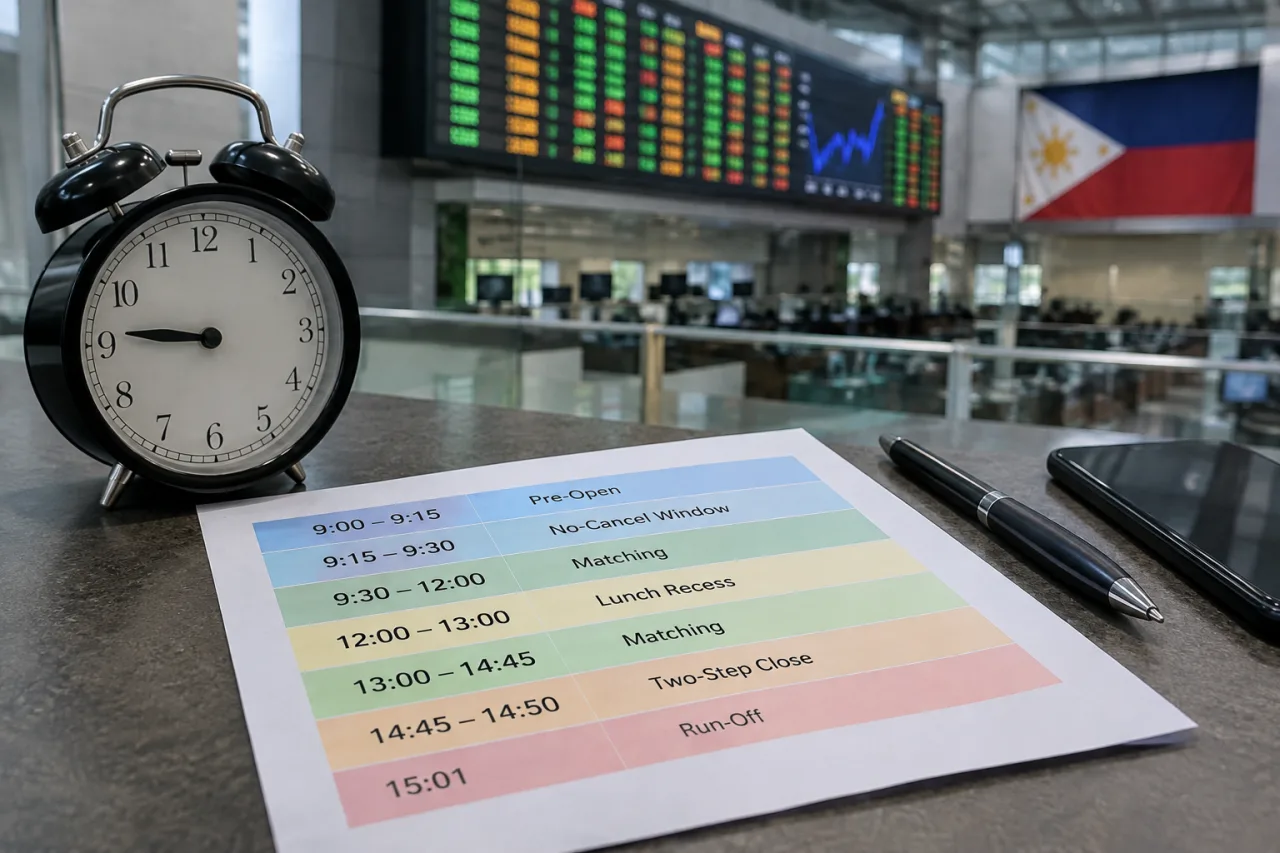
The PSE trading day, mapped window by window (October 2026): pre-open runs 9:00-9:15 (orders taken, none matched), the no-cancel window 9:15-9:30, matching 9:30-12:00, the lunch recess, matching 13:00-14:45, the two-step close 14:45-14:50, run-off to 15:01 — the full clock per BPITrade’s official schedule on record | settlement runs T+2 (trade date + two clearing days) since August 24, 2023 per the SCCP’s own rollout (PSE president Ramon Monzon on record) | the beginner traps priced honestly: the windows that lock your orders, the recess that queues them, and the close that behaves differently
Key Takeaway
- ⏰ The PSE trading day is nine distinct windows, not one session: two pre-open windows (9:00-9:15 then the 9:15-9:30 no-cancel lock), two matching sessions (9:30-12:00 and 13:00-14:45), the lunch recess (12:00-13:00), the two-step pre-close (14:45-14:50), and the run-off to 15:01 — each window treats your orders differently, and the differences are the whole lesson.
- 🔒 Two windows lock your orders on purpose: inside 9:15-9:30 and 14:48-14:50, new orders CAN be placed but existing ones CANNOT be modified or cancelled — the exchange’s anti-sniping design; a beginner who treats these like ordinary minutes can carry an unwanted order straight into the open.
- 🧮 Your money settles T+2: since August 24, 2023, SCCP settles trades ontrade date plus two clearing days (down from T+3) — the honest wait between “sold” and “withdrawable,” per the PSE president’s own rollout statement on record.
- 📈 Order types do the real work: market orders buy/sell whatever’s opposite at the moment of matching (right for liquid blue chips, dangerous for thin names), limit orders price your patience — and the pre-open’s opening auction is the day’s single biggest liquidity event for small names.
- 🧭 The beginner’s clock habit: long-term orders go in during matched sessions; the no-cancel windows get respect (not wagers); the recess is for lunch; the close sequence is for watching how your names end the day — nothing more.
The PSE trading day runs on a clock most beginners read like a wall decoration and that active investors read like a manual: nine windows, two of them traps, two of them auctions, and every one of them doing something different to your orders. The 2026 record makes the manual worth learning — the session structure is published on BPITrade’s official schedule, the settlement cycle runs T+2 since the SCCP’s August 24, 2023 rollout (PSE president Ramon S. Monzon’s own words: the shortened cycle “would further improve operations in the local bourse”), and the closing sequence’s behavior shapes how end-of-day prints form (the rules the PSE’s one-share and run-off proposals keep touching, per BusinessWorld’s rule-tracker). This piece walks the full PSE trading day in order — window by window, decision by decision — so a Filipino professional who can only check the market at lunch or after work knows exactly what was happening while away, and what it did to any order left standing.
The Full Clock: All Nine Windows in Order
- 9:00-9:15 — Pre-Open: orders can be placed, modified and cancelled; nothing matches — the exchange collects intention and lets the book grow.
- 9:15-9:30 — Pre-Open, no-cancel: orders can still be PLACED but cannot be modified or cancelled — the lock window before the open.
- 9:30-12:00 — Market Open: the first matching session: orders place, modify, cancel and match freely — the morning’s real market.
- 12:00-13:00 — Market Recess: no orders accepted at all; the book rests — the lunch break that doubles as the day’s biggest information-absorption pause.
- 13:00-14:45 — Market Resumption: the second matching session: everything works again — the session most afternoon-checkers live inside.
- 14:45-14:47 and 14:48-14:50 — Pre-Close, two steps: orders place, modify, cancel but don’t match (14:45-14:47); then the final lock: orders can be placed but NOT modified or cancelled (14:48-14:50) — setting up the close. (BPITrade’s table stamps the pre-close at 2:45/2:48 pm local — verify your broker’s clock labels, stamps differ by system.)
- 14:50-15:01 — Run-Off: the exchange’s final matching window: orders placed here match against each other AT THE CLOSING PRICE mechanism — the day’s last liquidity before shut-down (the window the PSE’s pending rule proposals also target).
- Every day: Monday through Friday only — weekends and bank holidays close the market entirely; and exchange holidays follow the PSE’s own published calendar.
The Opening Auction: Why the Pre-Open Exists
The two pre-open windows exist to build the opening — the exchange collects orders for twenty minutes and then matches the whole accumulated book against one opening price. The honest mechanics for a beginner: before 9:15, you can reconsider (place, modify, cancel — nothing binds); after 9:15, you’re locked in (new orders accepted but no edits — the window exists so the book can’t be jerked around at the open); and at 9:30 everything accumulated matches at once. For liquid blue chips the auction barely matters (the matching session flows through the day); for thinner names, the opening auction IS most of the day’s volume — which is why thin-name entries placed at the wrong price in pre-open can execute badly and sit until the resumption or worse. The clock lesson the desks teaches: the pre-open is for watching the book build, not for beginners’ first orders.
The Matching Sessions: Where Orders Actually Do Something
The 9:30-12:00 morning session and the 13:00-14:45 resumption are the PSE trading day’s working hours: continuous matching between buyers and sellers. Two order types do the PSE trading day’s beginner work here: market orders (execute immediately at whatever price the opposite side offers — the honest use: liquid, heavily-traded blue chips where the spread is a tick; the honest misuse: thin names where a market order fills at whatever someone decided to sell) and limit orders (execute only at your price or better — patience becomes part of the order, and unfilled limits just expire at day’s end). The session’s quieter truths: liquidity thins near the recess (the 11:45-12:00 stretch slows), and the resumption re-opens with the morning’s information priced in — a name that hit news during the recess (a disclosure, an index print) gaps at 13:00 rather than drifting; the honest afternoon-checker reads the gap, not the drift.
The Close Sequence: Pre-Close, the Lock, and the Run-Off
The day’s last chapter runs in three moves: at 14:45 matching stops and the pre-close accepts final order edits (place, modify, cancel); at 14:48 the lock arrives — placed orders cannot be touched; and at 14:50 the run-off begins, matching the close-in orders against each other under the closing-price mechanism until 15:01. The honest beginner read: the close is a mechanism, not a mood — end-of-day prints form from this sequence, the run-off’s pending-rule tweaks (in the exchange’s 2025-2026 proposals per BusinessWorld’s tracking) show the mechanism still evolving, and the professional habit is simple: if your plan doesn’t require the close, place the day’s business inside the matching sessions and LET the close sequence work on its own. Orders that linger into the run-off match at the closing mechanism’s prices — which is exactly right for close-auctions and exactly wrong for a beginner’s accidental leftovers. (The desk’s session-clock companion — the stock-market-for-beginners playbook — covers the whole first-account side of this.)
After the PSE Trading Day Ends: T+2 Settlement and the Money’s Real Timeline
When the PSE trading day ends, “sold” and “cash-in-hand” are different dates, and the record says so plainly: since August 24, 2023, SCCP settles trades on a T+2 cycle — trade date plus TWO clearing days (SEC-approved, down from the old T+3). Philstar’s report on the rollout carried the PSE president’s framing (Ramon S. Monzon: the shortened cycle “would further improve operations in the local bourse”), and the practical beginner translation: sell Monday, the money is in the settlement system by Wednesday — and broker-side withdrawal rails add their own cut-offs on top (each broker’s cash-out cutoff lives on its fee-and-faq page; check yours before scheduling anything that depends on next-day cash). The honest budgeting rule that replaces folklore: treat brokerage cash as T+2-plus-broker-processing money — never the emergency layer, which is why the emergency fund sits in banks as this desk keeps saying.
The Clock vs the Filipino Schedule: Lunch-Checkers and After-Work-Checkers
Most professionals can’t watch a nine-window clock in real time, so the honest version of the PSE trading day is written for the checkers you actually are. The lunch-checker (free 12:00-13:00): the recess is the day’s information pause — nothing executes without your instruction, disclosures land, prices stand still; the honest lunch routine reads the morning’s prints and the recess disclosures, then places the planned order into the 13:00 resumption with limit-order patience rather than chasing the 13:00 gap with a market order. The after-worker (first free minutes near 17:00+): the whole PSE trading day has closed — the honest use of evening time is preparation, not reaction: set tomorrow’s limit orders (some broker platforms queue pre-placed orders into the next pre-open automatically), read the day’s tape and disclosures, and let the orders run without 15-minute-decision pressure. The weekend planner: the market is closed entirely, and the honest weekend work is the ladder’s slow layer — the board-lot budgeting, the monthly-add calendar, the reading list. The PSE trading day serves all three styles because it never demands presence: limit orders, queued entries and the T+2 settlement rhythm let a person with a day job run a disciplined portfolio with less screen time than the market’s news coverage would have you believe. The clock’s honest gift is this: know the windows, use the patience instruments, and the PSE trading day works while you work.
FAQ
What time does the PSE open?
Matching opens at 9:30 am Manila time (after the 9:00-9:15 pre-open and the 9:15-9:30 no-cancel window) — but the exchange’s day actually starts at 9:00 with order-taking. Full sessions run 9:30-12:00 and 13:00-14:45, closing through the pre-close and run-off sequence by 15:01.
When can I modify or cancel an order?
During the matched sessions and the first pre-open and pre-close steps — but NOT inside the two lock windows (9:15-9:30 and 14:48-14:50), where new orders can be placed but placed orders cannot be modified or cancelled. The lock exists so the book cannot be jerked into the auction.
What is the run-off window on the PSE?
The day’s final matching window (14:50-15:01): orders placed during it match against each other under the closing-price mechanism. The PSE’s pending 2025-2026 rule proposals touch the run-off and trading-at-last rules too — the mechanism is on the exchange’s own evolution list.
How long does settlement take after selling PSE stocks?
T+2 — trade date plus two clearing days — since August 24, 2023 (SCCP’s rollout, SEC-approved, shortened from T+3). Broker withdrawals add their own cut-off on top, so treat brokerage cash as T+2-plus-processing, and keep emergency money in banks, not in the brokerage.
Should beginners place orders in the pre-open?
Generally no — the pre-open is the book-building and auction window: for thin names the opening auction dominates the day’s volume, and a beginner’s mispriced pre-open order can execute badly at the open with the lock already in place. Place ordinary orders inside the matched sessions, and watch the pre-open to learn how the opening price forms.
Does the stock market take a lunch break?
Yes — the 12:00-13:00 recess: no orders accepted at all. It’s a genuine information-absorption break: disclosures that land mid-day price into the 13:00 resumption as a gap rather than a drift, which the afternoon checker reads honestly.
Financial Disclaimer: This article is an educational explainer for general information only — it is not investment advice or trading guidance, and no window, order type or timing suggestion here is a recommendation to act. Session schedules, settlement cycles, rules and cut-offs change; figures are cited from sources on record (October 2026) and must be verified on the PSE’s, SCCP’s and your broker’s official pages before any decision. Stock markets carry risk of loss; consult a licensed financial adviser for personal decisions. worldngayon.com holds no position in any security or broker named and is not liable for outcomes from actions taken on this content.
Sources and on-record carriers: BPITrade’s official PSE trading-hours schedule (the full window table); Philstar’s settlement-shortening report (SCCP’s T+2 rollout effective August 24, 2023, with PSE president Ramon S. Monzon on record); BusinessWorld’s one-share and run-off proposal tracking; COL Financial’s trade-execution fee schedule; and the PSE’s official investing guide. The desk’s companions on the same ladder: the stock market for beginners playbook, the OFW broker-account walk, and the blue-chip guide.
- new.bpitrade.com/faq/what-is-the-schedule-of-trading-hours — official PSE trading-hours schedule
- philstar.com/business/2023/08/17/2289138/pse-shortens-settlement — settlement-shortening report
- bworldonline.com/corporate/2026/01/02/721873/analysts-weigh-impact-of… — one-share and run-off proposal tracking
- colfinancial.freshdesk.com/support/solutions/articles/6000073098-what… — trade-execution fee schedule
- pse.com.ph/investing-at-pse — PSE’s official investing guide
External sources linked in this article, in order of first mention. Spotted an error or a broken link? Tell us.
Cite this pagePublished Oct 29, 2026
Agron, E. (2026, October 29). The PSE Trading Day: Pre-Open, Breaks, Cut-Offs, and How Your Orders Actually Execute. WorldNgayon. https://worldngayon.com/pse-trading-day/
Agron, Edmon. “The PSE Trading Day: Pre-Open, Breaks, Cut-Offs, and How Your Orders Actually Execute.” WorldNgayon, 29 Oct. 2026, worldngayon.com/pse-trading-day/.
Agron, Edmon. “The PSE Trading Day: Pre-Open, Breaks, Cut-Offs, and How Your Orders Actually Execute.” WorldNgayon, October 29, 2026. https://worldngayon.com/pse-trading-day/.
Agron, E. (2026) ‘The PSE Trading Day: Pre-Open, Breaks, Cut-Offs, and How Your Orders Actually Execute’, WorldNgayon, 29 October. Available at: https://worldngayon.com/pse-trading-day/.
E. Agron, “The PSE Trading Day: Pre-Open, Breaks, Cut-Offs, and How Your Orders Actually Execute,” WorldNgayon, Oct. 29, 2026. [Online]. Available: https://worldngayon.com/pse-trading-day/
@online{agron2026psetrading,
  author       = {Agron, Edmon},
  title        = {{The PSE Trading Day: Pre-Open, Breaks, Cut-Offs, and How Your Orders Actually Execute}},
  year         = {2026},
  date         = {2026-10-29},
  organization = {WorldNgayon},
  url          = {https://worldngayon.com/pse-trading-day/},
  urldate      = {}
}TY - ELEC AU - Agron, Edmon TI - The PSE Trading Day: Pre-Open, Breaks, Cut-Offs, and How Your Orders Actually Execute T2 - WorldNgayon PY - 2026 DA - 2026/10/29/ UR - https://worldngayon.com/pse-trading-day/ Y2 - ER -
Cite the version you read; the page may be updated. Zotero and Mendeley can also import this page directly.