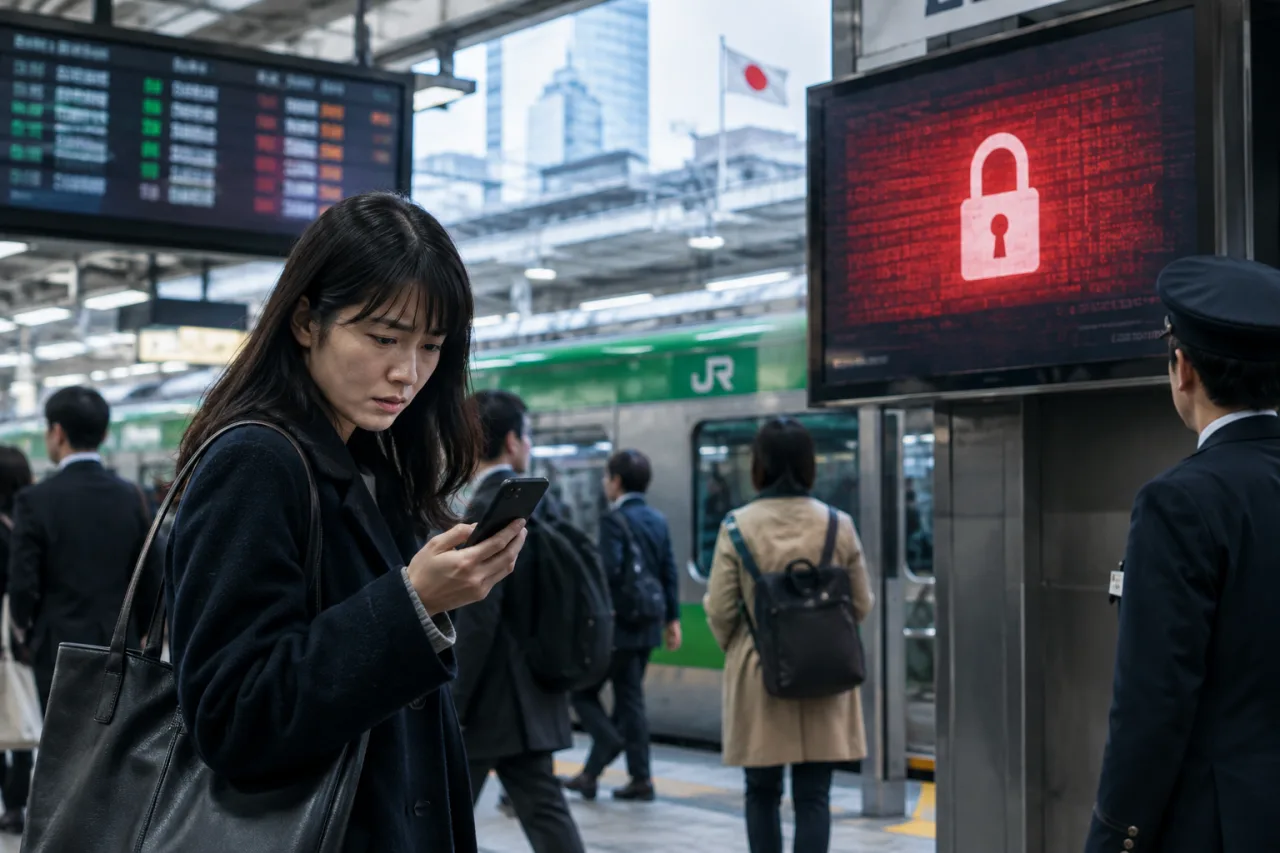
Japan’s government has declared its first-ever cybersecurity state of emergency – a “state of emergency in cyberspace,” not a disaster-law decree – after an AI-accelerated Japan ransomware wave that exposed records touching roughly a tenth of the population, from JR East commuters to express-delivery customers. The numbers behind the declaration, verified across sources: one cloud provider’s breach (IDCFrontier, October 7) disrupted 495 companies and local governments at once; Sagawa Express put its breach at 53 million records – Japan’s largest count this year; cyberattack disclosures rose 48% between Q2 and Q3; and cybersecurity-software tracker TrendAI counted 600 reported attacks in the first nine months of 2026, which the New York Times coverage of the wave reports may be AI’s doing – AI is making these attacks faster to build and easier to run. This guide separates the declaration’s real meaning from the panic versions, lays out the verified incident ledger week by week, explains what “AI-accelerated” actually does to ransomware economics, and shows the policy turn Japan now proposes: fighting AI attacks with an AI team that simulates attacks back.
Key Takeaway
- The declaration: October 9, 2026 – Masaaki Taira, head of the National Cybersecurity Strategy Headquarters (NCSH), declared a “state of emergency in cyberspace” – Japan’s first-ever cybersecurity emergency declaration, NOT a disaster-law state of emergency.
- The verified damage: IDCFrontier cloud ransomware (Oct 7) disrupted 495 companies and local governments in one shot; Sagawa Express: up to 53 million records (Japan’s largest breach count of the year); attack disclosures rose 48% Q2→Q3; TrendAI counted 600 attacks in nine months.
- The AI link: the NYT’s framing – AI may be making ransomware easier – is the mechanism the declaration names; Japan’s week-in-review confirmed AI tooling on BOTH sides: attackers automate, defenders simulate.
- The weird incident: the CAN RAIDEN disaster-alert system breach (Oct 13) exposed up to 3.14 million local-government email addresses – and the attackers used it to send 1.42 million phishing emails through the disaster-alert infrastructure itself.
- The counter-move: Japan Times (Oct 24): Japan will field a team that runs AI-driven attack simulations against its own systems; LDP and opposition Team Mirai both published emergency cybersecurity proposals the week of Oct 20.
What the Japan ransomware declaration actually says about the wave
The precision matters, because the viral phrasing (“state of emergency!!!”) carries a wrong implication. What Japanese leadership declared on October 9 is a state of emergency in cyberspace – a political/administrative alarm the ruling party’s National Cybersecurity Strategy Headquarters issued after a run of breaches at Japanese companies, banks and local governments made failure ordinary. The Financial Times logged the declaration as Japan declaring a cyber-space emergency as attacks soared; the phrase Taira’s NCSH used – validated by Recorded Future’s intelligence-platform note – is “state of emergency in cyberspace.” What it does NOT do: it is not the Disaster Management Act’s constitutional emergency, no military mobilization, no nationwide shutdown – it is the government saying, in the loudest administrative register available, that the breach wave has become a national-scale problem requiring coordinated response. The declaration’s force is political and budgetary: it unlocks the task-force machinery, the emergency proposals and the simulation program now moving across ministries. Treat it as the fire alarm, not the fire brigade – the brigade is the policy below.
The Japan ransomware incident ledger
The wave’s core entries, dated, with the sources that pinned them:
| Date | Incident | Verified damage |
| Oct 7 | IDCFrontier cloud ransomware | 495 companies and local governments disrupted at once (Recorded Future) |
| Oct 9 | NCSH declares state of emergency in cyberspace | First-ever cybersecurity emergency declaration in Japan (FT, Recorded Future) |
| Oct 13 | CAN RAIDEN disaster-alert breach (local governments) | Up to 3.14M email addresses exposed; 1.42M phishing emails sent via the disaster-alert system (Japan Cyber Watch) |
| Oct 13 | Sourcenext data breach | Software company breach disclosed (Recorded Future) |
| mid-Oct | Sagawa Express breach finalized | Up to 53 million records – Japan’s largest breach count this year (Japan Cyber Watch) |
| Oct 24 | GMO/Onamae.com Desktop Cloud | Attackers used saved logins to trade in customers’ FX accounts – a ransomware-adjacent pivot into fraud (Japan Cyber Watch) |
| Week of Oct 20 | LDP + Team Mirai emergency cybersecurity proposals; AI-simulation team announced | The policy response (Japan Cyber Watch, Japan Times) |
Below the table sit the aggregates: cyberattack disclosures up 48% quarter-over-quarter, TrendAI’s 600-attack nine-month count, and the population-scale estimate the CPO Magazine analysis of the declaration carried – roughly a tenth of Japan’s population touched across the wave, about 14 million people, a scale consistent with the 53-million-record Sagawa figure and the 495-organization IDCFrontier disruption. The Japan ransomware wave’s fingerprint is the aggregation, not any single breach: hundreds of ordinary infrastructure failures – delivery, transit, alerts, cloud – stacked inside one month.
What “AI-accelerated” really means for ransomware
The mechanism, stripped of the panic: ransomware has three cost centers – target discovery (who is vulnerable), weaponization (building the exploit chain), and negotiation/spam infrastructure (each victim’s comms). AI compresses all three. Reconnaissance that a human operator priced in days – reading a target’s exposed infrastructure, drafting the lure, tuning the phishing email – an AI agent iterates through in hours, at a marginal cost near zero. The New York Times’ Japan ransomware report puts the same read on record: AI may be making these attacks easier – not smarter, easier, which is the dangerous word: the floor of attacker capability drops until every mid-tier operator runs like a well-resourced team. Japan Japan Cyber Watch’s week-in-review confirmed the both-sides reality: AI attack tools are confirmed on both sides – the same class of AI-assisted finding the Black October disclosure wave documented for the flaw-discovery side, and the same asymmetry the Storm-0940 agentic-attack report industrialized into full attack chains. The Japan ransomware emergency is the first national-scale demonstration that the floor has moved.
The numbers agree with the mechanics. A 48% quarter-over-quarter jump in disclosures is not a new hacker class growing linearly; it is tooling amortization – the same attack effort reaching more targets per week. The ransomware groups reusing Japan’s infrastructure this year (Gentlemen and Qilin, per the leak-site mapping the week-in-review ran – with Gentlemen listing more Japanese organizations than the better-known Qilin) are the industrial layer the tooling rides on.
The counter-move: Japan fights AI with AI
The policy turn that gives this story its second act: per the Japan Times’ October 24 report, Japan said it will set up a team to simulate cyberattacks using AI – using the same class of tooling on the defensive side, to identify weaknesses in national technology systems before attackers do. The symmetry is the story’s real thesis: the declaration happened because both sides got the same weapon; the counter-move industrializes the defense the way the attack was industrialized. Japan’s simulation team lands alongside this month’s wider disclosure climate (the PHP2Shell flaw pair currently forcing hundreds of websites across Japan to pause and patch at the same time as globally) – the defense calendar has its own backlog, and the Japan ransomware simulation team is how Japan proposes to work down the queue at machine speed.
The politics: two parties, two emergency proposals
Japan’s ruling LDP and the opposition tech-candidate bloc Team Mirai both issued emergency cybersecurity proposals the week of October 20 – the domestic politics of the breach wave turning cybersecurity into an election-relevant lane, per Japan Cyber Watch’s comparison of the two packages. The desk’s read of the political moment: the NCSH’s October 9 declaration converted cybersecurity from a ministry file into a governing priority, which is why BOTH parties moved proposals into the same week – the competition to own the response is itself evidence of the wave’s political weight. The bills-and-budgets will carry the actual funding; the watch-item is whether the simulation team and the proposals consolidate into a standing AI-defense capability or remain announcement-grade. The honest expectation, per history: Japan’s cyber-governance announcements have been slower than its breach ledger; this wave is forcing whichever consolidation comes first.
The read for everyone outside Japan
Three portable lessons. One: the aggregation kill – no single breach in Japan’s wave was civilization-ending; the aggregation of them (495 simultaneous, 53M records, 3.14M addresses, hundreds of firms) is what triggered a first-ever national declaration. Your organization’s own risk posture should be sized against aggregation, not per-incident. Two: the AI floor moved – the 48% quarter-jump shows tooling economics, not a talent boom; assume your attack surface faces operators whose marginal cost just dropped to near-zero, which changes every risk model’s denominator. Three: the counter-move is simulation – Japan’s answer (attack yourself with AI before attackers do) is becoming the defensible standard everywhere; the wallet-side version of the same lesson is in our Electrum-security playbook, and the enterprise version in the edge-device attack-surface guide. The Japan ransomware emergency is the first national alarm of the AI-floor era – the practical takeaways above are the version that travels.
Security Disclosure Note
This article is security analysis for general awareness; it is not legal or financial advice. Incident figures reflect disclosures and analyses cited as of October 25, 2026 (Recorded Future, Japan Cyber Watch, the Financial Times, The New York Times, CPO Magazine, the Japan Times) and are revised as investigations proceed; verify current advisories before acting. WorldNgayon covers these incidents independently and holds no affiliation with any vendor or government agency named.
The final contextual number for the desk’s ledger: the wave ran through October alongside every other October crisis the week-in-review of Japan ransomware incidents tracked – the PHP2Shell patch pauses, the SimTeam announcement, the party proposals – and the honest summary the international desks should carry is exactly that simultaneity: Japan’s Japan ransomware emergency did not happen in a quiet month; it happened in the month the internet’s patch discipline cracked globally, and the response calendar reflects the intersection. The aggregation-kill mechanism that triggered the declaration runs on the same fuel everywhere: infrastructure components trusted without validation, updates treated as optional until they become mandatory, AI tooling amortizing attack effort across every target at once. Japan’s declaration is the first official acknowledgment that these three conditions crossed a national threshold – the other governments watching the same arithmetic will be counting their own denominators.
FAQ
Did Japan declare a state of emergency over ransomware?
Yes – but precisely: on October 9, 2026 the head of the National Cybersecurity Strategy Headquarters declared a “state of emergency in cyberspace” – Japan’s first-ever cybersecurity emergency declaration. It is an administrative/political alarm, NOT a disaster-law state of emergency with military or shutdown powers.
How many people were hit in the Japan ransomware wave?
The CPO Magazine analysis of the declaration put the wave’s impact at roughly a tenth of Japan’s population – about 14 million people – across ~495 companies and local-government systems disrupted by the IDCFrontier ransomware alone; Sagawa Express alone finalized a leak of up to 53 million records.
Was AI really behind the attacks?
AI-accelerated is the accurate term: the New York Times reports AI may be making the ransomware easier – cheaper to build and run – and the Japan ransomware week ended with AI tooling confirmed on both attack and defense sides this month. The disclosures rose 48% quarter-over-quarter, the signature of tooling economics rather than a talent boom.
What is Japan’s counter-move?
Per the Japan Times (October 24), Japan will set up a team that simulates cyberattacks using AI against its own systems to find weaknesses first – and both ruling and opposition parties published emergency cybersecurity proposals the week of October 20.
Which companies were breached?
The verified names: IDCFrontier (cloud provider, Oct 7), JR East and JR Kyushu (data leaks), Sagawa Express (up to 53 million records), Sourcenext (software, Oct 13), CAN RAIDEN (local-government disaster-alert system, 3.14M emails), and GMO’s Onamae.com Desktop Cloud (trading-desktop intrusion turned account fraud).
What should organizations outside Japan do?
Sized against aggregation, not single incidents: inventory your aggregated exposure, assume AI-accelerated attackers whose marginal cost is near zero, and adopt the simulation model – running AI-driven attacks against your own systems before someone else does. The verification habits in our security explainers apply directly.