Table of Contents
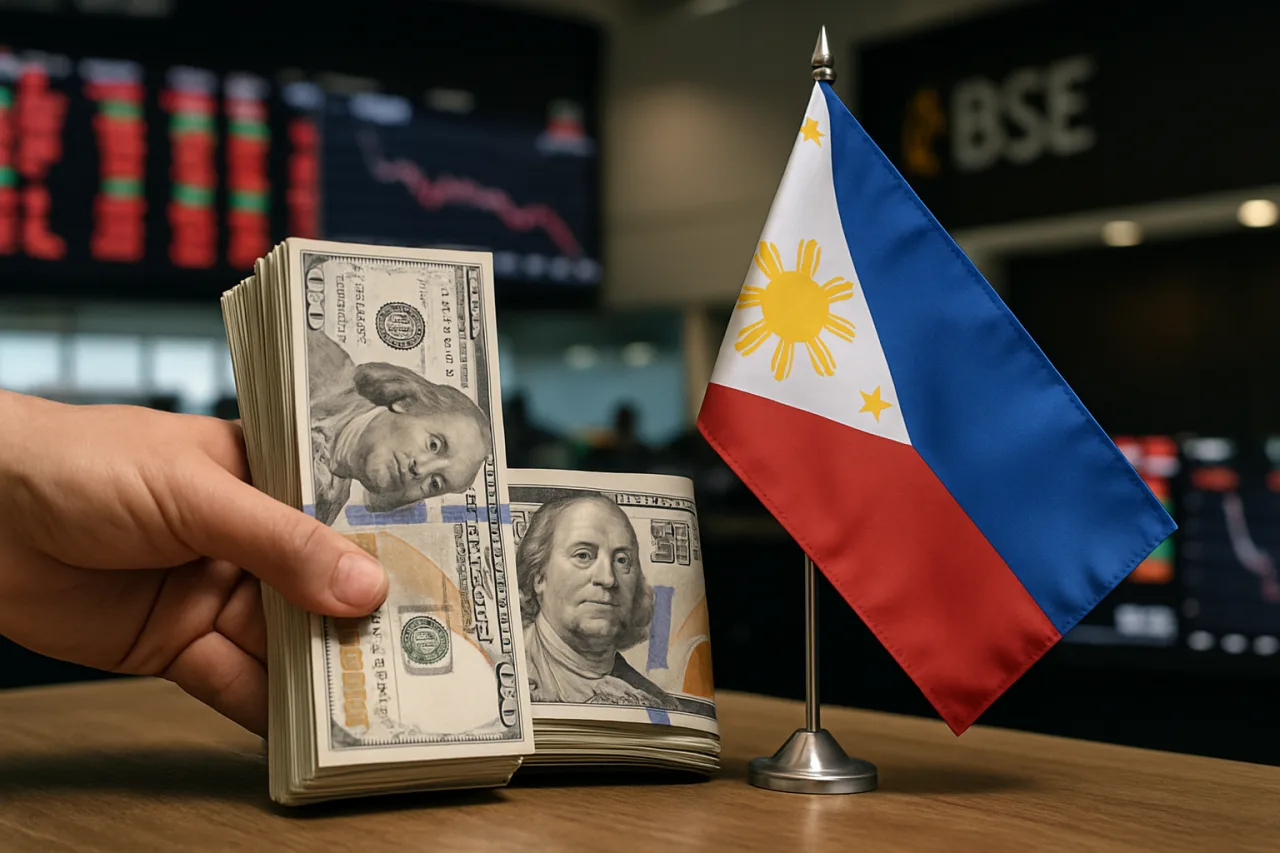
Foreign portfolio investments in the Philippines collapsed to a net inflow of just $66.47 million in July — a 91 percent plunge from the $742.56 million recorded in the same month last year, according to Bangko Sentral ng Pilipinas data published September 1, 2026. Worse, the year-to-date tally has swung to a net outflow of $3.94 billion — a full reversal from the $2.25 billion in net inflows posted over the same seven months of 2025. The numbers landed within days of the bluntest warning yet from inside the country’s financial establishment: Ed Francisco, president of BDO Capital & Investment Corp., telling One News’ Money Talks that some foreign fund managers have all but written off the Philippines. “We’re really negligible as part of the overall index,” Francisco said — and his prescription for what happens if nothing changes includes a consequence few Philippine investors have priced in: delistings.
Key Takeaway: Foreign Portfolio Investments in Free Fall
- 📉 The July number was a 91% collapse: foreign portfolio investments netted just $66.47 million in July 2026, versus $742.56 million in July 2025 — and the year-to-date tally is a $3.94 billion net outflow, reversing last year’s $2.25 billion inflow.
- 🗣️ BDO Capital’s president said the quiet part aloud: Ed Francisco told One News that the Philippines is now “negligible” to some global fund managers — not because listed companies are failing, but because the country’s growth outlook and political noise have pushed it off the buy list.
- 🚫 Zero IPOs in 2026 — while neighbors cash in: no Philippine company has listed this year, even as Southeast Asian exchanges raised $3.07 billion in the first half, with Malaysia alone accounting for 36 listings.
- ⚠️ Delisting is the next risk: Francisco warned that if valuations stay depressed long enough, more companies may simply leave the exchange rather than trade at prices they consider unfair.
- 🏦 What it means for BDO and PSEi holders: the warning coming from inside the country’s largest banking group is itself the signal — foreign flows set the marginal price of local blue chips, and thin foreign participation means more volatility for portfolios concentrated in them.
Foreign Portfolio Investments: The Numbers Behind “Negligible”
The BSP’s foreign portfolio investment registration data — the official tracker of “hot money,” the short-term foreign funds that move quickly between markets — tells the story in three figures. July’s net inflow of $66.47 million was down 91.05 percent from July 2025’s $742.56 million, and down 60.9 percent from June’s $170.12 million. July marked the third consecutive month of positive net flows, which sounds like momentum until the cumulative column comes into view: $3.94 billion net outflow for January-to-July 2026, against a $2.25 billion net inflow over the same stretch of 2025.
| BSP hot-money data (registered flows) | 2026 | 2025 |
|---|---|---|
| July net inflow | $66.47 million | $742.56 million (−91.05%) |
| June net inflow | $170.12 million | — |
| Jan–July net position | −$3.94 billion | +$2.25 billion |
| Jan–July gross inflows | $15.61 billion | $14.52 billion |
| Jan–July gross outflows | $19.55 billion | $12.27 billion |
The anatomy of July matters for anyone reading the tea leaves. Within the month, foreign investors actually bought Philippine listed equities — PSE-listed securities registered an $86 million net inflow — while dumping government securities to the tune of a $20 million net outflow. Foreign money is not fleeing Philippine assets indiscriminately; it is trimming the country down to a smaller and smaller allocation. The central bank itself has conceded the trend: the BSP’s latest forecast now expects total foreign portfolio investments of just $1.8 billion net inflow for full-year 2026, less than half its previous estimate of $3.7 billion. For the full data trail, see BusinessMirror’s BSP breakdown.
What Ed Francisco Actually Said — and Why It Carries Weight
Strip the diplomatic padding from Francisco’s interview and three claims remain. First, the performance paradox: “These companies are surpassing guidance, they’re doing extremely well,” he said — Philippine listed firms are, by and large, delivering. Second, the allocation verdict: “From a foreign portfolio manager’s perspective, the Philippines is not that important anymore, they’re putting less funds in.” Third, the attribution: “All this political noise is not helping us.” The country that once ran neck-and-neck with Vietnam for Southeast Asia’s growth crown has, in Francisco’s telling, slipped toward the bottom of the region’s rankings — and global allocators respond to rankings, not potential.
The source gives the warning its force. BDO Capital & Investment Corp. is the investment banking arm of the BDO Unibank group — the Philippines’ largest bank, and the house that underwrites many of the country’s equity deals. When the president of that institution says foreign fund managers are writing the market off and floats delisting as a possibility, it is not a foreign commentator editorializing from Singapore. It is an insider whose business depends on capital-market confidence, saying the patient’s condition is worse than the family admits. His co-chair role on the Capital Market Development Council — the public-private body tasked with exactly this problem — sharpens the point further: this is the man charged with reviving listings, telling the country the pipeline is at risk.
Why does negligible status matter so much? Because in modern portfolio management, allocation is largely index-driven. When a market shrinks as a share of global and regional indices, funds that track those indexes mechanically reduce their Philippine exposure, and active managers have less reason to fight the flow. A market can be small and still matter — but only if it is growing. A market that is small, shrinking and politically noisy becomes easy to skip, and the skipping compounds itself: less foreign buying means thinner volume, thinner volume means more volatile prices, and volatility gives the next allocator one more reason to look away. That is the loop Francisco is describing, and the BSP’s outflow data says it is already running.
Why Foreign Portfolio Investments Are Leaving — Three Compounding Forces
The exodus has a macro signature, and it is not mysterious. The Philippines spent 2026 absorbing a tightening cycle — three consecutive BSP rate hikes to 5.00 percent to contain inflation that peaked at 7.2 percent in April and still ran at 6.2 percent in July — while the peso slid to a record low of ₱62.40 against the dollar. Global funds compare markets on expected return in dollar terms; a weakening currency converts local gains into dollar losses, and the peso’s roughly seven-percent slide this year has done precisely that math for them. Our analysis of the record-low peso’s two-sided effects covered how the same weakness that boosts OFW remittance power drags on foreign-held assets.
Growth expectations complete the picture. The World Bank and regional forecasters have trimmed Philippine growth outlooks toward three percent — a level at which the country’s growth story stops distinguishing it from peers and starts resembling a laggard. Moody’s Analytics cut its 2026 forecast to three percent citing weak consumption and a collapse in private investment, a read we examined in our Philippine growth forecast coverage. When a market’s headline growth decelerates while its currency depreciates, the foreign investor’s question shifts from “why not the Philippines?” to “why the Philippines?” — and the current account of sentiment flips.
Then there is the political dimension Francisco named directly. Persistent political noise — governance controversies, headline volatility, questions about policy predictability — raises the risk premium foreign managers attach to any allocation. Investors do not price a country on its best day; they price it on its noisiest week. In a region where Vietnam markets itself on stability and Malaysia on reform momentum, the Philippines’ news cycle has become an active cost. None of this means Philippine companies are bad assets, which is exactly Francisco’s point: the disconnect between corporate performance and country perception is the inefficiency, and inefficiencies that persist for years stop being temporary mispricings and start being the market’s settled opinion.
Zero IPOs and the Delisting Warning: The Capital Market Consequence
The clearest physical evidence of foreign disengagement is the deal calendar: not a single initial public offering has priced on the Philippine Stock Exchange in 2026. Zero. Meanwhile, Southeast Asian exchanges collectively raised $3.07 billion in the first half of the year — more than double 2025’s $1.41 billion over the same period — with Malaysia leading on both count and value: 36 IPOs worth roughly $1.34 billion, 43 percent of the regional total. Vietnam’s market roared back with landmark consumer and deep-tech listings. Even Indonesia, deliberately slowing its IPO conveyor for quality reforms, out-raised Manila. The regional context, documented in Nikkei Asia’s mid-year IPO review, makes the Philippine silence unmistakable.
Francisco’s delisting warning is the other edge of that blade. An exchange lives on two flows: new companies coming in, and existing companies finding enough buyer interest to justify staying. When valuations stay depressed for years, boards begin asking why they carry the costs, disclosures and shareholder scrutiny of a listing while the market assigns their company a price they consider unfair. The Philippines has already watched major names reconsider their public status in recent years; what Francisco is describing is the mechanism going systemic — depressed valuations begetting delistings, delistings shrinking the index, and a smaller index making the market even more negligible to the foreign allocators who drove the depression in the first place. It is the same feedback loop as the flow data, one step further downstream.
For context, the PSE is fighting the tide with fundamentals: the exchange raised its capital-raising target to ₱204 billion for 2026 and has relaxed SME listing rules to widen the pipeline, moves we covered as they landed. But targets require willing issuers and willing buyers, and the foreign money that historically anchored both ends of Philippine deals is, by the BSP’s own numbers, standing on the sidelines. The peso-denominated retail investor — increasingly the market’s only reliable buyer — inherits more influence over prices, and more exposure to their volatility.
What This Means for Your BDO Shares and PSEi Holdings
Start with the uncomfortable truth in Francisco’s own house: BDO Unibank — the parent of BDO Capital, and the country’s largest bank — is one of the PSEi’s heavyweight foreign-ownership names, a stock whose daily volume and price discovery have historically leaned on foreign institutional participation. When foreign portfolio investments run a $3.94 billion yearly outflow, the blue-chip banks are where much of that selling pressure concentrates. If you hold BDO, Metrobank, BPI or any of the index’s liquid large caps, the practical meaning of “negligible” is this: fewer counterparties at the margins, wider swings on foreign-flow days, and a valuation ceiling set by local liquidity rather than global conviction.
Does that make bank stocks a sell? No — and Francisco’s own performance paradox explains why. Philippine banks remain profitable, well-capitalized and beating guidance; the sector’s problem is the price the world assigns that performance, not the performance itself. Long-term investors have historically been paid for holding quality through periods when global attention was elsewhere. What the environment does change is the discipline required: position sizes should reflect that the marginal buyer is thinning, entry points matter more when rallies lack foreign fuel — as September’s bounce off 6,000 showed, recoveries can be sharp but fragile without external money behind them — and diversification across sectors matters more when the index’s heavyweight names carry the flow risk.
For OFW-earning households and peso-based savers, there is one more asymmetry worth naming. Foreign investors exit in dollars and return in dollars, so the record-weak peso that hurts their home-currency returns is, for the local investor accumulating shares with peso income, a companion signal: assets are cheap in historical terms precisely when the currency that buys them is at its weakest. That is not a guarantee — cheap can get cheaper, as 2026 has demonstrated — but it is the discipline the great value investors describe: the moment of maximum local gloom has usually been the moment foreign money later returns to, and the BSP’s projection of a $1.8 billion full-year inflow implies the central bank itself expects the bleeding to slow, not continue forever.
What Could Bring Foreign Portfolio Investments Back to the Philippines
The recovery checklist for foreign portfolio investments is not a mystery, because every item is the mirror image of an exit driver. Currency stabilization — the single most direct fix for dollar-denominated losses — depends on the BSP’s tightening cycle cooling inflation without breaking growth, a balance the September 4 Monetary Policy Report will illuminate. Growth re-acceleration toward the country’s 6-percent potential would restore the differentiator that made the Philippines a destination in the first place, and August’s decade-best manufacturing PMI, covered in our factory-surge analysis, is the first hard hint the real economy is still capable of it. And the political-noise premium? That is priced by events, not forecasts — a stretch of governance headlines about infrastructure and reform rather than controversy would mechanically lower the country’s risk score.
Watch three indicators over the next two quarters rather than the headlines. First, the BSP’s monthly hot-money register: a fourth and fifth consecutive month of net inflows, at growing size, would mark the turn; the $86 million July inflow into PSE-listed equities is the green shoot to watch. Second, the IPO calendar: the first Philippine listing of 2026 — whenever it comes — will be read by global allocators as a confidence vote, and its book-building demand will be the honest referendum on whether “negligible” is curable. Third, the peso: a stabilization anywhere above the lows would convert dollar-based returns positive again and quietly re-rank the Philippines in the regional funds’ spreadsheets.
Francisco’s warning, in the end, is not a eulogy — it is a diagnosis from a man whose job is curing the disease. The Philippines has been written off before and re-rated back; the difference this cycle is that the competition for global capital is faster and more index-driven than ever. The country does not need to become the best story in Asia to matter again. It needs to become a story global managers cannot afford to skip — and that starts with the numbers already on the tape: companies beating guidance, a manufacturing sector at decade highs, and a market priced as if none of it were true.
Frequently Asked Questions About Foreign Portfolio Investments and the Philippines
What are foreign portfolio investments?
Foreign portfolio investments — often called “hot money” — are short-term foreign funds placed in a country’s stocks, bonds and other securities, registered through the central bank’s authorized agent banks. Unlike foreign direct investment, which builds factories and stays for decades, portfolio money can exit quickly, which is why it is the most sensitive gauge of foreign investor confidence.
How much have foreign portfolio investments fallen in 2026?
According to BSP data published September 1, 2026, the Philippines recorded a net outflow of $3.94 billion in foreign portfolio investments from January to July — a reversal from the $2.25 billion net inflow over the same period in 2025. July’s net inflow was just $66.47 million, down 91 percent year-on-year.
Why did BDO Capital’s president call the Philippines ‘negligible’?
Ed Francisco, president of BDO Capital & Investment Corp., told One News’ Money Talks that some foreign fund managers have written off the Philippines — not because listed companies are underperforming, but because the country’s weaker growth outlook, political noise and years of depressed valuations have pushed it down global allocation lists. “We’re really negligible as part of the overall index,” he said.
Could Philippine companies really delist from the PSE?
Francisco warned that if valuations stay depressed for a prolonged period, more companies may choose to delist rather than remain listed at prices they consider unfair. Delistings shrink the index, reduce the market’s weight in regional benchmarks, and can deepen the very foreign-investor disengagement that caused them — which is why regulators and the PSE treat the risk seriously.
Why has the Philippines had no IPOs in 2026?
Issuers delay listings when market conditions suggest weak demand or low pricing. With foreign participation down and valuations depressed, Philippine companies have held off, while neighbors raised a combined $3.07 billion in the first half of 2026 — led by Malaysia’s 36 listings. The PSE has responded by relaxing SME listing sponsorship rules to widen the pipeline.
What does the foreign outflow mean for ordinary Filipino investors?
Thin foreign participation means the local investor is now the market’s dominant buyer — which brings both risk and opportunity. Blue chips like the major banks trade with fewer counterparties and more flow-driven volatility, but quality companies are priced at historically cheap levels. The disciplined response is position sizing, staggered entries, and holding companies whose earnings justify their prices regardless of who is buying on any given day.
This article is for general information and education, not personalized investment advice. Investing in stocks involves risk, including possible loss of principal; consult a licensed financial adviser and consider your own circumstances before making investment decisions.