Table of Contents
Key Takeaways
- The F5 breach in one line: a highly sophisticated nation-state actor held long-term, persistent access inside F5 and stole portions of the BIG-IP source code plus information about undisclosed vulnerabilities — learned August 9, 2025, disclosed October 15, 2025.
- The stolen blueprint makes hidden flaws findable by static and dynamic analysis, which is why CISA issued Emergency Directive 26-01 the same day, calling the situation an imminent threat to federal networks.
- F5 shipped one patch wave covering 44 vulnerabilities (per F5 via BleepingComputer), and independent reviews found no evidence the software supply chain was modified.
- No evidence of active exploitation of the stolen flaws has been disclosed; the public warning was delayed at the U.S. Department of Justice’s request — a trade-off that cut both ways.
- The live F5 breach checklist today: confirm the October 2025 patch wave landed, inventory every F5 device including end-of-support gear, and rotate the embedded credentials and API keys that live inside load balancers.
A hacker who steals the blueprint of an internet appliance is more dangerous than one who picks a single lock. The F5 breach gave an unnamed nation-state just that: a long, quiet stay inside the company that builds BIG-IP, the load balancer trusted in front of banks, telcos, cloud platforms, and government systems worldwide.
Here is the uncomfortable arithmetic. F5 detected the intruder on August 9, 2025, and by then the actor had held long-term, persistent access to the BIG-IP product development environment and the company’s engineering knowledge platform (per F5’s 8-K filed October 15, 2025). What left the building: portions of BIG-IP source code, plus information about undisclosed vulnerabilities F5 was working on. The F5 breach remains the clearest vendor-side lesson in modern cybersecurity — and in October 2026, roughly a year later, the audit point it created is still biting.
One year on, the question for any organization running BIG-IP is no longer “what happened at F5?” It is “did my patch wave actually land, and did I rotate what the attacker would target first?” This explainer gives you the honest timeline, the vendor-nightmare logic, and the five-point checklist that still closes the gap.
What Happened in the F5 Breach: the Honest Timeline
The F5 breach timeline starts on August 9, 2025, the day F5 learned that a highly sophisticated nation-state threat actor had gained unauthorized access to certain company systems (F5, Inc., Form 8-K, filed October 15, 2025). The company activated incident response, brought in external cybersecurity experts, and began containment. F5 states its containment actions have been successful and that no new unauthorized activity has been observed since those efforts began — an assessment worth reading carefully, because it is self-reported.
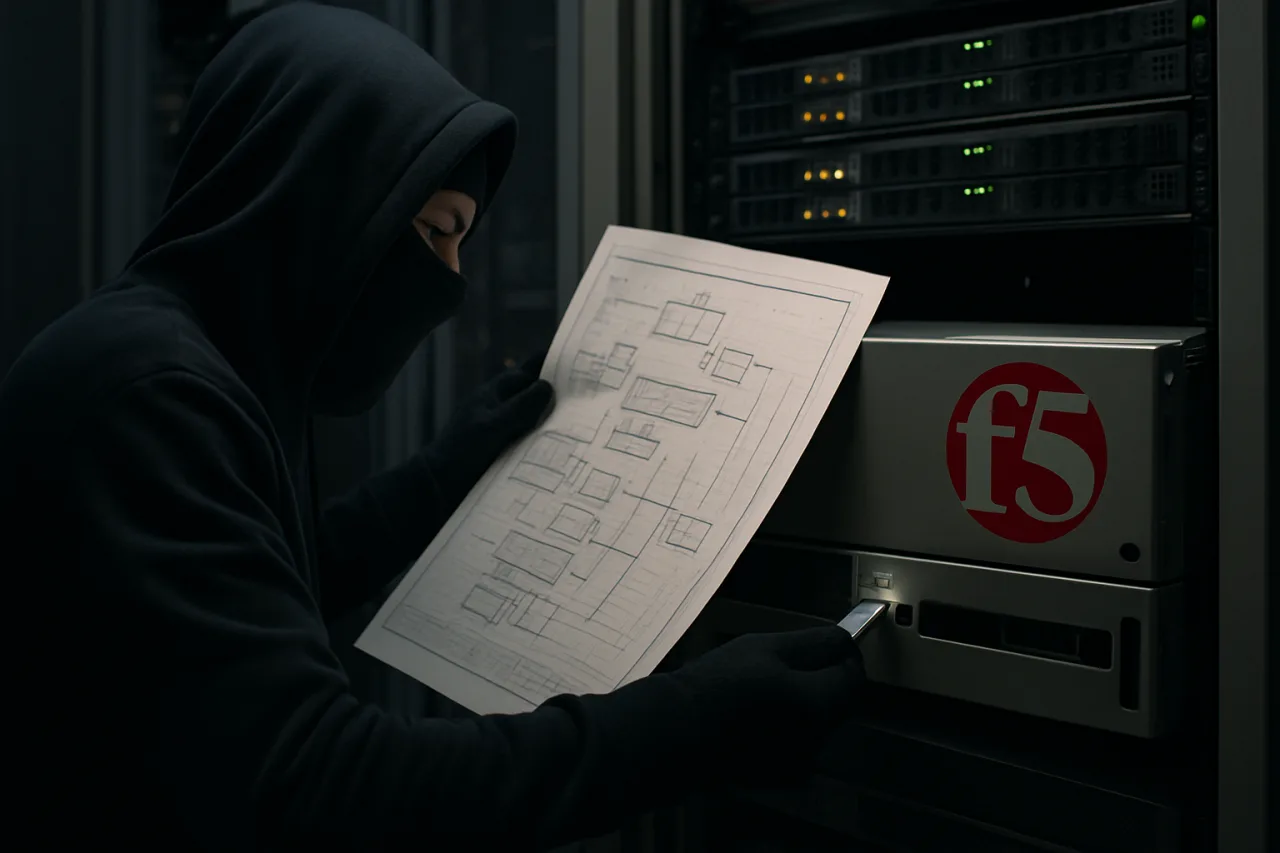
The stolen material is the part that matters most. The actor maintained long-term, persistent access to the BIG-IP product development environment and the engineering knowledge management platform. Exfiltrated files included portions of the BIG-IP source code and information about undisclosed vulnerabilities that F5 was working on. In plain words: whoever holds this can study the product the way its own engineers do, hunting for flaws nobody outside has been told about.
A small number of customer files left too. Some exfiltrated files from the knowledge platform contained configuration or implementation information for a small percentage of customers (8-K), which F5 committed to communicating about directly. F5 also states there is no evidence of access to NGINX source code, F5 Distributed Cloud Services, or Silverline systems — so the exposure is scoped to the BIG-IP estate.
Disclosure timing is its own subplot. On September 12, 2025, the U.S. Department of Justice determined a delay in public disclosure was warranted under Item 1.05(c) of Form 8-K; F5 filed the report on October 15, 2025, the day CISA issued Emergency Directive 26-01 on the same intrusion. The F5 breach disclosure arrived alongside the government’s own emergency order — a rare alignment that tells you how seriously Washington read the theft.
Attribution stops at “nation-state.” No specific country has been publicly named in the verified record as of October 2026, and this article will not speculate. Likewise, the honest exploitation line stands: F5 has said it is not aware of active exploitation of any undisclosed F5 vulnerabilities, and no public evidence of in-the-wild use of the stolen flaw data has been published in the year since.
Load Balancers 101: Why F5 and BIG-IP Sit at the Center of Everything
Strip the jargon and a load balancer is the digital traffic cop in front of an organization’s applications. When you open a banking app, hit a government portal, or stream from a content platform, a device or software layer — very often F5’s BIG-IP — receives the request first, checks it is not hostile, terminates the encrypted connection, spreads the work across back-end servers, and routes traffic so no single machine drowns. It sits between the internet and everything an organization runs.
That position gives it privileges nothing else has. A BIG-IP appliance commonly holds the SSL/TLS private keys that decrypt an organization’s traffic, embedded credentials for the systems behind it, and API keys that open internal doors. If an attacker fully controls the load balancer, they do not need to hack the bank, the telco, or the agency one server at a time — the appliance is already trusted inside the perimeter and watching everything flow through it.
The F5 breach matters here because CISA spelled out the chain in Emergency Directive 26-01 (issued October 15, 2025): successful exploitation of impacted F5 products could let an actor access embedded credentials and API keys, move laterally within a network, exfiltrate data, and establish persistent access — potentially leading to full compromise of target information systems. That is why a single stolen zero-day on BIG-IP is not one bank’s problem; it is a skeleton key with a queue of victims — the multiplier effect that makes the F5 breach a network event, not a single breach.
Now stack the F5 breach on top of that position. With portions of the BIG-IP source code in hand, an actor can run the kind of static and dynamic analysis that CISA warned about — studying the code and probing a running system to find logical flaws and zero-day vulnerabilities invisible to outsiders, then building targeted exploits against them (CISA, ED 26-01). The blueprint turns a defensive appliance into an attack surface.
Scale check, per CISA’s directive: the affected product list covered BIG-IP hardware (iSeries, rSeries, and any F5 device past end of support) plus software — all devices running BIG-IP (F5OS), BIG-IP (TMOS), Virtual Edition (VE), BIG-IP Next, BIG-IQ, and BIG-IP Next for Kubernetes/CNF. These are the load balancers in front of Fortune 500 apps, national payment rails, airport systems, and hospital networks. The F5 breach did not hit one company’s data; it handed a toolkit aimed at everyone who trusts the box.
The Vendor-Nightmare Logic: When the Shield Itself Becomes the Attack Surface
Defenders run on a trust model with a quiet assumption baked in: the vendor inside your perimeter is on your side. Firewalls, load balancers, endpoint agents, VPN concentrators — organizations install these precisely because they trust the maker. The F5 breach breaks that assumption at its root, because here the compromise did not land on a customer; it landed on the vendor who builds what customers lean on.
That is the difference between two failure classes you should hold side by side. When a threat actor sells hack services to other crews, the defenders’ tooling still works — you can patch, hunt, and block. Our previous coverage tracked exactly that pattern: Integrity Technology Group, the firm CISA says supplied the hack infrastructure behind Chinese state-aligned intrusions. The F5 case inverts it: the intruder did not rent a crowbar, they walked into the shield factory and photographed the molds.
A breached vendor converts the moat into the attack surface. Every customer who patched diligently last quarter is still exposed to a stolen flaw the vendor had not yet shipped a fix for. Every trust decision made on the vendor’s word — “our builds are clean,” “our pipeline is untouched” — has to be re-verified from the outside. The moat, as the standing line in this coverage goes, is only as strong as the company that built it.
This is not a F5-only lesson, either. The same logic powered the patching-discipline problem we documented earlier this year: most intrusions still ride defects that had a fix available long before the breach. A vendor-side breach adds a category that patch-discipline tables rarely capture — vulnerabilities that exist as stolen knowledge before a public CVE ever ships. The defensible posture is to ask vendors the questions auditors stopped asking: do you publish a software bill of materials (SBOM) we can verify? What is your contractual patch SLA after a vendor-side incident? What breach-notification terms do you commit to, and on what clock?
There is also an AI-era echo worth naming. Organizations are wiring AI agents into their operational stack the same way they once wired in load balancers — as trusted infrastructure with deep credentials. The governance questions are the same ones the F5 breach just re-asked: how do you secure AI agents before they become the next trusted-but-unverified insider? A vendor you never audited and an agent you never sandboxed fail for the same reason.
What F5 and the Government Did: 44 Patches and an Emergency Directive
The response moved on two tracks the same day. On October 15, 2025, F5 released security updates addressing 44 vulnerabilities across its BIG-IP product line, including the ones tied to the stolen material, and urged customers to update immediately (per F5 via BleepingComputer). F5 confirmed the updates address impact from the incident, closing the most urgent door the F5 breach opened. A 44-flaw single drop — a number F5 attributed to the breach response — is the clearest sign of how much knowledge the theft put at risk.
The supply-chain question got a cleaner answer than most breaches manage. F5 states it has no evidence of modification to its software supply chain, including source code and the build and release pipelines — an assessment it says was validated through independent reviews by leading cybersecurity research firms, with IOActive and NCC Group named in press coverage of the disclosure (per BleepingComputer). Read that with the usual rigor: “no evidence found” is a statement about search results, not a mathematical proof. But an independent thumbs-up on the build pipeline is the difference between a stolen blueprint threat and a poisoned-shipping-crate threat.
CISA, the same day, issued Emergency Directive 26-01 — “Mitigate Vulnerabilities in F5 Devices” — an order federal civilian agencies rarely see, demanding inventory and immediate action on F5 estate. The directive called the threat actor an imminent threat to federal networks. FedRAMP followed with actions for cloud service providers: identify whether affected devices sit inside the authorization boundary, patch or mitigate by October 22, 2025, remove public internet exposure of management interfaces, apply the latest vendor patches, and decommission anything past end of support (ED 26-01 via FedRAMP, October 15, 2025). Vendors also had to report to CISA.
Then there is the DOJ subplot that cuts both ways. The U.S. Department of Justice determined on September 12, 2025 that delaying the disclosure was warranted, so the public learned about a breach detected on August 9 only on October 15. Give the government its due: a two-month quiet window lets federal agencies inventory in advance of a noisy disclosure, when every attacker on earth starts scanning. But the same window is two months in which non-federal customers — banks, hospitals, telcos — ran the vulnerable estate with no warning from their own vendor. The dual-use disclosure doctrine deserves scrutiny, not reflex.
One year on, the honest scorecard stands as follows: patches shipped, pipeline reviews came back clean per F5 and press reporting, CISA order complied with across federal estate — and still, as of October 2026, no public evidence that the stolen flaw knowledge was ever used in an actual attack. That last clause is the load-bearing statement of this entire article.
The F5 Breach Defense Checklist: What to Verify in October 2026
The F5 breach happened in 2025, but its audit point is permanent, and it is a two-lane checklist: one lane for organizations running or adjacent to BIG-IP hardware, one for everyone who depends on any vendor’s appliance. Work it like an audit, not a news skim — every item below is verifiable, dated, and priced in the only currency that matters (hours of work now versus weeks of incident response later).
1. Confirm the October 2025 patch wave actually landed — today. F5 shipped 44 vulnerability fixes in one consolidated release dated October 15, 2025 (per F5 via BleepingComputer), and the company’s fall wave was followed by quarterly maintenance across 2026. The audit question: is every BIG-IP appliance, virtual edition, BIG-IQ installation, and BIG-IP Next deployment in your estate on the October 2025 build or later? Check the version report from the management plane, not the memory of a ticket that said “patching scheduled.” If anything is sitting on a pre-breach build, the F5 breach changed nothing for you and you are carrying every flaw that was stolen.
2. Inventory all F5 devices, including end-of-support gear. CISA’s Directive demanded exactly this inventory for federal networks, because the affected surface spans hardware (BIG-IP iSeries, rSeries, and anything past end of support), and software — BIG-IP F5OS, TMOS, Virtual Edition, BIG-IP Next, BIG-IQ, and BIG-IP Next for Kubernetes (CISA, ED 26-01). Shadow load balancers are the classic miss: a BIG-IP VE spun up in 2019 for one project and forgotten is exactly the asset nobody patched. Anything the vendor has dropped off the support calendar should be disconnected and decommissioned, per CISA’s own order.
3. Rotate the embedded credentials and API keys — regardless of the breach. CISA’s exploitation chain puts credentials first: access to embedded credentials and API keys, then lateral movement, then exfiltration, then persistence (CISA, ED 26-01). Treat every shared service account configured on or through a load balancer as a first-target asset: rotate its credentials, invalidate and reissue API keys, and vault the replacements with tightened scopes. This costs hours and closes the specific chain CISA named. The step is worth doing regardless of the F5 breach — any appliance that fronts your apps holds keys worth rotating on a schedule, not a headline.
4. Treat management interfaces as internet-hostile — no exposed management plane, MFA, jump host only. The FedRAMP/CISA emergency action list said it in one line: identify if management interfaces on affected devices are accessible via the public internet and, if so, remove, harden, or mitigate that accessibility as quickly as possible (CISA ED 26-01 via FedRAMP). The 2026 translation: BIG-IP management plane off the public internet, MFA enforced on every administrative path, administrative access brokered through a jump host with session recording. A management interface exposed to the internet plus a stolen blueprint is the combination the F5 breach was effectively built to punish.
5. For everyone else — treat vendors as a threat surface. You do not run BIG-IP to still be exposed by the F5 breach; you buy infrastructure from vendors who could be next. The due-diligence trio worth writing into your next renewal: demand a software bill of materials (SBOM) you can actually validate, a contractual patch SLA with a clock after vendor-side incidents, and breach-notification terms with teeth. The vendor trust assumption that broke here is industry-wide — the moat is only as strong as the company that built it.
A note on scope honesty: nothing above implies the stolen flaw data has been weaponized. As of October 2026, no public evidence of active exploitation of the undisclosed vulnerabilities at issue has been published. This checklist is the posture that keeps you safe from the possibility — not evidence of a live campaign.
What to Watch After the F5 Breach
Three watch items carry decision triggers, not vague curiosities.
Watch for exploited-in-the-wild evidence. If CISA adds affected F5 flaws to its Known Exploited Vulnerabilities catalog or F5 raises its assessment, treat every unpatched F5 device in your estate as an open incident that day — inventory, patch, and hunt, in that order.
Watch the quarterly maintenance stream. If F5 ships an out-of-cycle emergency release outside its quarterly cadence, that is the signal pattern of a patched flaw meeting real-world probing; verify whether your estate’s build predates the release within 48 hours, and if any management plane has been reachable from the public internet since October 2025, treat credential rotation as overdue rather than optional.
Watch the vendor-trust doctrine. The F5 breach joins a 2024-class pattern of vendor-side compromises in the national-security conversation. If a future U.S. directive or rulemaking formalizes SBOM and notification duties for infrastructure vendors, your procurement contracts are the lever — get the SLA language in before the law does.
Frequently Asked Questions About the F5 Breach
What is the F5 breach in plain language?
In 2025, a nation-state actor tied to no named country got long-term access inside F5, the company that builds BIG-IP load balancers, and stole portions of the BIG-IP source code plus information about undisclosed vulnerabilities (F5 8-K, October 15, 2025). Think of it as the burglar photographing the lock factory’s blueprints rather than picking one lock — which is why the F5 breach reads less like one company’s incident and more like an industry rehearsal — every door built from those plans deserves a re-key.
When did the F5 breach happen and when was it disclosed?
F5 detected the intrusion on August 9, 2025, and disclosed it October 15, 2025, in a Form 8-K with the SEC. The U.S. Department of Justice determined a disclosure delay was warranted on September 12, 2025 (8-K, Item 1.05(c)), and CISA issued Emergency Directive 26-01 the same day as the public filing.
What did the hackers steal in the F5 breach?
Per F5’s 8-K: portions of BIG-IP source code and information about undisclosed vulnerabilities F5 was working on, plus configuration and implementation details for a small percentage of customers. F5 reports no evidence of access to NGINX, F5 Distributed Cloud Services, Silverline, CRM, financial, or support-case systems.
Was the F5 supply chain compromised in the F5 breach?
F5 states it found no evidence that the software supply chain, including source code and build and release pipelines, was modified, an assessment validated by independent reviews from leading cybersecurity research firms — IOActive and NCC Group in press coverage (via BleepingComputer). “No evidence found” reflects the search, not a certainty, but it is the strongest supply-chain claim available on the record.
Are the F5 breach flaws being exploited right now?
Not on the public record as of October 2026. F5 has stated it is not aware of active exploitation of undisclosed vulnerabilities, and no agency or vendor disclosure has reported exploitation of the stolen flaw data. CISA’s warning was about capability — the access enabling static and dynamic analysis and exploit development — not observed attacks.
Which F5 devices are affected by the F5 breach response?
CISA Emergency Directive 26-01 covers BIG-IP hardware (iSeries, rSeries, and devices past end of support) and software — BIG-IP F5OS, TMOS, Virtual Edition, BIG-IP Next, BIG-IQ, and BIG-IP Next for Kubernetes/CNF. If your organization runs any of these, the October 2025 patch wave from F5 (44 vulnerability fixes per F5 via BleepingComputer) is the baseline you verify against.
What should an organization do today about the F5 breach?
Work the five-point checklist: confirm the October 2025 patch wave landed on every F5 device; inventory all F5 hardware and software including end-of-support gear; rotate embedded credentials and API keys on load balancers; lock management interfaces away from the public internet with MFA and jump-host access; and add SBOM, patch-SLA, and breach-notification terms to vendor contracts.
Why does the F5 breach still matter in 2026?
Because the asset stolen — the blueprint of a load balancer most of the internet trusts — does not expire. The F5 breach is the standing lesson that vendor-side compromise converts your trusted infrastructure into an attack surface, and the October 2026 audit point is whether your organization ever completed the patch-and-rotate work that CISA ordered federal agencies to do in October 2025.
Filipino and OFW Relevance: Why the F5 Breach Touches Philippine Institutions
Philippine readers have a direct stake because the F5 product line runs in financial and government infrastructure that Filipinos use daily: bank apps, e-wallet rails, telco systems, BPO networks, and government portals all lean on load balancers, and BIG-IP is a common build in that tier. The F5 breach is worth a Filipino professional’s attention for three concrete reasons.
First, the same checklist applies to Philippine institutions. Filipino security teams and IT managers in banks, telcos, and BPOs should run the five-point audit against their own F5 estate — the patch wave from October 2025 either landed or it did not, and the answer is one version report away.
Second, the peso math makes the checklist cheap. Rotating credentials, closing exposed management interfaces, and verifying a patch level costs a small team a few days of focused work — call it the cost of a mid-level laptop in engineer-hours — while a full compromise of a load balancer can cascade into service outages and regulatory exposure priced in the millions of pesos.
Third, the career signal. Vendor-side breach response and SBOM-era due diligence are becoming standard requirements in regional SOC and infrastructure hiring, and Filipino engineers who can speak fluently about the F5 breach lessons — patch verification, secret rotation, management-plane hardening — are building exactly the vocabulary the next procurement cycle will demand.
The Standing Lesson of the F5 Breach
WorldNgayon delivers Digital Intelligence for the AI-powered world, and the standing lesson of the F5 breach fits that promise precisely: a moat is only as strong as the company that built it. The theft turned a trusted appliance’s own blueprints into the attacker’s research library, and the defenses that mattered afterward were the unglamorous ones — patches verified, credentials rotated, management planes locked away, and vendors asked questions auditors used to skip.
Your move this week, whether you run BIG-IP or simply depend on someone who does: find out when your organization last verified its patch wave and rotated the credentials inside its load balancers. If the answer is “before the F5 breach,” you have your answer — the F5 breach handed you the audit, and your next work order is simply its completion.
How to cite this article: Worldngayon, “F5 Breach: Nation-State Hackers Stole the Blueprint of the Internet’s Load Balancers,” October 16, 2026 — worldngayon.com. Facts date to F5’s SEC Form 8-K (Oct 15, 2025), CISA Emergency Directive 26-01 (Oct 15, 2025), FedRAMP’s ED 26-01 explainer, and BleepingComputer’s disclosure and patch coverage (Oct 15, 2025). No public attribution to a specific country exists; no public evidence of active exploitation as of October 2026.