Table of Contents
Key Takeaway: What Every OFW Must Know About AI Deepfake Scams and Bitdefender RealCheck
- 🎙️ AI voice cloning is now a mainstream scam weapon: Scammers in the Philippines and globally are using seconds of recorded audio to clone voices and demand ransom payments from panicked families. Voice cloning fraud specifically rose 680% in the past year according to industry tracking.
- 📹 Video deepfakes are the next wave: Deepfake video calls have already caused $39 million in verified losses, with a single Hong Kong case losing $25 million to a fake CFO video conference. OFWs and their families are prime targets because remittance money and family anxiety create perfect scam conditions.
- 🔍 Bitdefender RealCheck launched June 24, 2026: A standalone iOS/Android app that analyzes any video for manipulation signs and malicious intent — not just a yes/no, but a structured report showing what was altered and whether it was designed to steal money.
- 💰 $4.99/month for 200 checks: The Core plan is affordable for most OFW families. A 7-day free trial lets you test before subscribing. Reports are shareable to group chats even if recipients do not have an account.
- ⚠️ Humans fail the test: Research shows consumers correctly identify high-quality deepfakes only 24.5% of the time. Technology must supplement vigilance, not replace common sense — but without it, families are defenseless against sophisticated attacks.
The Threat: How Deepfake Scams Are Evolving Against OFW Families
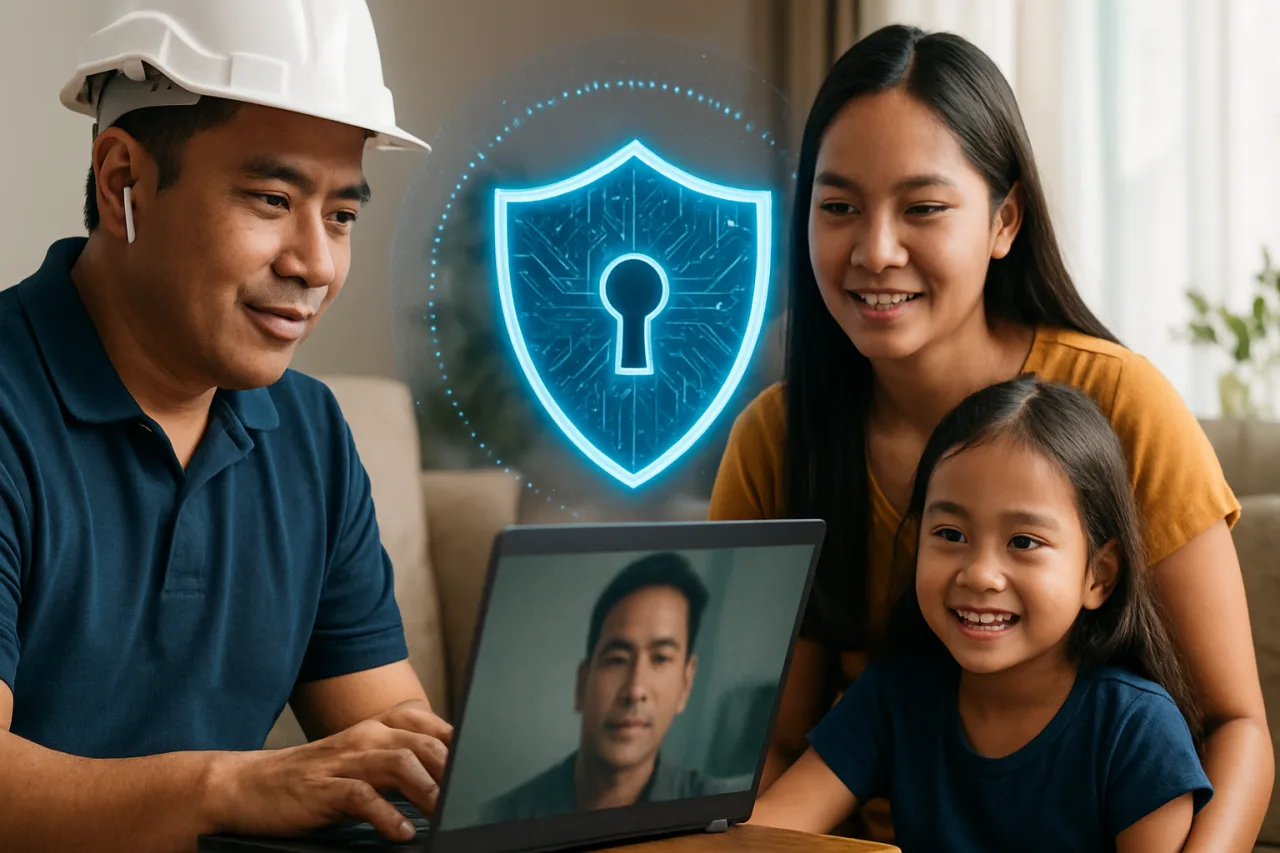
Imagine receiving a WhatsApp video call from your husband working in Riyadh. The face looks right. The voice sounds right. He is in a warehouse, wearing his office shirt, and the lighting is slightly dim. He sounds stressed. He says his wallet was stolen at the airport, the police confiscated his passport, and he needs ₱50,000 wired immediately to a lawyer who will get him out. He begs you not to tell anyone. He is ashamed. He hangs up before you can ask questions.
This scenario is no longer science fiction. Bitdefender’s global survey of 7,000 consumers found that deepfake scams are now the single largest security concern among internet users worldwide. And the delivery mechanism is the one OFW families use most: social media and messaging apps. According to Bitdefender’s research, social media has surpassed every other channel — email, phone calls, SMS, even fake websites — as the leading medium for successful scams. Deepfakes do not arrive as obviously fake videos. They arrive as polished clips in Facebook feeds, TikTok recommendations, and family group chats.
The technology has advanced beyond simple filters. AI voice cloning can now generate convincing replicas using just seconds of audio scraped from social media posts, phone answering messages, or video clips. A scammer in Manila can clone an OFW’s voice from a Facebook birthday video and call the OFW’s mother in Davao claiming a medical emergency abroad. The mother hears her son’s voice — the same cadence, the same accent — and wires emergency money before verifying the story.
Real Cases: What Deepfake Scams Already Cost Real People
The scale of verified losses is staggering and growing. In February 2024, a multinational firm’s Hong Kong office lost $25 million after a finance employee participated in a video call with what appeared to be the company’s Chief Financial Officer and other senior executives. Every face on the call was a deepfake. The CFO instructed urgent wire transfers to multiple accounts. The employee complied. It took days before the company realized the entire video conference was synthetic.
In the United States, deepfake CEO fraud cases have already totaled $39 million in confirmed losses, according to industry tracking. The average loss per deepfake scam now exceeds traditional phishing attacks by an order of magnitude because the psychological manipulation is deeper — seeing a trusted face and hearing a trusted voice triggers faster compliance than reading a suspicious email.
Voice cloning fraud specifically surged 680% year-over-year according to cybersecurity industry reports. The tools are cheap and accessible. Open-source voice cloning models require only a few seconds of sample audio. Scammers no longer need technical expertise — they need only motivation and a target. For OFW families, that target is the emotional vulnerability created by separation: a child in the Philippines hears their father’s voice requesting emergency funds, and the fear of something happening abroad overrides normal skepticism.
Why OFW Families Are Specifically Vulnerable
OFW families face a unique combination of risk factors that make deepfake scams particularly devastating. Understanding these vulnerabilities explains why a tool like Bitdefender RealCheck is not a luxury but part of essential digital protection for households with overseas workers.
Geographic Separation Creates Verification Gaps
When a family member receives a call from someone claiming to be an OFW relative in distress, the normal verification pathway is blocked by distance. You cannot drive to their apartment. You cannot call their office landline and ask a receptionist to confirm a medical emergency. The only verification tool is the voice or video of the person themselves — exactly what deepfakes replicate. Bitdefender RealCheck closes this gap by adding a technical verification layer that families can use before wiring money.
Emotional Manipulation at Scale
Scammers know that OFW families maintain constant anxiety about safety abroad. Any call claiming arrest, hospitalization, deportation, or workplace injury triggers immediate panic before rational analysis begins. A deepfake video showing an OFW looking distressed in a warehouse environment — perhaps using publicly available company photos as visual references — can generate compliance within minutes. Bitdefender RealCheck detects manipulation even when human emotion prevents rational assessment.
Social Media Audio Harvesting
Many OFWs maintain active Facebook, TikTok, or Instagram accounts to stay connected with family. Scammers harvest video posts, voice messages, and even audio from livestreams to create training data for voice cloning models. An OFW posting birthday greetings in Tagalog provides not just visual training data but enough audio for a convincing clone. Periodically reviewing what audio content is publicly available and restricting access can reduce exposure. When in doubt about a suspicious video or voice message, families can use Bitdefender RealCheck to analyze suspicious media.
Bitdefender RealCheck: What It Is and How It Works
On June 24, 2026, Bitdefender — the Romanian cybersecurity company known for its antivirus and endpoint protection platforms — launched RealCheck as a standalone mobile application for Android and iOS. It is not bundled into Bitdefender’s existing Total Security suite. It is designed specifically for consumers who need to evaluate videos they encounter on social media, messaging apps, and email before deciding whether to trust, share, or act on them.
Ciprian Istrate, Senior Vice President of Operations for the Consumer Solutions Group at Bitdefender, framed the launch in stark terms: “Cybercriminals have weaponized AI to defraud consumers, steal personal information, and manipulate political perception at a massive scale. Deepfakes that were once easy to spot have become nearly impossible to detect with the naked eye. Bitdefender RealCheck closes that gap, delivering powerful intelligence on whether a video has been manipulated and whether it was designed with malicious intent.”
The Core Analysis: Not Just Real vs. Fake
Bitdefender RealCheck does something smarter than most deepfake detection tools. Rather than classifying a video as simply “real” or “fake,” it conducts multi-layered analysis across three dimensions:
- Manipulation likelihood: Does the video contain technical artifacts — frame inconsistencies, unnatural blinking patterns, audio-visual misalignment, or generative-model fingerprints — indicating AI alteration?
- Deceptive intent assessment: Is the content pushing financial fraud, credential theft, defamation, or political manipulation? Not all synthetic media is malicious — some is satire, entertainment, or art. Bitdefender RealCheck differentiates between creative AI and dangerous AI.
- Transcript-level indicators: The app analyzes speech patterns in segments to identify suspicious claims, urgency triggers, or known scam language patterns commonly used in deepfake fraud campaigns.
This three-dimensional approach matters because a fake video announcing a celebrity endorsement for a health product is materially different from a fake video of your relative pleading for ransom money. Bitdefender RealCheck flags both but assigns them different risk levels and context, letting users make informed decisions rather than panicking over every AI-generated clip.
Where Bitdefender RealCheck Works
The app accepts video input from multiple sources. Users can paste public links from X, YouTube, Instagram, Facebook, and TikTok. They can also upload local video files from their device gallery — critical for analyzing suspicious WhatsApp or Messenger videos before forwarding them. Bitdefender RealCheck additionally identifies public figures — celebrities, business executives, politicians — who are currently being impersonated in active deepfake campaigns, alerting users when they encounter known impersonation scams.
Shareable Reports for Family Protection
One of Bitdefender RealCheck’s most practical features for OFW families is shareable analysis reports. After analyzing a video, the app generates a report that can be forwarded through WhatsApp, Messenger, or email to family members who do not have RealCheck installed. In a Philippines context where single meme videos spread through extended family Viber groups within minutes, the ability to quickly share a “this video is a deepfake scam” warning prevents chain-reaction financial losses. Grandmother forwards a suspicious video. Daughter runs it through RealCheck. Daughter shares the report back to the family group. Chain broken.
Bitdefender RealCheck Pricing: Is It Worth the Cost for OFW Families?
The pricing is straightforward but requires honest evaluation of how often suspicious videos reach your family.
| Plan | Monthly Price | Checks Included | Per-Check Cost |
|---|---|---|---|
| RealCheck Core | $4.99 / ~₱290 | 200 | ~₱1.45 |
| RealCheck Plus | $12.99 / ~₱755 | 600 | ~₱1.25 |
Both plans include a 7-day free trial, which is the correct starting point for most OFW families. During the trial, users can test RealCheck against known deepfake examples available on awareness websites or check a few suspicious videos that have circulated in their social feeds. The trial requires providing payment information upfront and will auto-convert to a paid subscription unless canceled.
The Core plan at $4.99 monthly is the logical choice for most households. Two hundred checks per month is more than six per day. For an OFW family receiving occasional suspicious video links through group chats, that is sufficient. The Plus plan at $12.99 makes sense only for families actively researching scam content, managing community awareness groups, or running small businesses where video verification is a recurring operational need.
Currently, Bitdefender RealCheck is available only in English and launched across 14 countries: the United States, United Kingdom, Australia, Canada, Germany, Italy, Spain, France, and others. The Philippines is not explicitly listed among launch markets, but the iOS and Android app stores make the application globally downloadable provided you have a Google Play or Apple ID account. Additional languages, including Filipino, are planned for future releases according to Bitdefender’s launch announcement.
How to Use Bitdefender RealCheck: Step-by-Step for OFW Families
Understanding how to use the app when panic strikes is critical. Here is the correct sequence for evaluating a suspicious video.
- Pause before reacting. The most dangerous moment in a deepfake scam is the first 60 seconds. Scammers engineer urgency specifically to prevent verification. If a video call or forwarded clip demands immediate money, passwords, or personal information, stop. Do not forward it. Do not click embedded links.
- Open Bitdefender RealCheck. Launch the app on your Android or iOS device. If you do not have an active subscription, use the 7-day trial.
- Submit the video. If the suspicious video is a public link from social media, paste the URL into RealCheck. If it is a local file downloaded to your device or received through WhatsApp, upload it directly. RealCheck supports both input methods.
- Wait for analysis. Processing time varies based on video length and server load. Short clips under one minute typically take 30-90 seconds. Longer videos may take several minutes.
- Read the report carefully. RealCheck delivers a structured report showing manipulation likelihood, deception intent, and segment-by-segment audio analysis. It does not simply say “fake.” It explains what was found and what it means.
- Share if relevant. If the analysis confirms a deepfake scam, share the report to your family group chat immediately. Family members without RealCheck accounts can read the report and understand why the video is dangerous.
- Report to platforms. Forward confirmed scam videos to Facebook, TikTok, or YouTube’s reporting systems. Reporting removes the content and trains platform algorithms to detect similar scams faster.
What Bitdefender RealCheck Cannot Do: Honest Limitations
No security tool is perfect, and OFW families should understand RealCheck’s boundaries before relying on it exclusively. The app analyzes video content, not live video calls. It cannot intercept a real-time Zoom or WhatsApp video call to warn you that the person on the other end is a deepfake. You must record the interaction or receive a shareable file, then submit it for analysis after the fact. In an emergency scam scenario where a caller demands immediate wire transfer, this post-hoc protection may not prevent the first financial loss.
RealCheck also does not analyze audio-only phone calls. If a scammer uses voice cloning without video, the app cannot help. Families should implement complementary defenses for audio-only scams: a pre-arranged family code word, secondary verification through a different communication channel, or requiring the caller to answer specific questions only the real person would know.
The app requires internet connectivity to upload videos to Bitdefender’s cloud analysis servers. In areas of the Philippines with limited mobile data coverage, this creates practical barriers for some users. Additionally, while RealCheck can analyze videos in 14 countries, data privacy laws vary. Users should review Bitdefender’s privacy policy to understand what video metadata is stored and for how long.
Complementary Defenses Every OFW Family Should Implement
Bitdefender RealCheck is one layer of protection, not a complete defense. Families should combine it with other established practices.
- Family code words: Establish a secret phrase that only the family knows. If someone calls claiming to be an OFW relative in distress, ask for the code word before discussing money.
- Secondary verification channels: If a suspicious call comes in, immediately message the supposed caller through a different platform. If your husband calls from an unknown number claiming emergency, message his WhatsApp simultaneously. A real person will confirm. A deepfake scammer cannot.
- Limit public audio/video exposure: Review your social media privacy settings. Set Facebook, TikTok, and Instagram accounts to private so strangers cannot harvest voice samples from your posts. Consider deleting old video posts that contain extended clear audio.
- Pre-arranged emergency protocols: Before an OFW departs, agree on what constitutes a genuine financial emergency and what channels will be used to communicate it. If the agreed protocol requires a specific verification step that the caller skips, treat the call as suspicious regardless of how convincing it sounds.
- Community awareness: Share verified deepfake scam news in barangay, church, and workplace groups. The more people in your network recognize the threat, the less likely scammers are to find victims locally. Our guide to AI deepfake scams targeting OFW families provides additional awareness materials for community distribution.
The Broader Picture: Why Deepfake Fraud Is Accelerating
Bitdefender RealCheck arrives in a market where deepfake technology has outpaced consumer defenses by years. The numbers explain the urgency. Deloitte projects that generative AI-driven fraud losses in the United States alone could reach $40 billion annually by 2027. Globally, that figure scales proportionally. The cost is not borne primarily by large corporations — it is transferred to ordinary consumers through stolen savings, unauthorized loans, and identity theft recovery.
The human detection problem is worse than most people assume. Academic research and industry testing both converge on the same alarming finding: consumers correctly identify high-quality deepfakes approximately 24.5% of the time. Put differently, even attentive, intelligent, and skeptical viewers are wrong three out of four times when watching a well-crafted deepfake. This is not a failure of intelligence. It is a failure of biology — the human brain is optimized to recognize faces and voices, and AI has learned to exploit that optimization flaw perfectly.
Social media platforms have become the primary delivery mechanism not because they are the most technologically sophisticated channel, but because they are the most trusted. A deepfake video shared by a family member in a private group chat arrives pre-endorsed. The recipient’s suspicion threshold drops because the source is familiar. Bitdefender RealCheck’s shareable reports directly counter this trust exploitation by giving family members a concrete, technical reason to reject a video forwarded by someone they love.
Related Resources
For more information on protecting your family and staying informed, see these related articles and official sources:
- AI Deepfake Scams: How OFW Families Can Protect Themselves — foundational awareness guide covering the broader deepfake threat landscape.
- AI Voice Cloning Scam OFW: 7 Warning Signs Every OFW Must Know — specific indicators of audio-only voice fraud.
- Bitdefender RealCheck Official Launch Announcement — product details, technical specifications, and pricing from the manufacturer.
- Bitdefender RealCheck on Google Play — Android download and system requirements.
- Digital Trends: Deepfake Scams Are Getting Uglier — independent product review and consumer recommendation.
FAQ: Bitdefender RealCheck and Deepfake Protection for OFW Families
What is Bitdefender RealCheck?
Bitdefender RealCheck is a standalone mobile application for Android and iOS that analyzes videos for signs of AI manipulation and malicious intent. Launched June 24, 2026, it provides structured reports showing manipulation likelihood, deception signals, and transcript-level indicators rather than a simple real-or-fake verdict.
How much does Bitdefender RealCheck cost?
RealCheck Core costs $4.99 per month (~₱290) and includes 200 video checks. RealCheck Plus costs $12.99 per month (~₱755) and includes 600 checks. Both plans offer a 7-day free trial. At Core pricing, each check costs approximately ₱1.45.
Can Bitdefender RealCheck analyze live video calls?
No. RealCheck analyzes recorded video files or public video links, not real-time streams. For live video calls, families should use pre-arranged verification protocols instead: family code words, simultaneous messaging through other channels, and refusal to act on financial requests without secondary confirmation.
Does Bitdefender RealCheck work on audio-only phone calls?
No. RealCheck is a video analysis tool. For voice-only scams, implement the complementary defenses described above: family code words, cross-platform verification, and limiting publicly available audio content on social media.
How effective is Bitdefender RealCheck?
Bitdefender has not published formal independent testing scores against standardized deepfake datasets at launch. The company emphasizes that RealCheck uses multi-layered analysis combining technical manipulation detection, intent assessment, and transcript review. For context, human observers correctly identify high-quality deepfakes approximately 24.5% of the time, so any technical detection tool significantly outperforms unaided human judgment.
Is Bitdefender RealCheck available in the Philippines?
While the Philippines was not explicitly listed among the 14 launch countries, the app is downloadable globally through Google Play and the Apple App Store. The interface is currently available in English only, with additional languages including Filipino planned for future updates.
Can I share RealCheck reports with family who do not have the app?
Yes. Analysis reports are shareable through WhatsApp, Messenger, email, and other messaging platforms. Recipients can read the report without installing RealCheck or creating an account.
What platforms does Bitdefender RealCheck support?
RealCheck accepts public video links from X, YouTube, Instagram, Facebook, and TikTok. It also accepts local video file uploads from your device gallery or file storage.
What if RealCheck says a video might be manipulated but I still think it is real?
RealCheck produces structured reports, not definitive judgments. False positives are possible, particularly with heavily compressed or low-resolution genuine videos. When the app flags manipulation, verify through independent channels before acting financially. Never send money, passwords, or personal information based solely on a video that has not passed external verification.
Are there free alternatives to Bitdefender RealCheck?
Several free browser-based deepfake detection tools exist, but they typically provide less detailed analysis, lack mobile app convenience, and do not assess malicious intent. The 7-day free trial is the best low-risk way to evaluate whether RealCheck’s structured reporting justifies the subscription cost for your family’s specific risk profile.
Should every OFW family subscribe to Bitdefender RealCheck?
RealCheck is most valuable for families who regularly encounter suspicious videos through social media, group chats, or messaging apps. If your family network has already experienced attempted scams or if the OFW maintains a public social media presence that scammers could harvest for cloning, the $4.99 monthly cost is a reasonable insurance premium. Families with minimal social media exposure may find free verification practices — code words, secondary channels, strict money transfer protocols — sufficient.
Financial Disclaimer: This article is for informational and educational purposes only. It is not a product endorsement, investment recommendation, or financial advice. Bitdefender RealCheck pricing and features are accurate as of July 2026 and subject to change. OFW families should evaluate their specific risk profile, budget, and digital habits before subscribing. The authors receive no commission or affiliate revenue from Bitdefender or any other security product mentioned. Always verify pricing and terms directly with the product vendor.